
Introduction
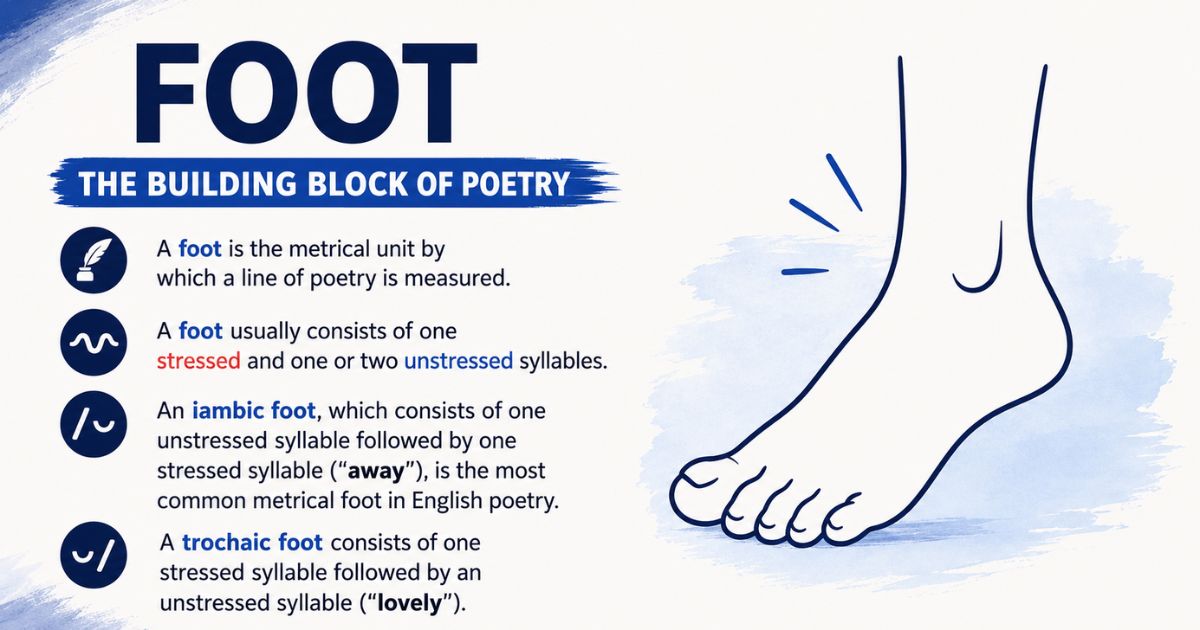
A foot of poetry is the smallest repeating unit of rhythm in a line of verse, made up of a specific pattern of stressed and unstressed syllables. Poets combine several feet to build a line’s meter; for example, five iambic feet in a row create iambic pentameter, the rhythm behind most of Shakespeare’s plays. Understanding this single building block unlocks how rhythm works in almost all traditional English poetry.
This guide walks through what a foot actually is, the main types you’ll encounter, how they differ from meter and line length, and a simple step-by-step method for spotting them in any poem.
Key Takeaways
A foot is the basic rhythmic unit of a poetic line, built from a pattern of stressed and unstressed syllables.

The four most common Poetry feet in English poetry are the iamb, trochee, dactyl, and anapaest.

Most feet contain two or three syllables, though rare types exist with just one stressed syllable.

Meter is simply a pattern of repeated feet across a line five feet make pentameter, four make tetrameter, and so on.

Learning to scan a poem by ear, not just by rule, is the fastest way to identify feet accurately.

Feet shape how a poem sounds when read aloud, which is often the whole point of formal verse.
What Is a Foot of Poetry? (Definition and Meaning)
A foot of poetry is a unit of measurement used to describe rhythm in a line of verse. Each foot contains a fixed pattern of stressed (accented) and unstressed (unaccented) syllables, and a full line is typically built from several feet strung together. In my own experience teaching basic scansion, the concept clicks fastest once you say a line aloud and physically tap out where the emphasis naturally falls the tapped beats are the feet.
The term comes from classical Greek and Latin poetry, where meter was based on syllable length rather than stress, but English poetry adapted the same vocabulary to describe stress patterns instead. So when a poem is described as written “in iambic pentameter,” that simply means each line contains five iambic feet and five repetitions of an unstressed syllable followed by a stressed one.
It helps to think of a foot the way a musician thinks of a musical measure. Just as a measure divides a piece of music into countable, repeating units, a foot divides a line of poetry into countable, repeating rhythmic units. Neither concept requires the reader to consciously count anything the ear picks up the pattern naturally once it’s established.
Foot vs. Meter: How They’re Related
Meter and foot are closely linked but not identical. A foot is the individual rhythmic unit; meter is the overall pattern created by repeating that unit across a line. For example, a line made of five iambic feet is called iambic pentameter, while a line made of four trochaic feet is called trochaic tetrameter. Understanding one term without the other leaves half the picture missing, since meter is essentially just feet multiplied and named by count.
The Origins and History of Poetic Feet
The concept of a poetic foot originated in ancient Greek and Roman verse, where meter was based on syllable duration long versus short rather than stress. Poets like Homer composed in dactylic hexameter, a meter built from six dactylic feet per line, which gave epic poems like “The Iliad” their distinctive rolling rhythm. Latin poets, including Virgil, continued this tradition, and the vocabulary for describing feet (iamb, trochee, dactyl, anapaest, spondee) comes directly from these classical languages.
When English poetry developed its own metrical tradition, poets borrowed the Greek and Latin terms but adapted them to fit a stress-based language rather than a syllable-length-based one. Geoffrey Chaucer helped establish iambic patterns in Middle English, and by the time Shakespeare was writing in the late 1500s, iambic pentameter had become the dominant meter for English drama and poetry. This borrowed vocabulary still forms the backbone of how English-language poetry is taught and scanned today, even though the underlying mechanics differ from the classical originals.
Milton’s “Paradise Lost” later demonstrated just how flexible iambic pentameter could become in the hands of a skilled poet, stretching and bending the pattern across enormous unrhymed verse paragraphs without ever losing the underlying rhythm. By the 18th and 19th centuries, poets like Alexander Pope and later the Romantics had turned strict adherence to metrical feet into something closer to a craft discipline, with critics judging a poet’s skill partly on how gracefully they could vary a foot without breaking the overall pattern.
From Classical Greek Meter to English Verse
The shift from quantitative meter (based on syllable length) to accentual-syllabic meter (based on stress) happened gradually across several centuries of English literary history. This transition mattered because English, unlike Greek or Latin, doesn’t naturally distinguish between long and short vowel sounds in a way that’s useful for rhythm. Instead, English relies heavily on stress, which made the classical foot-based vocabulary a natural fit once adapted to accent patterns rather than syllable duration.
Types of Feet in Poetry (Primary Metrical Feet)
English poetry relies on a handful of recurring foot types, each defined by its specific stress pattern. Learning to recognize these four or five patterns covers the overwhelming majority of formal verse you’ll encounter, from Shakespeare to modern formalist poets.
Iamb
The iamb is the most common foot in English poetry, consisting of one unstressed syllable followed by one stressed syllable (da-DUM). Words like “away,” “begin,” and “the SUN” naturally fall into this pattern. Iambic pentameter five iambs per line is the meter behind nearly all of Shakespeare’s sonnets and plays, largely because the rhythm closely mirrors natural English speech patterns, making it feel conversational rather than forced.
Trochee
A trochee reverses the iamb’s pattern: one stressed syllable followed by one unstressed syllable (DUM-da). Words like “garden,” “happy,” and “table” are natural trochees. Trochaic meter often gives poetry a more insistent, driving rhythm than iambic verse, which is part of why it appears frequently in chants, nursery rhymes, and poems meant to be recited with strong forward momentum.
Dactyl and Anapaest
A dactyl contains one stressed syllable followed by two unstressed syllables (DUM-da-da), as in the word “elephant.” Dactylic meter produces a galloping, forward-leaning rhythm, which is why Homer used dactylic hexameter for epic storytelling; the meter itself seems to propel the narrative forward. An apparatus is the reverse pattern: two unstressed syllables followed by one stressed syllable (da-da-DUM), as heard in the word “understand.” Anapaestic meter shows up frequently in limericks and comic verse, since its bouncy, accelerating rhythm suits playful or humorous subject matter.
Two rarer feet are also worth knowing: the spondee, made of two consecutive stressed syllables (DUM-DUM), and the pyrrhic, made of two consecutive unstressed syllables (da-da). Neither typically sustains an entire poem, but poets often insert them briefly to disrupt an established rhythm for emphasis or dramatic effect.
How Many Syllables Are in a Foot of Poetry?
Most feet contain either two or three syllables, though the exact number depends on the specific type being used. The iamb and trochee are both two-syllable feet, while the dactyl and anapaest are three-syllable feet. The spondee and pyrrhic, though less common, also contain exactly two syllables each.
Because feet can vary in syllable count within the same poem, counting total syllables in a line isn’t always a reliable shortcut for identifying meters. A line of iambic pentameter, for instance, typically contains ten syllables total (five feet of two syllables each), while a line of dactylic hexameter contains far more, since each of its six feet carries three syllables. Readers often tell us this is the single most confusing part of learning scansion; the syllable count changes depending on which foot type is dominant, so it’s the stress pattern, not the raw syllable total, that ultimately defines the foot.
Foot of Poetry vs. Line Length: What’s the Difference?
A foot of poetry measures rhythm within a line, while line length measures the total number of feet a line contains. These are related but separate concepts, and mixing them up is one of the most common beginner mistakes in metrical analysis. For example, a line described as “pentameter” contains five feet, regardless of what type those feet are iambic pentameter and trochaic pentameter both have five feet per line, but they sound noticeably different because the stress pattern within each foot differs.
Line length terminology follows a consistent naming pattern based on the number of feet: monometer (one foot), dimeter (two), trimeter (three), tetrameter (four), pentameter (five), hexameter (six), and so on. Combining the foot type with the line length gives you the full metrical description of a line “iambic tetrameter” means four iambic feet per line, while “trochaic trimeter” means three trochaic feet per line. Confusing these two layers of information is easy at first, but keeping them separate makes scansion far more manageable.
How to Identify a Foot in a Poem
Scanning a poem for its feet sounds intimidating, but the process becomes much more intuitive once you break it into a repeatable sequence of steps.
Step-by-Step Guide to Scanning a Poem
- Read the line aloud naturally. Don’t force a rhythm yet just read it the way you’d normally speak the words.
- Mark the stressed syllables. Say the line again and tap your hand or foot on each syllable that naturally receives more emphasis.
- Mark the unstressed syllables between the stresses. Every syllable that isn’t stressed fills in the pattern around the beats you just marked.
- Group the syllables into repeating units. Look for a consistent pattern of two syllables repeating as unstressed-stressed likely signals iambic feet, for example.
- Count the feet per line to identify the meter. Five repeating feet means pentameter, four means tetrameter, and so on.
- Check for variation. Many poems substitute a different foot occasionally for emphasis, so don’t assume every single foot in a poem will match perfectly.
Common Mistakes When Scanning Poetic Feet
Beginners scanning poetry for the first time tend to make a handful of predictable errors. The most common is forcing a rhythm onto the words rather than reading naturally and letting the stress fall where it actually does in spoken English. This often happens when someone already knows a poem is “supposed” to be iambic pentameter and unconsciously bends their reading to match.
Another frequent mistake is assuming every foot in a poem will be identical. In reality, skilled poets frequently substitute a different foot type into an otherwise regular line, often at the start of a line or right before an important word, specifically to draw attention through the disruption. Treating every irregularity as a mistake in the poem, rather than a deliberate choice, causes many readers to misjudge the poet’s intent.
Finally, some readers confuse syllable stress with word length or spelling, assuming longer words automatically carry more stress. Stress is about emphasis in pronunciation, not letter count, so a short word like “the” can be unstressed while a longer word carries the beat instead.
Examples of Poetic Feet in Famous Poems
Seeing feet in action within real poems makes the concept far easier to internalize than definitions alone. Shakespeare’s sonnets provide the clearest classroom example of sustained iambic pentameter, with each line built from five unstressed-stressed pairs that closely mirror natural English speech rhythm. Edgar Allan Poe’s “The Raven” leans heavily on trochaic meter, giving the poem its insistent, almost hypnotic pacing that suits its unsettling subject matter.
Henry Wadsworth Longfellow’s “Evangeline” is a well-known English-language example of dactylic hexameter, deliberately echoing the classical epic meter used by Homer and Virgil centuries earlier. Meanwhile, many limericks the five-line comic poems most readers learn as children rely on an apparatus meter, which gives them their characteristic bouncy, sing-song rhythm. Comparing these examples side by side shows just how differently the same basic building block, the poetic foot, can shape a reader’s experience depending on which type a poet chooses.
Final Thoughts
Understanding this single unit of rhythm opens up a much deeper appreciation for how formal poetry actually works. Once you can hear an iamb versus a trochee, or spot a dactyl breaking up an otherwise steady line, poems that once felt mysterious start to reveal their construction. The best way to build this skill is simple repetition: read poems aloud, tap out the beats, and over time the patterns will start to feel automatic rather than academic.
Recent Article : Dactylic Poetry Explained: Meter, Rhythm & Famous Examples

Jennifer Aston is a passionate poetry curator and writer with a deep love for the written word. She believes poetry has the power to heal, inspire, and connect people across all walks of life. Through PoemSteric, she brings together timeless and modern verses for every emotion and every moment.