
Introduction
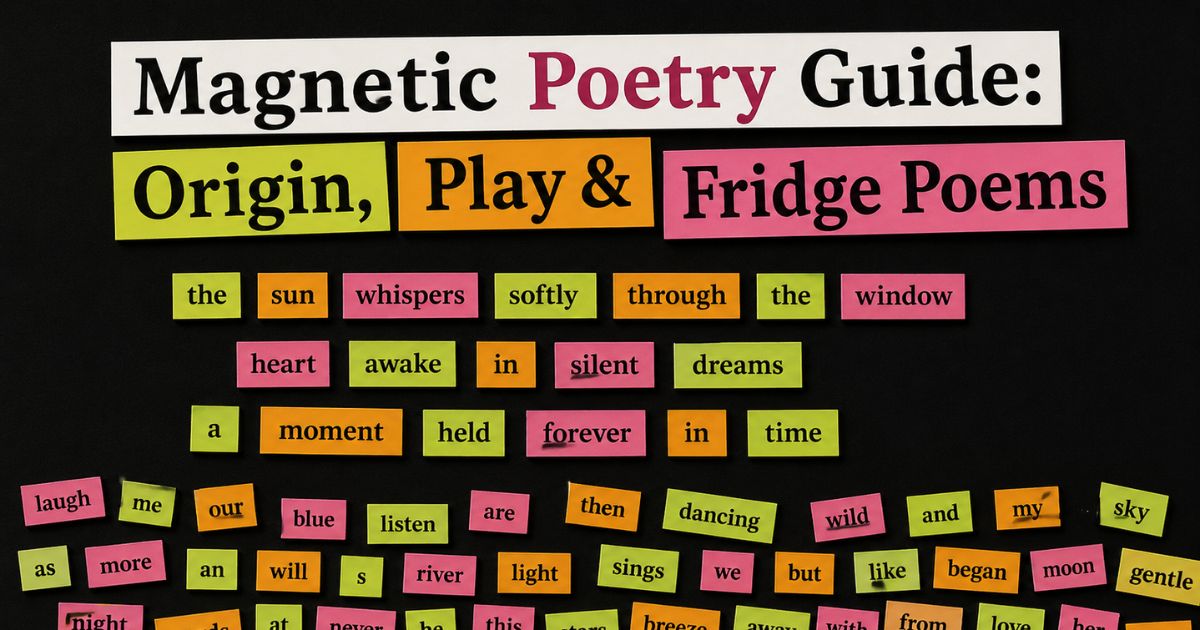
Magnetic poetry is a word-tile game invented in 1993 by Minneapolis songwriter Dave Kapell, made of small magnets printed with individual words that stick to a refrigerator or other metal surface. Players rearrange the tiles into original poems, phrases, or jokes, using only the vocabulary included in the kit. What started as one man’s personal song writing tool has since sold millions of kits worldwide and inspired digital apps and endless social-media videos. This guide covers where magnetic poetry actually came from, how to play it, and how to write a genuinely good poem with it.
Key Takeaways
Magnetic poetry was invented in 1993 by Minneapolis songwriter Dave Kapell, originally as a personal tool for beating writer's block.

The famous "sneeze" story is real, but it involved a specific, often-skipped detail: misprinted magnets from a roommate's pizza-restaurant job.

Writing a strong magnetic poem is a craft skill involving word choice, rhythm, and restraint, not just random rearranging.

Teachers and speech-language therapists both use magnetic word tiles as structured tools for literacy and communication practice.

The format has expanded well beyond the physical fridge, into dedicated apps and short-form video content.

Millions of kits have been sold worldwide since 1993, and the company Kapell founded still operates independently today.
What Is Magnetic Poetry? A Quick Overview
Magnetic poetry is a physical word game consisting of small magnetic tiles, each printed with a single word or word fragment, designed to be arranged into sentences or poems on any metal surface. Because the vocabulary is fixed, players work within real creative limits, choosing from whatever nouns, verbs, and connector words happen to be included in that particular kit. This constraint is part of the appeal: instead of facing a blank page, you’re rearranging a curated set of possibilities.
The original 1993 kit, simply called “Poetry,” contained a general-purpose vocabulary meant to support all kinds of writing, from romantic notes to abstract verse. Since then, the format has expanded into dozens of themed kits covering everything from Shakespearean vocabulary to specific pop-culture and holiday themes, alongside kids’ versions and kits translated into other languages. As a result, “magnetic poetry” today refers less to one single product and more to an entire category of word-tile writing games.
For example, a household might keep a general kit in the kitchen fridge for everyday use while also owning a themed kit reserved for holidays or parties. In my own experience testing several kits, the vocabulary selection matters enormously. A kit heavy on strong, image-driven words produces far more interesting poems than one padded with filler terms.
What’s Actually Inside a Magnetic Poetry Kit?
A typical magnetic poetry kit includes several hundred word tiles, usually a mix of nouns, verbs, adjectives, and short connector words like “the,” “a,” “of,” and “and.” Most kits also include a handful of blank tiles, letting players write in their own custom words when the fixed vocabulary doesn’t quite fit. This small addition matters more than it might seem, since it lets a poet insert a name, a specific place, or an invented word the kit’s designers couldn’t have anticipated.
The Real Origin Story of Magnetic Poetry (Beyond the Sneeze)
Most retellings of magnetic poetry’s origin stop at “a guy sneezed and the words stuck to magnets,” which is true but leaves out the details that actually explain how the idea came together. In 1993, Dave Kapell was living in an eight-person co-op house in Minneapolis, working a data-entry job while pursuing songwriting on the side. To break through writer’s block, he used the cut-up technique, a method of slicing up printed text into small pieces and rearranging them for inspiration, a technique with roots in earlier 20th-century experimental writing.
The magnets themselves have an oddly specific backstory. One of Kapell’s roommates worked at a Minneapolis pizza restaurant that had ordered a batch of promotional fridge magnets printed with the wrong phone number. Unable to use the misprinted batch, the roommate brought the useless magnets home, and they sat around the co-op with no clear purpose. When Kapell sneezed mid-session and scattered his carefully arranged paper word clippings across the room, he realized he could glue the words directly onto the backs of those leftover magnets instead of risking another gust ruining his layout.
From Cookie Sheet to Refrigerator: How the Kit Was Born
Once the words were glued to magnets, Kapell needed a metal surface to arrange them on, so he started with a cookie sheet kept beside his desk. However, when a different roommate wanted to actually bake cookies for a house party, the sheet was reclaimed for its original purpose, and Kapell’s word magnets migrated to the household refrigerator instead. That single, practical swap turned out to be the format’s defining feature.
At the party, guests spent more time rearranging the word magnets into jokes and phrases than eating the cookies the sheet had originally been meant for. Several asked Kapell to make them a set of their own, and within weeks, informal word-of-mouth demand had grown into something resembling a small business. Kapell formally founded Magnetic Poetry Inc. the following year, and the company has remained independently owned and based in Minneapolis ever since.
How to Play Magnetic Poetry: The Basic Rules
Playing magnetic poetry has almost no formal rules, which is exactly why it works for such a wide range of ages and settings. The only real constraint is the vocabulary included in your specific kit, since you can only use the words physically present on the tiles, plus anything you write on the included blank tiles.
- Spread the tiles across a metal surface. A refrigerator door is traditional, but any magnetic surface works.
- Scan the available words before starting. Notice a few strong nouns or verbs that stand out to you.
- Build outward from one anchor word. Pick a single word that interests you and arrange others around it.
- Rearrange freely as you go. Unlike pen and paper, nothing here is permanent until you decide it is.
- Leave it up for others. Part of the tradition is letting roommates, family, or guests add or rearrange lines over time.
Because there’s no scoring system or winner, magnetic poetry functions more like a shared creative space than a competitive game, which is part of why it works equally well solo or as a group activity.
Why Magnetic Poetry Works: The Psychology of Creative Constraint
Magnetic poetry succeeds partly because it removes the intimidation of a blank page. Instead of generating words from nothing, a player only has to choose and arrange, a much smaller creative task that still produces a genuine finished product. This is the same principle behind other constrained writing forms, where a fixed toolset paradoxically makes people more creative, not less, because it removes the paralysis of infinite options.
Additionally, the format’s physical nature matters. Moving small tiles by hand engages a different kind of attention than typing, and the ability to instantly swap one word for another encourages experimentation without commitment. As a result, people who would never call themselves “writers” often produce surprisingly striking lines, simply because the format lowers the stakes of trying.
Finally, the shared, visible nature of a fridge poem adds a social layer few writing exercises have. Because the poem sits somewhere household members pass by daily, it naturally invites collaboration and gradual revision, turning writing into an ongoing, low-pressure household activity rather than a single completed task.
The Craft of a Great Magnetic Poem: Writing Technique That Works
Writing a genuinely good magnetic poem is a real skill, even though the format looks casual. Because you’re working with a fixed vocabulary, technique matters just as much as inspiration, arguably more, since you can’t simply reach for the perfect word if it isn’t on a tile.
Step-by-Step: Building a Magnetic Poem That Actually Works
- Choose one strong image word first. Start with something concrete, like “rain” or “bone,” rather than an abstract word like “love.”
- Build a simple subject-verb spine. Get a basic sentence structure working before adding description.
- Add connector words sparingly but naturally. Words like “the” and “of” should smooth the sentence, not just fill space.
- Look for surprising word pairings. Unexpected combinations, such as pairing a soft word with a harsh one, often create the most memorable lines.
- Read the arrangement aloud. If it doesn’t sound right spoken, rearrange it, even if it reads fine silently.
- Resist over-explaining. With limited vocabulary, a poem that tries to say too much usually ends up saying very little clearly.
Common Mistakes That Weaken a Magnetic Poem
New players often default to whatever words are physically closest on the board, rather than actively searching for the strongest available options, which produces flat, arbitrary lines. Another common mistake is overusing connector words like “the” and “a,” padding a poem instead of tightening it. Finally, many beginners aim for a complete grammatical sentence at all costs, when some of the most memorable magnetic poems actually lean into fragments and unusual word order for effect.
Magnetic Poetry in the Classroom and in Therapy
Beyond casual home use, magnetic poetry has a well-established second life as an educational and therapeutic tool. Teachers frequently use word-tile kits to teach sentence structure, parts of speech, and vocabulary in a hands-on way that keeps students engaged, particularly useful for younger learners and English-language learners who benefit from manipulating physical words rather than only writing them.
Speech-language pathologists have also adopted magnetic word-tile activities as structured language exercises. Because the format limits vocabulary to a manageable set, it works well for practicing sentence construction, word retrieval, and expressive language skills with both children and adults working through speech or language differences. Therapists sometimes adapt the format into themed prompts, such as building a sentence around a specific everyday scenario, which keeps sessions engaging while targeting specific language goals.
The format has also found a place in memory and communication support for older adults, including those living with dementia. Poetry-based activities, including guided word-selection exercises similar to magnetic poetry, are used in some senior care settings to support vocabulary recall, self-expression, and social engagement, since the physical act of choosing and arranging words can feel more approachable than composing from a blank page. While outcomes vary by individual and setting, the underlying idea, reducing the creative burden through constraint, is the same principle that makes the format work for casual writers at home.
Magnetic Poetry Goes Digital: Apps, TikTok, and Beyond
Magnetic poetry’s constraint-based format has translated naturally into digital tools. Several mobile apps now offer a drag-and-drop word-tile experience similar to the physical kits; one popular option includes a library of nearly 4,000 words, letting users build poems, lyrics, or notes directly on a phone or tablet without needing physical magnets at all.
Short-form video platforms have also given the format new life. Fridge poetry boards are a recurring subject on platforms like TikTok and Instagram Reels, where users film themselves rearranging tiles or share time-lapse videos of a poem evolving over weeks as different household members contribute lines. This kind of content works well for video precisely because the format is visual and process-driven, viewers can watch a poem take shape in real time, something a purely text-based poem can’t offer.
Meanwhile, the broader idea of interactive, ever-changing digital poetry continues to evolve well beyond the fridge-magnet format. Museums and galleries have begun exhibiting generative, screen-based poetry that regenerates itself over time, showing that the core magnetic poetry concept, poetry as something assembled and reassembled rather than fixed once written, still resonates in entirely new digital contexts.
Magnetic Poetry vs. Other Creative Writing Games: A Comparison Table
| Format | Vocabulary | Physical or Digital | Best For |
| Magnetic Poetry | Fixed set of word tiles | Physical (plus modern apps) | Casual, visual, low-pressure writing |
| Mad Libs | Fill-in-the-blank prompts | Physical/digital | Group humor, structured storytelling |
| Exquisite Corpse | Fully open, each writer adds a line | Physical/digital | Collaborative, surprise-driven writing |
| Cut-Up Technique | Any source text you cut apart yourself | Physical | Individual experimental writing |
| Poetry-Writing Apps | Open text entry or large word banks | Digital only | Solo drafting with no physical materials needed |
As the table shows, magnetic poetry sits in a distinctive middle ground: more open-ended than Mad Libs, but more structured and vocabulary-limited than either the cut-up technique or a blank digital page.
Where to Buy and Explore Magnetic Poetry Today
Readers interested in trying magnetic poetry have several straightforward options. Magnetic Poetry Inc. sells its original and themed kits directly through its own website, alongside third-party retailers and craft stores that regularly stock the classic edition and seasonal variations. Independent and specialty toy shops also frequently carry smaller-batch or novelty-themed kits not always available through major retailers.
For a fully digital option, several word-tile poetry apps are available on both major mobile app stores, letting new users try the format without purchasing physical tiles first. Additionally, some public libraries and community centers keep magnetic poetry kits available for use during writing workshops or teen programming, offering a no-cost way to test the format before deciding whether to buy a kit of your own.
FAQs
Q: Who invented magnetic poetry?
A: Dave Kapell, a Minneapolis songwriter, invented magnetic poetry in 1993 while trying to overcome writer’s block using the cut-up writing technique. After a sneeze scattered his paper word clippings, he glued the words onto leftover magnets from a roommate’s pizza-restaurant job. He founded Magnetic Poetry Inc. the following year, and the company still operates independently in Minneapolis today.
Q: What words are included in a magnetic poetry kit?
A: A typical kit includes several hundred word tiles covering nouns, verbs, adjectives, and short connector words like “the” and “of,” along with a small number of blank tiles for writing in custom words. Themed kits swap in vocabulary suited to a specific topic, while the original general-purpose kit supports a wide range of writing styles.
Q: Is magnetic poetry good for kids or the classroom?
A: Yes, magnetic poetry is widely used in classrooms to teach sentence structure, parts of speech, and vocabulary through hands-on manipulation rather than only writing. Its fixed vocabulary and physical format make it especially useful for younger learners and English-language learners who benefit from moving and rearranging real words rather than generating them from scratch.
Q: Can magnetic poetry be used in speech or language therapy?
A: Yes, speech-language pathologists sometimes use magnetic word-tile activities to practice sentence construction, word retrieval, and expressive language skills with both children and adults. The limited, manageable vocabulary makes the format useful for structured language exercises, and some senior care settings use similar word-selection activities to support communication and memory.
Q: Is magnetic poetry still available to buy today?
A: Yes, Magnetic Poetry Inc. continues to sell its original and themed kits directly and through retailers, more than three decades after the format’s 1993 invention. Several mobile apps also now offer a digital version of the same word-tile concept, letting people try the format without buying physical magnets.
Final Thoughts
Magnetic poetry endures because its core idea, structured creative constraint on a surface everyone walks past daily, still works exactly as well now as it did in that Minneapolis co-op in 1993. The sneeze really did happen, but so did a misprinted batch of pizza-shop magnets, a borrowed cookie sheet, and a party where guests cared more about rearranging words than eating dessert. Decades later, that same format now shows up in classrooms, therapy sessions, mobile apps, and TikTok videos, proof that a good creative constraint rarely goes out of style, it just finds new surfaces to stick to.
Recent Article : Black Poetry: A Complete Guide From the Harlem Renaissance to Today

Jennifer Aston is a passionate poetry curator and writer with a deep love for the written word. She believes poetry has the power to heal, inspire, and connect people across all walks of life. Through PoemSteric, she brings together timeless and modern verses for every emotion and every moment.