
Introduction
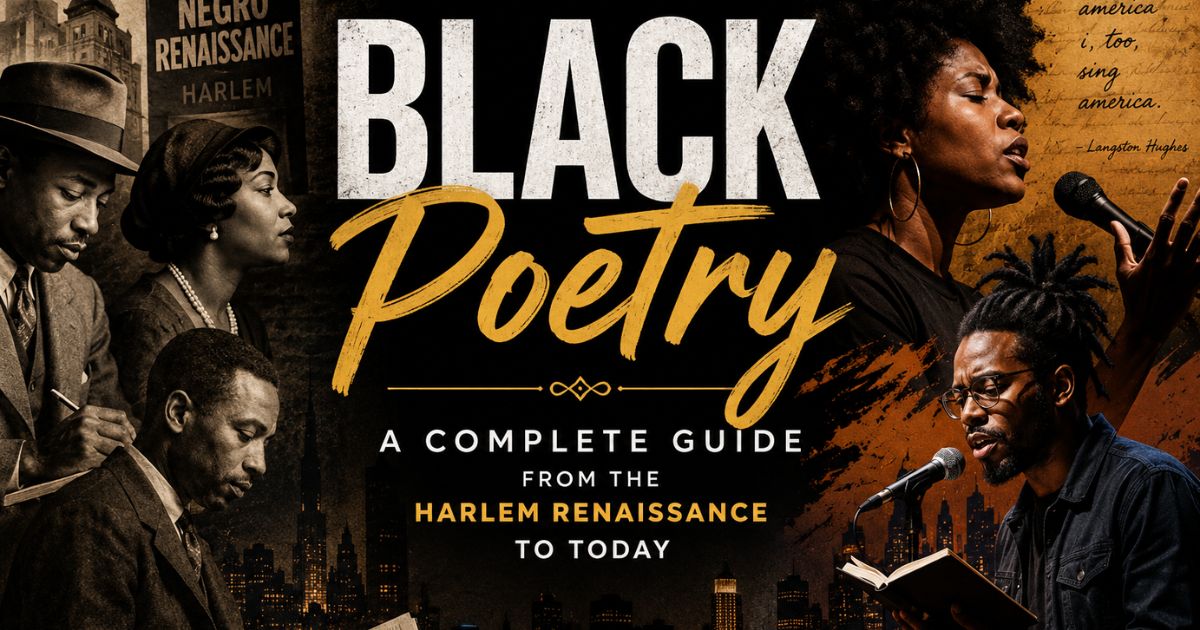
Black poetry is the body of verse written by Black writers, spanning enslaved people’s oral spirituals, the published poems of the 1700s, the Harlem Renaissance, the Black Arts Movement, and today’s spoken-word and Instapoetry scenes. It is not one single style but an evolving tradition connected by shared history, rhythm, and voice. From Phillis Wheatley’s 1773 debut collection to poets shortlisted for the 2026 Pulitzer Prize, Black poetry has continuously reshaped American literature. This guide walks through that full timeline, era by era, along with the poets and poems worth reading from each period.
Key Takeaways
Black poetry's roots stretch back to enslaved people's oral spirituals, long before any Black American poet was formally published.

Phillis Wheatley became the first African American to publish a book of poetry in 1773, decades before the Harlem Renaissance.

The Harlem Renaissance of the 1920s marked Black poetry's first widely recognized golden age, led by writers like Langston Hughes and Claude McKay.

The Black Arts Movement of the mid-1960s to mid-1970s treated poetry as a direct tool for political and cultural power.

Contemporary Black poetry now spans U.S. Poet Laureates, Pulitzer winners, and Insta-poetry, with active poets publishing new work in 2025 and 2026.

Black poetry is a year-round literary tradition, not a topic limited to a single month on the calendar.
What Is Black Poetry? A Working Definition
Black poetry refers to poems written by Black authors, most often centered on the African American and wider African diaspora experience, though its themes range far beyond race alone. It includes love poems, nature poems, political poems, and experimental work, unified less by subject matter than by the identity and cultural inheritance of the writer. As a result, calling something “Black poetry” says more about who wrote it and what tradition it draws on than about a fixed set of rules.
This tradition also blends multiple influences at once. Many Black poets draw on rhythms from spirituals, blues, and jazz, while others work in classical forms like the sonnet or free verse borrowed from broader American and European poetry. For example, Langston Hughes famously built poems around blues chord structures, while contemporary poet Jericho Brown invented his own form, the “duplex,” which fuses the sonnet, the ghazal, and the blues.
However, it’s worth being clear that Black poetry isn’t a genre defined only by struggle or protest, even though those themes appear often. In my own reading across this tradition, I’ve found joy, humor, and quiet domestic detail sitting right alongside political urgency, sometimes within the same poem. Reducing Black poetry to a single mood or message misses most of what the tradition actually offers.
Is “Black Poetry” the Right Term?
Scholars and readers use several related terms, and the differences matter. “African American poetry” specifically describes poets from the United States, while “Black poetry” is broader and can include poets from the Caribbean, the United Kingdom, and across the African diaspora. “African poetry,” meanwhile, refers to work by poets from the African continent itself, a related but distinct tradition.
Because these terms overlap without being identical, most literary databases and anthologies use “Black poetry” as the umbrella term this guide follows, while noting more specific labels where a poet’s national or regional identity is central to their work.
The Roots of Black Poetry: Spirituals and Oral Tradition
Before any Black American poet was formally published, an oral poetic tradition already existed among enslaved people in the form of spirituals. Songs such as “Wade in the Water” and “Go Down, Moses” combined religious imagery with coded messages, some scholars believe, about escape routes on the Underground Railroad. These spirituals were composed and passed down communally, without a single credited author, which sets them apart from the individually authored poems that came later.
Frederick Douglass, in his 1845 narrative, described how enslaved people’s songs carried meanings far deeper than their surface lyrics suggested, noting that the sorrow embedded in the music revealed truths about slavery that spoken testimony often couldn’t capture. This oral tradition established rhythmic and thematic patterns, repetition, call-and-response, and coded double meaning, that would echo through nearly every later era of Black poetry, from Harlem Renaissance blues poems to today’s spoken word.
Understanding this oral root matters because it corrects a common misconception: Black poetry didn’t begin with the printing press. It began with voice, memory, and community performance, decades before Phillis Wheatley’s book made it into print. Recognizing spirituals as the tradition’s true starting point gives the entire timeline that follows a far more accurate foundation.
Black Poetry’s First Published Voices (18th–19th Century)
Phillis Wheatley holds the distinction of being the first African American, and one of the first American women of any background, to publish a book of poetry. Her collection, Poems on Various Subjects, Religious and Moral, appeared in London in 1773 while Wheatley was still enslaved in Boston. The book’s publication was itself remarkable given the era’s deep skepticism that an enslaved person could produce literary work, and Wheatley had to defend her authorship before a panel of Boston notables before publishers would accept the manuscript as genuinely hers.
Roughly a century later, Frances Ellen Watkins Harper emerged as one of the most widely read Black poets of the 19th century. An abolitionist and women’s rights advocate, Harper published Poems on Miscellaneous Subjects in 1854, and her work often directly confronted slavery and its aftermath. Meanwhile, Paul Laurence Dunbar became the first Black poet to achieve broad national fame, publishing multiple collections in the 1890s that alternated between standard English verse and dialect poems modeled on Black Southern speech patterns.
Dunbar’s dual approach, formal poems alongside dialect work, reflected a tension that would recur throughout Black poetry’s history: how to write authentically for a Black audience while also reaching, and sometimes being filtered through, a largely white publishing industry. This tension set the stage directly for the explosion of Black literary expression that arrived with the Harlem Renaissance a generation later.
The Harlem Renaissance: Black Poetry’s First Golden Age
The Harlem Renaissance, roughly spanning 1918 to the mid-1930s, transformed a single New York City neighborhood into the center of Black literary and artistic life in America. Fueled by the Great Migration, which brought hundreds of thousands of Black Americans from the rural South to Northern cities, Harlem became a gathering point for poets, novelists, musicians, and visual artists working simultaneously across disciplines.
Langston Hughes emerged as the movement’s most influential poetic voice, publishing The Weary Blues in 1926, a collection that directly incorporated blues and jazz rhythms into verse. Hughes deliberately wrote in accessible, musical language aimed at everyday Black readers rather than a narrow literary elite, a choice that made his work widely beloved but occasionally controversial among critics who wanted more “respectable” subject matter. Claude McKay took a more overtly political approach; his 1919 poem responding to that summer’s wave of racial violence became one of the era’s most quoted calls for Black self-defense and dignity.
As a result, the Harlem Renaissance didn’t just produce great individual poems, it established Black poetry as a serious, unavoidable force in American letters. Magazines like The Crisis and Opportunity published emerging poets alongside essays on Black political life, tying literary achievement directly to the era’s broader civil rights arguments. This fusion of art and advocacy would resurface even more explicitly decades later during the Black Arts Movement.
Key Harlem Renaissance Poets to Know
- Langston Hughes blended blues and jazz rhythm with everyday Black speech; author of The Weary Blues (1926).
- Claude McKay Jamaican-born poet whose sonnet responding to 1919’s racial violence became a rallying cry for self-defense.
- Countee Cullen worked largely in traditional forms like the sonnet, often exploring the tension between his classical training and racial identity.
- Georgia Douglas Johnson hosted an influential literary salon in Washington, D.C., and published extensively on love and womanhood.
- Jean Toomer blurred poetry and prose in his experimental 1923 book Cane, capturing rural Southern Black life.
The Black Arts Movement: Poetry as Political Power
The Black Arts Movement began in 1965, shortly after the assassination of Malcolm X, when poet and playwright Amiri Baraka founded the Black Arts Repertory Theatre/School in Harlem. Unlike the Harlem Renaissance, which often sought recognition from mainstream literary institutions, the Black Arts Movement deliberately built independent Black publishing houses, theaters, and journals, treating art as inseparable from the Black Power political movement happening at the same time.
Poet and critic Larry Neal helped define the movement’s mission in his influential 1968 essay, arguing that Black art should speak directly to Black communities rather than seeking white critical approval. This philosophy shaped the era’s poetry style: direct, often confrontational language, frequent use of Black vernacular, and subject matter tied explicitly to liberation and self-determination. Nikki Giovanni’s early collections, for instance, moved between tender personal reflection and sharp political statement, sometimes within the same poem.
Gwendolyn Brooks offers a striking bridge between eras. She had already won the 1950 Pulitzer Prize for Poetry, becoming the first Black person to win a Pulitzer in any category, well before the Black Arts Movement began. However, after attending the 1967 Fisk University Black Writers’ Conference, Brooks shifted toward the movement’s more direct political style and began publishing with Black-owned presses, illustrating how the movement reshaped even established poets’ approach to craft and publishing.
Key Black Arts Movement Poets to Know
- Amiri Baraka founded the movement’s foundational Harlem institution in 1965; formerly published as LeRoi Jones.
- Sonia Sanchez combined experimental form with direct political address; helped establish some of the first Black studies courses in the U.S.
- Nikki Giovanni balanced intimate personal poems with revolutionary political statements throughout the late 1960s and 1970s.
- Haki Madhubuti founded Third World Press in 1967, one of the era’s most important independent Black publishing houses.
- Gwendolyn Brooks Pulitzer winner who shifted toward the movement’s aesthetic after 1967, publishing with Black-owned presses.
Contemporary Black Poetry: From Poet Laureates to Instapoetry
Since the 1990s, Black poets have moved into some of American poetry’s most visible institutional roles. Rita Dove became the first African American U.S. Poet Laureate in 1993, followed later by Natasha Trethewey, who won the 2007 Pulitzer Prize for Native Guard before serving as Poet Laureate from 2012 to 2014, and Tracy K. Smith, who served from 2017 to 2019 after winning the 2012 Pulitzer for Life on Mars. These appointments placed Black poets at the center of national literary culture rather than at its margins.
At the same time, Black poetry has flourished in more accessible, informal spaces. Poet Claudia Rankine’s 2014 book Citizen: An American Lyric blended poetry, essay, and image to examine everyday racism, becoming a bestseller far outside typical poetry readership. Meanwhile, poets like Nayyirah Waheed helped shape the Instapoetry movement, publishing spare, image-driven short poems, such as her 2013 collection salt., formatted for social media sharing rather than traditional print anthologies.
Amanda Gorman brought Black poetry into a global spotlight in January 2021, reading her poem “The Hill We Climb” at the U.S. presidential inauguration and becoming, at 22, the youngest inaugural poet in American history. She followed with a second full collection in 2024, Call Us What We Carry, extending her reach into bestseller lists typically dominated by fiction. This range, from Poet Laureate ceremonies to viral Instagram captions, shows contemporary Black poetry operating across every level of the literary world at once.
Black Poets Making News Right Now
Several Black poets have released or been recognized for major work in the current publishing cycle. Poet Aja Monet released her collection Florida Water in late 2025, building on her 2024 Nelson Mandela Changemaker Award recognition. At the 2026 Pulitzer Prizes, announced May 4, 2026, Black poets Douglas Kearney and Patricia Smith both earned finalist honors, for I Imagine I Been Science Fiction Always and The Intentions of Thunder: New and Selected Poems respectively, following Danez Smith’s finalist recognition the previous year for Bluff.
Additionally, poet Cortney Lamar Charleston published It’s Important I Remember through Curbstone Books/Northwestern University Press in February 2026, continuing themes from his earlier collection Doppelgangbanger, named a best book of 2021 by the New York Public Library. These examples show that Black poetry isn’t a closed historical chapter; new, award-recognized work continues to appear every publishing season.
Why Black Poetry Matters: Themes That Run Through Every Era
Black poetry matters first because it preserves history that formal records often left out or distorted. Spirituals documented enslaved people’s inner lives at a time when few other written accounts existed from their own perspective, and later poets like Trethewey have explicitly written to recover overlooked historical figures, such as Black Union soldiers, from historical footnotes.
Second, Black poetry has repeatedly expanded what American poetry as a whole is allowed to sound like. Hughes’s blues rhythms and the Black Arts Movement’s vernacular language pushed mainstream poetry away from purely European forms, influencing generations of poets regardless of background. Third, the tradition offers a continuous record of joy and interior life, not only struggle; Georgia Douglas Johnson’s love poems and Nikki Giovanni’s playful early work prove the tradition was never one-note.
Finally, and importantly, Black poetry deserves attention year-round rather than only during a single designated month. Treating it as evergreen literary history, connected to spirituals, the Harlem Renaissance, the Black Arts Movement, and this year’s Pulitzer finalists alike, gives readers a far more accurate and complete picture than a once-a-year spotlight ever could.
How to Read Black Poetry Closely
Reading Black poetry well often means paying attention to layered meaning, rhythm, and historical context all at once, since many poems reward more than a single pass.
A Close-Reading Method
- Read the poem once for overall feeling. Don’t stop to analyze; just notice your initial emotional reaction.
- Research the poet’s era and context. A Harlem Renaissance poem and a 2026 collection carry very different historical weight.
- Read the poem aloud a second time. Many Black poets, from spiritual composers to Hughes to spoken word artists, wrote primarily for the ear.
- Identify recurring sounds and rhythms. Look for blues structure, call-and-response, or repetition borrowed from oral tradition.
- Note where the poem shifts tone. Many Black poems move between personal and political registers within just a few lines.
- Connect the poem to its historical moment. Understanding events like the Great Migration or the Black Arts Movement often unlocks a poem’s full meaning.
Common Mistakes When Reading Black Poetry
Readers sometimes assume every Black poem is primarily about racial struggle, which causes them to miss humor, romance, and quiet observation present throughout the tradition. Another common mistake is reading silently without ever hearing the poem aloud, missing rhythms borrowed from music and oral performance. Finally, treating Black poetry as a single unified style, rather than a tradition spanning centuries and wildly different movements, flattens real differences between, say, a Wheatley sonnet and a Baraka political poem.
Black Poetry Eras at a Glance
| Era | Time Period | Defining Style | Key Figures |
| Spirituals & Oral Tradition | 1600s–1800s | Communal, coded, passed down orally | Unattributed; documented by figures like Frederick Douglass |
| Early Published Poets | 1770s–1890s | Formal verse, often addressing slavery and faith | Phillis Wheatley, Frances Ellen Watkins Harper, Paul Laurence Dunbar |
| Harlem Renaissance | 1918–mid-1930s | Blues- and jazz-influenced, urban, culturally proud | Langston Hughes, Claude McKay, Countee Cullen |
| Black Arts Movement | 1965–mid-1970s | Direct, vernacular, explicitly political | Amiri Baraka, Nikki Giovanni, Sonia Sanchez |
| Contemporary/Instapoetry | 1990s–present | Institutional recognition alongside spare, social-media-native verse | Rita Dove, Amanda Gorman, Nayyirah Waheed |
As the table shows, each era built directly on the last, moving from communal oral expression toward today’s split between formal literary recognition and informal, widely shared short-form poems.
10 Must-Read Black Poetry Examples Across Eras
The following list moves chronologically through the tradition. Rather than reproducing the original text, each entry describes the poem’s subject, style, and significance so readers can seek out the full pieces.
- The traditional spiritual “Wade in the Water” an oral-tradition song widely believed to carry coded guidance related to escape and the Underground Railroad.
- Phillis Wheatley, “On Being Brought from Africa to America” (1773) a short, formally structured poem grappling with faith and identity under slavery.
- Paul Laurence Dunbar, “We Wear the Mask” (1895) a poem about concealing pain behind a public performance of composure.
- Claude McKay, “If We Must Die” (1919) a defiant sonnet written in direct response to that summer’s racial violence.
- Langston Hughes, “The Weary Blues” (1926) a poem structurally built around the rhythm and repetition of a blues song.
- Gwendolyn Brooks, “We Real Cool” (1959) a tightly compressed poem about a group of young pool players, famous for its rhythmic internal rhyme.
- Amiri Baraka, “Black Art” (1966) a foundational Black Arts Movement poem arguing for poetry as direct political action.
- Nikki Giovanni, “Ego Tripping” (1968) a bold, mythic poem celebrating Black womanhood on a sweeping historical scale.
- Natasha Trethewey, “Native Guard” (2006) a sequence recovering the overlooked history of Black Union soldiers during the Civil War.
- Amanda Gorman, “The Hill We Climb” (2021) the poem read at the 2021 U.S. presidential inauguration, addressing national unity and division.
Where to Read More Black Poetry Today
Readers looking to go deeper have strong, reliable starting points. The Academy of American Poets maintains an extensive online archive, including its daily Poem-a-Day series, which regularly features contemporary Black poets alongside historical figures. Cave Canem, a non-profit organization founded specifically to support Black poets, runs an annual fellowship, retreat, and first-book prize that has launched numerous major careers.
University press catalogs, particularly from Wave Books, Graywolf Press, and Northwestern University Press, consistently publish major contemporary Black poetry collections, including several of the 2025 and 2026 titles mentioned above. Public library poetry sections, especially those organized by movement or era, also make it easy to move chronologically from Harlem Renaissance anthologies through Black Arts Movement collections to this year’s new releases.
FAQs
Q: What is Black poetry, in simple terms?
A: Black poetry is verse written by Black authors, most often connected to African American and wider African diaspora history and culture, though its themes range across love, nature, politics, and everyday life. It spans centuries, from enslaved people’s oral spirituals through Phillis Wheatley’s 1773 debut to today’s Instapoetry and Pulitzer-recognized collections. The tradition is defined more by the writer’s identity and cultural inheritance than by any single fixed style.
Q: Who are the most famous Black poets from the Harlem Renaissance?
A: Langston Hughes is the era’s most widely recognized poet, known for blending blues and jazz rhythm into verse in works like The Weary Blues (1926). Claude McKay, Countee Cullen, Jean Toomer, and Georgia Douglas Johnson were also central figures, each bringing distinct styles ranging from politically defiant sonnets to formal, classically influenced verse during the 1920s and early 1930s.
Q: What was the Black Arts Movement?
A: The Black Arts Movement was a literary and cultural movement running roughly from 1965 to the mid-1970s, founded in the aftermath of Malcolm X’s assassination. Led by figures like Amiri Baraka, it treated poetry as a direct tool for Black political and cultural power, favoring vernacular language and independent, Black-owned publishing over mainstream literary institutions.
Q: Is there a difference between Black poetry and African American poetry?
A: Yes. African American poetry specifically refers to work by poets from the United States, while Black poetry is a broader umbrella that also includes Caribbean, Black British, and other African diaspora writers. Most literary databases treat “Black poetry” as the wider category, with African American poetry as one significant tradition within it.
Q: Which Black poets are publishing notable work right now?
A: Several Black poets have released acclaimed work recently. Aja Monet published Florida Water in late 2025, while Douglas Kearney and Patricia Smith were both finalists for the 2026 Pulitzer Prize in Poetry. Cortney Lamar Charleston released It’s Important I Remember in February 2026, showing that Black poetry continues producing award-recognized new collections every publishing season.
Final Thoughts
Black poetry is not a single moment in literary history; it’s a living, unbroken tradition running from enslaved people’s spirituals through Phillis Wheatley’s 1773 debut, the Harlem Renaissance, the Black Arts Movement, and into a 2026 Pulitzer Prize cycle that still includes Black finalists and award-winning new collections. Reading it chronologically, rather than through a single famous poem or a once-a-year spotlight, reveals just how much this tradition has shaped, and continues to shape, American poetry as a whole. Whichever era draws you in first, there’s a direct historical line connecting it to the poets publishing new work right now.
Recent Article : Beatnik Poetry: History, Famous Poets & 10 Must-Read Examples

Jennifer Aston is a passionate poetry curator and writer with a deep love for the written word. She believes poetry has the power to heal, inspire, and connect people across all walks of life. Through PoemSteric, she brings together timeless and modern verses for every emotion and every moment.