
Introduction
Ancient Greek epic poetry is a tradition of long narrative verse, composed in dactylic hexameter and rooted in oral performance, that tells the stories of gods, heroes, and the origins of the world. Its two surviving masterworks, Homer’s “Iliad” and “Odyssey,” were composed sometime in the eighth century BCE, though the tradition itself stretches from the oral songs of the Greek Dark Age through Hesiod’s didactic poems, the largely lost Epic Cycle, and later Hellenistic and Roman-era epics written centuries afterward. Below is a complete history of the form, its major poets, and the specific works that shaped Western literature for the next 2,700 years.
Key takeaways
Ancient Greek epic poetry was composed in dactylic hexameter and originally performed orally by professional singers called aoidoi, long before it was written down.

Homer's "Iliad" and "Odyssey," generally dated to the eighth century BCE, are the only complete surviving epics from the earliest period of the tradition; nearly everything else from that era survives only in fragments or later summaries.

Hesiod, active around 750–650 BCE, wrote in the same hexameter tradition as Homer but produced didactic rather than narrative epics, most notably the "Theogony" and "Works and Days."

The Epic Cycle, a set of roughly twelve additional epic poems covering the wider Trojan War story, survives today only through fragments and later summaries, mainly because Homer's two epics were copied and preserved so much more consistently.

The tradition did not end in antiquity's earliest centuries; poets like Apollonius of Rhodes in the third century BCE and Nonnus in the fifth century CE continued writing genuinely new Greek epic poetry for nearly a thousand years after Homer.
What is ancient Greek epic poetry, exactly?
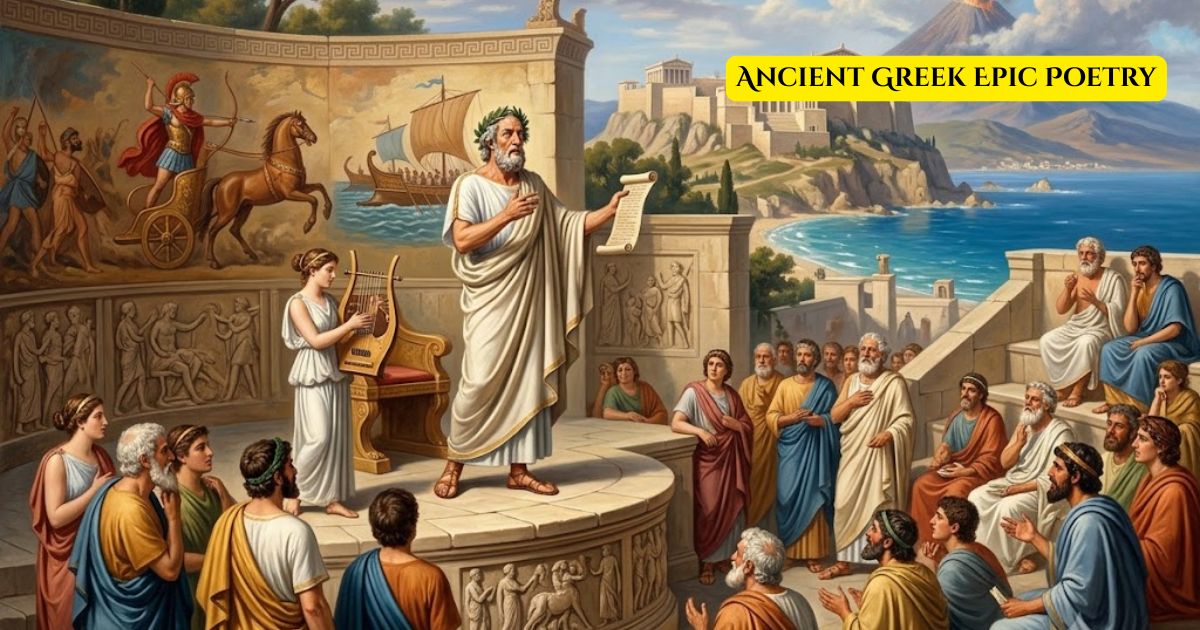
Ancient Greek epic poetry refers to long narrative poems, composed in a specific metrical pattern called dactylic hexameter, that recount the deeds of gods and heroes, the origins of the cosmos, or extended mythological cycles. Unlike shorter lyric poetry meant to be sung with a lyre, epic poetry was originally performed by reciting or chanting rather than singing, often at public festivals, religious occasions, or the courts of wealthy patrons.
The form developed out of a long oral tradition during the Greek Dark Age, a period roughly between 1200 and 800 BCE following the collapse of Mycenaean civilization. Professional performers known as aoidoi, or singers, composed and recited these poems from memory, relying on a large stock of repeated formulaic phrases and epithets “swift-footed Achilles,” “wine-dark sea” that helped them improvise long performances while maintaining the strict hexameter rhythm.
In my own reading of this material, what’s easy to miss at first is just how much of the surviving evidence for oral composition comes from close textual analysis rather than direct historical record. Classical scholar Milman Parry identified these formulaic patterns as clear evidence of oral origin in his influential 1930 studies on Homeric technique, a finding that reshaped how modern scholars understand the entire tradition of ancient Greek epic poetry, not just Homer’s two surviving works.
The oral tradition behind ancient Greek epic poetry
Before any of these poems existed as written text, they existed as live performances, passed down and reshaped across generations of singers rather than fixed by a single author at a single moment. Understanding this oral background is essential context for nearly everything else in this article, since it explains both how the poems were composed and why so many of them were eventually lost.
Dactylic hexameter and oral formulas
Dactylic hexameter is the metrical backbone of nearly all ancient Greek epic poetry, built from six metrical feet per line, each typically a “dactyl” (one long syllable followed by two short ones) or a substituted spondee (two long syllables). This consistent, chant-like rhythm made long poems easier to memorize and perform, and it remained the standard meter for Greek epic for well over a thousand years, from Homer through poets writing under the Roman Empire.
Alongside meter, oral poets relied heavily on formulaic language: fixed epithets attached to specific characters or objects (“grey-eyed Athena,” “rosy-fingered dawn”) that fit neatly into the hexameter line and gave performers reliable building blocks during live composition. This technique let a skilled singer improvise thousands of lines in performance without needing to memorize an exact fixed text word for word.
The aoidoi: professional bardic performers
The aoidoi were professional oral poets who performed epic poetry at festivals, religious ceremonies, and the homes of wealthy or powerful patrons during the Greek Archaic period. Unlike a modern author working alone, an aoidos operated within a living tradition, drawing on inherited stories, formulas, and structural patterns shared across many generations of performers rather than inventing an entirely original text from scratch.
This collective, evolving process is part of why modern scholars are cautious about treating “Homer” as a single historical individual in the way we’d think of a modern novelist. As a result, the question of authorship remains one of the most debated topics in classical scholarship, a debate explored in more detail in the next section.
Homer: the central figure of ancient Greek epic poetry
Homer is traditionally credited as the author of the “Iliad” and the “Odyssey,” the two oldest surviving complete works of ancient Greek epic poetry and among the oldest works of literature still widely read today. Both poems are generally dated to the eighth century BCE, composed in dactylic hexameter, and divided into 24 books each, following a structure later editors at the Library of Alexandria imposed on the text for organizational purposes.
However, almost nothing reliable is known about Homer as a historical person. Ancient biographical traditions disagree even on his birthplace, and modern scholars broadly agree that “Homer” likely represents a culmination of generations of oral tradition rather than a single historical author working in isolation. Both epics are generally attributed to poets working somewhere in Asia Minor, based on dialect features preserved in the text, though this remains an inference rather than a documented fact.
The Homeric Question
The “Homeric Question” refers to the long-running scholarly debate over who actually composed the “Iliad” and “Odyssey,” whether they were written by one person or many, and how oral tradition shaped their final written form. This debate dates back to antiquity itself and intensified dramatically in the eighteenth and nineteenth centuries as classical scholars began applying more rigorous textual and historical analysis to the poems.
Milman Parry’s early twentieth-century fieldwork studying living oral epic traditions in the Balkans provided crucial comparative evidence, showing how illiterate oral poets could reliably compose extremely long poems using exactly the kind of formulaic techniques found throughout Homeric verse. This research shifted scholarly consensus away from treating the poems as the fixed, deliberate work of a single literary genius and toward understanding them as the eventual written crystallization of a long collective oral tradition, even if a specific gifted poet ultimately shaped their final surviving form.
The Iliad: wrath, war, and the fall of Troy
The “Iliad” is set during the final weeks of the legendary ten-year Trojan War, a conflict fought between a coalition of Mycenaean Greek states and the city of Troy. Rather than covering the entire war, the poem focuses narrowly on the wrath of Achilles, the greatest Greek warrior, after a bitter dispute with the Greek commander Agamemnon over a captured woman, and the devastating consequences that anger has for both armies.
At 15,693 lines in its most widely accepted version, the “Iliad” is a monumental work even by epic standards, combining intense battlefield violence with intimate, deeply human scenes, including Hector’s farewell to his wife Andromache and Priam’s grief-stricken plea to Achilles for his son’s body. The poem’s exploration of honor, mortality, and the terrible cost of pride made it a foundational text not just for later Greek literature, but for the entire subsequent tradition of Western epic poetry.
For example, the poem’s famous opening word, “mēnin” (wrath), immediately signals its central theme, a technique later epic poets across multiple languages and centuries would consciously imitate when opening their own works. This kind of direct, formal influence is one of the clearest ways to see how thoroughly ancient Greek epic poetry shaped the literary conventions that followed it.
The Odyssey: homecoming and cunning
Where the “Iliad” focuses on war, the “Odyssey” follows the Greek hero Odysseus’s ten-year journey home to the island of Ithaca after the fall of Troy, encountering monsters, gods, and increasingly dangerous obstacles along the way. Also structured in 24 books and composed in dactylic hexameter, the “Odyssey” is generally considered slightly later than the “Iliad,” though both are traditionally attributed to Homer.
The poem’s structure is notably more complex than the “Iliad’s” more linear battlefield narrative, opening in the middle of the story and using extended flashbacks, including Odysseus’s own first-person account of his encounters with the Cyclops Polyphemus, the witch Circe, and the underworld, before eventually catching up to his triumphant, disguised return to Ithaca. This nonlinear storytelling technique, sophisticated even by modern standards, is part of why the “Odyssey” remains one of the most frequently cited early examples of complex narrative structure in Western literature.
Readers often tell us the “Odyssey” feels more personally engaging on a first read than the “Iliad,” largely because Odysseus’s cleverness and resourcefulness, rather than pure martial glory, drive the story’s central tension. However, the poem is equally concerned with serious themes, including hospitality, loyalty, and the difficulty of returning to a home that has changed in one’s absence.
Hesiod: didactic epic and the origins of the gods
Hesiod, generally believed to have been active between 750 and 650 BCE, working around the same period as Homer, represents a genuinely different branch of ancient Greek epic poetry: didactic rather than narrative verse. Unlike Homer’s battlefield and adventure narratives, Hesiod’s major surviving works aim to explain and instruct, covering the origins of the universe and practical guidance for everyday agricultural life.
Hesiod is generally regarded by Western scholars as the first poet in this tradition to write himself into his own work as an individual persona, rather than remaining an anonymous narrator in the background. This self-referential quality sets him apart stylistically from Homer, even though both poets shared the same hexameter meter and archaic poetic vocabulary.
Theogony
Hesiod’s “Theogony” traces the origins of the universe and the genealogy of the Greek gods, beginning with the primordial union of Heaven (Uranus) and Earth (Gaia) and continuing through the birth of the Titans, the Olympian gods, and Zeus’s eventual rise to supreme power after defeating his father Cronus. The poem functions essentially as a systematic mythological reference work in verse, organizing an enormous body of scattered oral tradition into a single coherent genealogical structure.
Works and Days
“Works and Days,” Hesiod’s other major surviving poem, shifts entirely toward practical instruction, offering guidance on farming, seafaring, and moral conduct, framed as advice to his brother Perses following a dispute over their father’s inheritance. The poem blends genuinely useful agricultural calendar information with broader reflections on justice, labor, and the decline of human civilization through a sequence of mythological ages, from a lost golden age down to Hesiod’s own harsher “age of iron.”
As a result, Hesiod’s work gives modern readers a genuinely different window into ancient Greek epic poetry than Homer’s battlefield narratives: less concerned with individual heroism, and more focused on cosmic order, practical survival, and moral instruction for ordinary life.
The Epic Cycle: the lost poems of Troy
The Epic Cycle refers to a set of roughly twelve additional ancient Greek epic poems, composed between the eighth and sixth centuries BCE, that together filled in the broader mythological narrative surrounding the Trojan War and other major heroic cycles, including the stories of Thebes and Heracles. Unlike the “Iliad” and “Odyssey,” none of these poems survive in complete form today; they exist only as fragments and later prose summaries, mainly preserved through a now-lost work by the ancient scholar Proclus.
The core Trojan portion of the cycle traditionally included six principal epics: the “Cypria,” attributed to Stasinus or Hegesias of Salamis, covering the war’s origins including the Judgment of Paris; the “Aethiopis,” attributed to Arctinus of Miletus, covering Achilles’s later exploits and death; the “Little Iliad” and the “Sack of Ilium,” covering the Trojan Horse and the city’s fall; and the “Returns” (Nostoi) and the “Telegony,” covering the homecomings of the surviving Greek heroes after the war.
Why the Epic Cycle didn’t survive intact
- Homer’s works were copied far more consistently. Ancient Greek and later Roman schools treated the “Iliad” and “Odyssey” as core educational texts, ensuring continuous copying across centuries, while the Epic Cycle poems were gradually treated as secondary material.
- Perceived quality differences. Some ancient critics, including later commentators working under the Roman Empire, judged the cyclic poems as artistically inferior to Homer’s work, reducing incentive to preserve complete copies.
- Manuscript loss over time. Like the vast majority of ancient literature, physical manuscripts of the Epic Cycle simply didn’t survive the many centuries between antiquity and the invention of printing, especially without the same institutional preservation efforts applied to Homer.
However, even in fragmentary form, the Epic Cycle remains historically valuable, since later poets like Quintus of Smyrna directly drew on its lost content when reconstructing episodes of the Trojan War that Homer’s two surviving epics never directly covered.
Homeric Hymns: shorter epic poems to the gods
The Homeric Hymns are a collection of shorter poems, composed in the same dactylic hexameter meter as Homer’s epics and traditionally associated with his name, though modern scholars generally agree they were written by multiple different poets over a considerable span of time. Each hymn honors a specific Greek god, with the longer examples, including the hymns to Demeter, Apollo, Hermes, and Aphrodite, functioning almost as compact mythological narratives in their own right rather than simple religious invocations.
The Hymn to Demeter, for example, tells the story of the goddess’s search for her daughter Persephone after Persephone’s abduction by Hades, a narrative that also explains the mythological origin of the seasons. Because these hymns share Homer’s meter, formulaic style, and epic vocabulary, they’re generally studied as part of the broader tradition of ancient Greek epic poetry rather than treated as a separate poetic category entirely.
Despite their name, the hymns were likely composed and performed independently of the “Iliad” and “Odyssey,” often as introductory pieces recited before longer epic performances at festivals and poetic competitions. This context helps explain both their relatively compact length and their focus on a single deity’s story, rather than the sprawling, multi-book scope of Homer’s two major works.
Apollonius of Rhodes and the Hellenistic epic
Apollonius of Rhodes, born around 295 BCE, represents a crucial later chapter in the history of ancient Greek epic poetry: the Hellenistic revival of large-scale epic composition, centuries after Homer and Hesiod. His major surviving work, the “Argonautica,” tells the story of Jason and the Argonauts’ quest for the Golden Fleece across four books, adapting Homeric language and technique to fit the more self-consciously literary, romantic sensibilities of his own era.
Apollonius served at the Library of Alexandria, one of the ancient world’s great centers of scholarship, and his epic reflects that scholarly environment directly: dense mythological allusion, careful literary craftsmanship, and a notably sympathetic psychological treatment of Medea’s love for Jason that had few precedents in earlier Greek literature. Ancient critics praised his suggestive similes and vivid descriptions of nature, qualities that distinguish his style clearly from Homer’s more formulaic, orally rooted technique.
Beyond the “Argonautica,” Apollonius also wrote epigrams and poems on the mythological foundations of cities, though most of this additional work has since been lost. His influence extended well beyond Greek literature itself; the Roman poet Virgil drew directly on the “Argonautica” when crafting Dido and Aeneas’s relationship in the “Aeneid,” making Apollonius one of the clearest direct links between ancient Greek epic poetry and the later Roman epic tradition.
Later Greek epic: Quintus of Smyrna and Nonnus
The tradition of ancient Greek epic poetry continued for many centuries after Apollonius, producing genuinely new works well into the Roman imperial period. Quintus of Smyrna, generally dated to the third or fourth century CE, composed the “Posthomerica,” a lengthy epic specifically designed to bridge the narrative gap between the end of the “Iliad” and the beginning of the “Odyssey,” covering events including Achilles’s death and the fall of Troy that Homer’s surviving epics never directly narrated.
Quintus drew heavily on the lost Epic Cycle poems, including the “Aethiopis,” the “Little Iliad,” and Apollonius’s “Argonautica,” as his primary sources, effectively preserving the narrative content of otherwise lost works even though his own poem was composed many centuries after the events and poems it describes. Ancient critics generally considered his work less vivid than Homer’s, but praised his original similes and skillful handling of connecting narrative threads across the broader Trojan War story.
Nonnus of Panopolis, active around the fifth century CE, pushed the tradition even further chronologically with his “Dionysiaca,” an enormous 48-book epic recounting the mythological life and conquests of the god Dionysus. Composed roughly a thousand years after Homer, Nonnus’s massive poem demonstrates just how long the dactylic hexameter epic remained a living, actively practiced literary form in the Greek-speaking world, far outlasting the historical period most readers typically associate with “ancient Greece.”
What poetic devices define ancient Greek epic poetry?
Across nearly a thousand years of composition, several specific poetic devices remain remarkably consistent throughout the tradition of ancient Greek epic poetry, regardless of which individual poet or century produced a given work.
- Dactylic hexameter. The consistent six-foot metrical line used from Homer through Nonnus, functioning as the tradition’s defining formal feature.
- Epithets and formulaic phrases. Fixed descriptive phrases like “swift-footed Achilles” or “wine-dark sea” that helped oral poets compose fluently while maintaining a strict meter.
- Invocation of the Muse. Nearly every major epic opens with a direct appeal to a Muse for inspiration, a convention later Roman poets like Virgil also adopted directly.
- In media res structure. Beginning the narrative in the middle of the action, as the “Odyssey” and later “The Aeneid” both do, rather than starting from the earliest chronological point.
- Extended smiles. Long, elaborate comparisons of a warrior’s charge compared to a lion attacking a flock, for example, pause the narrative to develop a vivid secondary image.
- Divine intervention. Gods regularly appear as active participants in human events, directly shaping the plot rather than remaining distant or symbolic figures.
Recognizing these six devices in combination is often the fastest way to identify a work as belonging to this specific tradition, even centuries after Homer’s original poems were composed.
Why is so much ancient Greek epic poetry lost?
This is one of the most common questions readers have about ancient Greek epic poetry, so it’s worth addressing directly here rather than only in the closing FAQ section. The overwhelming majority of ancient Greek epic poetry, including nearly the entire Epic Cycle, survives only in fragments or later summaries, primarily because ancient and medieval manuscript preservation depended entirely on continuous, deliberate copying across many centuries, and only a small number of texts received that sustained institutional attention.
Homer’s “Iliad” and “Odyssey” survived largely intact because they became core educational texts in both ancient Greek and later Roman schools, ensuring a steady, ongoing supply of new manuscript copies generation after generation. Other epics, including most of the Epic Cycle, gradually fell out of that educational rotation, sometimes because later critics judged them artistically inferior, and sometimes simply due to the practical realities of which texts wealthy patrons and institutions chose to keep recopying as older manuscripts wore out.
As a result, our understanding of these lost poems today depends heavily on secondary sources: brief summaries preserved by ancient scholars like Proclus, scattered quotations in other surviving texts, and later poets like Quintus of Smyrna who drew on the lost material while composing their own new epics. This patchwork of indirect evidence means modern scholars can reconstruct the broad outlines of the Epic Cycle’s plots, but almost never its original exact wording.
How ancient Greek epic poetry influenced later literature
The influence of ancient Greek epic poetry on later Western literature is difficult to overstate, extending directly into Roman literature and, through Rome, into the entire subsequent European literary tradition. Virgil’s “Aeneid,” composed in the first century BCE, deliberately modeled its structure on both the “Iliad” and “Odyssey,” opening in media like the “Odyssey” before shifting into extended battlefield narrative closer to the “Iliad’s” style.
Beyond direct structural imitation, the broader conventions established by Homer and his successors — invoking a Muse, using extended similes, opening a story mid-action — became standard features of epic poetry across many later languages and centuries, from Dante’s “Divine Comedy” to Milton’s “Paradise Lost.” Rhodes’s psychologically detailed treatment of Medea in the “Argonautica” similarly shaped how Virgil approached Dido’s tragic love for Aeneas, showing a direct line of influence running from Hellenistic Greek epic straight into the foundational text of Roman literature.
However, this influence wasn’t limited to poetry alone. Homeric epithets, similes, and narrative structures also shaped ancient Greek historical writing, oratory, and philosophy, since educated readers throughout antiquity treated the “Iliad” and “Odyssey” as shared cultural reference points, similar to how certain foundational texts function in many literary cultures today.
How to start reading ancient Greek epic poetry: a step-by-step approach
For readers new to this tradition, a structured approach makes the material far less intimidating than picking a title at random.
- Start with the “Odyssey” rather than the “Iliad.” Its adventure-driven plot and single central protagonist tend to be more immediately accessible than the “Iliad’s” dense cast of warriors and battlefield-focused narrative.
- Choose a modern verse translation. Translations by scholars like Robert Fagles or Emily Wilson render the hexameter into readable modern English while preserving much of the poem’s rhythm and imagery.
- Read a plot summary first. Because both epics assume familiarity with the wider Trojan War story, a brief summary of the broader mythological context, including material from the lost Epic Cycle, makes the poems’ many references far easier to follow.
- Move to the “Iliad” next. With the mythological background from the “Odyssey” already in place, the “Iliad’s” tighter, more intense focus on Achilles’s wrath becomes easier to follow.
- Add Hesiod for contrast. Reading “Theogony” or “Works and Days” after Homer’s two narrative epics shows just how differently ancient Greek epic poetry could function when used for didactic rather than storytelling purposes.
- Finish with Apollonius’s “Argonautica.” Its more psychologically modern, romantic sensibility makes an excellent capstone, showing how the tradition evolved centuries after Homer while still working within the same hexameter form.
Following this order, rather than starting strictly chronologically, tends to make each subsequent text easier to appreciate on its own terms.
Famous works of ancient Greek epic poetry at a glance
A direct comparison of the major surviving and historically significant works makes the tradition’s overall shape easier to grasp.
| Work | Poet | Approximate date | Status |
| Iliad | Homer | 8th century BCE | Fully survives |
| Odyssey | Homer | 8th century BCE | Fully survives |
| Theogony | Hesiod | c. 750–650 BCE | Fully survives |
| Works and Days | Hesiod | c. 750–650 BCE | Fully survives |
| Epic Cycle (Cypria, Aethiopis, etc.) | Various (Stasinus, Arctinus, Lesches, and others) | 8th–6th century BCE | Fragments and summaries only |
| Homeric Hymns | Various, unknown | Archaic–Classical period | Fully survives |
| Argonautica | Apollonius of Rhodes | c. 3rd century BCE | Fully survives |
| Posthomerica | Quintus of Smyrna | c. 3rd–4th century CE | Fully survives |
| Dionysiaca | Nonnus of Panopolis | c. 5th century CE | Fully survives |
This range shows that ancient Greek epic poetry wasn’t a single, brief moment in literary history; it was an actively practiced tradition spanning well over a thousand years, from the Greek Dark Age through the late Roman Empire.
FAQs
Q: What is the oldest example of ancient Greek epic poetry?
A: Homer’s “Iliad” and “Odyssey,” generally dated to the eighth century BCE, are the oldest surviving complete works of ancient Greek epic poetry. However, the broader oral tradition behind them developed much earlier, during the Greek Dark Age between roughly 1200 and 800 BCE, meaning the poetic techniques and formulaic language found in Homer’s epics represent the culmination of centuries of earlier, unrecorded oral composition.
Q: Who are the main poets associated with ancient Greek epic poetry?
A: The most historically significant poets are Homer, traditionally credited with the “Iliad” and “Odyssey”; Hesiod, known for the didactic epics “Theogony” and “Works and Days”; and later poets including Apollonius of Rhodes, Quintus of Smyrna, and Nonnus of Panopolis, who continued composing genuinely new epic poetry in the same hexameter tradition for centuries after Homer, extending into the Roman imperial period.
Q: What is the difference between the Iliad and the Odyssey?
A: The “Iliad” focuses narrowly on a few weeks near the end of the Trojan War, centered on Achilles’s wrath after a dispute with Agamemnon, while the “Odyssey” follows Odysseus’s ten-year journey home after the war’s end. Both are attributed to Homer and share the same 24-book structure and dactylic hexameter meter, but the “Odyssey” uses a more complex, nonlinear narrative structure than the more direct battlefield focus of the “Iliad.”
Q: What was the Epic Cycle, and why don’t we have the full text today?
A: The Epic Cycle was a set of roughly twelve additional ancient Greek epic poems that filled in the broader Trojan War narrative and other heroic myths beyond what Homer’s two surviving epics covered. Most of it survives only in fragments and later summaries because it was copied far less consistently than the “Iliad” and “Odyssey,” which became core texts in ancient Greek and Roman education and were therefore continuously recopied across generations.
Q: Did ancient Greek epic poetry influence Roman literature?
A: Yes, extensively. Virgil’s “Aeneid,” composed in the first century BCE, deliberately modeled its structure and many conventions directly on Homer’s “Iliad” and “Odyssey,” while also drawing on Apollonius of Rhodes’s “Argonautica” for its treatment of romantic tragedy. This direct influence made ancient Greek epic poetry the foundational model for the entire subsequent Roman epic tradition, and through Rome, for epic poetry across the Western literary canon.
Q: Is Hesiod considered part of ancient Greek epic poetry, even though his work isn’t a war narrative?
A: Yes. Hesiod composed in the same dactylic hexameter meter and archaic poetic vocabulary as Homer, which places his work firmly within the broader tradition of ancient Greek epic poetry, even though his major poems, “Theogony” and “Works and Days,” are didactic rather than narrative in focus. Scholars generally classify his work as didactic epic, a distinct but closely related branch of the same larger poetic tradition.
Final thoughts
Ancient Greek epic poetry is not simply “Homer” it’s a tradition spanning roughly a thousand years, from anonymous oral singers reciting formulaic hexameter verse during the Greek Dark Age through Nonnus’s sprawling fifth-century “Dionysiaca.” Homer’s “Iliad” and “Odyssey” remain the tradition’s most famous and enduring works precisely because they survived intact while so much of the surrounding material, including the entire Epic Cycle, was gradually lost to time.
Reading Hesiod’s didactic verse, the fragments of the Epic Cycle, and later Hellenistic and Roman-era epics like Apollonius’s “Argonautica” alongside Homer’s two masterworks reveals a tradition far richer, longer, and more varied than most readers initially expect, one that shaped nearly every major epic poem written in the West for the next two millennia.
Recent Article : What Type of Poetry Style Is Gwendolyn Brooks Known For?

Jennifer Aston is a passionate poetry curator and writer with a deep love for the written word. She believes poetry has the power to heal, inspire, and connect people across all walks of life. Through PoemSteric, she brings together timeless and modern verses for every emotion and every moment.