
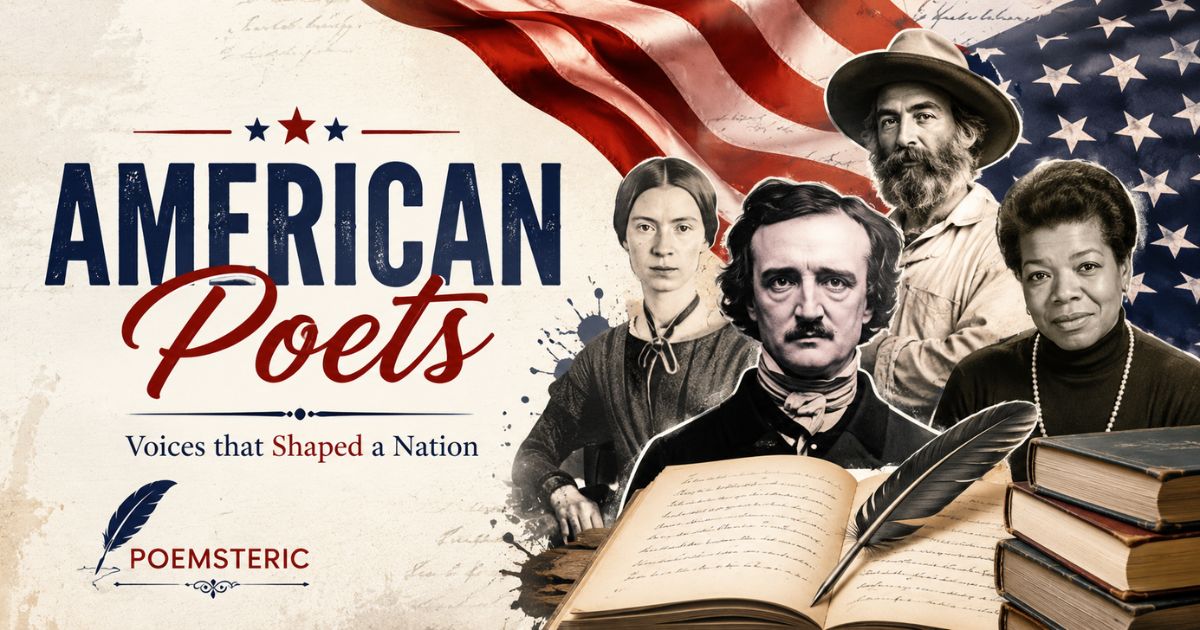
American Poets at a Glance: The Quick Answer
American poets have shaped how the country understands itself, from Walt Whitman’s sprawling celebration of democracy to Amanda Gorman’s 2021 inaugural poem watched by millions. If you want a starting point, the most influential names are Walt Whitman, Emily Dickinson, Robert Frost, Langston Hughes, and Maya Angelou five writers whose work is taught in nearly every American classroom because each one changed what poetry could do. This guide covers fifteen poets total, spanning four centuries, so you can find the voice that speaks to you.
In my own reading over the years, I’ve noticed that people rarely fall in love with “poetry” as a category they fall in love with one poet, then follow the thread. This list is built to give you fifteen possible starting threads.
Key Takeaways
American poetry spans more than 250 years, from Colonial-era verse to today's spoken word scene.

Fifteen poets below represent the major movements: Romanticism, Transcendentalism, Modernism, the Harlem Renaissance, the Beat Generation, Confessional poetry, and contemporary spoken word.

There's no single "most correct" definition of an American poet birthplace, citizenship, and subject matter all play a role, and even literary historians disagree at the edges.

As of 2026, Arthur Sze serves as the 25th U.S. Poet Laureate and the first Asian American to hold the role, continuing into a second term.

The clearest way to start reading American poetry isn't to read a textbook, it's to read one short poem from each poet on this list and notice which one you want to reread.
How to Choose Which American Poet to Read First
Most lists of famous American poets hand you fifteen or twenty names and leave you to guess where to start. That’s the wrong way in. Poetry is one of the few art forms where a single three-minute read can tell you whether a poet is for you, so treat this list like a menu, not a syllabus.
Match the Poet to the Mood You’re In
If you want long, rolling, big-hearted lines about democracy and the human body, start with Whitman. If you want short, strange, precise lines that reward rereading, start with Dickinson. If you want plain language wrapped around devastating clarity, start with Frost or Hughes. Matching mood to style works far better than starting alphabetically or chronologically, because it gets you hooked on one voice before you ever open an anthology.
Start With One Poem, Not One Collection
A common mistake is buying a “Complete Poems” volume and trying to read it cover to cover. As a result, most readers stall out by page thirty. Instead, look up a single, famous poem by each of the fifteen poets below most are available free through the Academy of American Poets at poets.org and read only that one. You’ll know within a page whether you want more.
What Makes Someone an “American” Poet?
This sounds like a simple question, and most articles skip it entirely but it’s genuinely contested. The label usually applies to poets who were born in the United States, hold U.S. citizenship, or built their major body of work while living and publishing in America. However, the edges get blurry fast.
W.H. Auden, for example, was born in England but became a U.S. citizen in 1946 and wrote some of his most famous later work in New York; he’s often included on “American poets” lists despite his British origins. T.S. Eliot moved the opposite direction born in St. Louis, he became a British citizen in 1927, yet he’s still claimed by American literature courses for his early, foundational work. For this list, we’ve focused on poets whose primary body of work is rooted in the American experience, regardless of where they were technically born, because that’s the definition most readers actually mean when they search for “American poets.”
The 15 American Poets Everyone Should Read At Least Once
This list moves roughly chronologically, from the 19th century through today, so you can see how American poetry’s concerns democracy, nature, race, war, identity, grief evolved across generations.
1. Walt Whitman
Walt Whitman (1819–1892) is often called the father of American poetry, and the label holds up. His 1855 collection broke from the rhymed, metered verse of the era in favour of sprawling, unrhymed free verse that mirrored the rhythms of ordinary speech. Whitman’s central subject was democracy itself the dignity of ordinary workers, the equality of all bodies, the interconnectedness of every American regardless of class. He revised and expanded that same book across nine editions over nearly forty years, treating it as a living document rather than a finished work. Readers new to Whitman often find his scale overwhelming at first; the trick is to read a single shorter section rather than the whole sprawling structure in one sitting.
2. Emily Dickinson
Emily Dickinson (1830–1886) wrote almost 1,800 poems during her lifetime and published fewer than a dozen of them. She lived a famously private, reclusive life in Amherst, Massachusetts, and her poetry was discovered and published only after her death. Formally, Dickinson is remarkable for her use of slant rhyme (near-rhymes rather than exact ones), unconventional dashes in place of standard punctuation, and compressed, riddle-like syntax that forces slow reading. Her recurring subjects were death, immortality, nature, and the interior life themes she approached with a precision that still feels startlingly modern more than 130 years later.
3. Edgar Allan Poe
Edgar Allan Poe (1809–1849) is remembered as much for his short fiction as his poetry, but his verse was foundational to American Romanticism and its darker offshoot, sometimes called Dark Romanticism. Poe’s poetry leaned heavily on musicality internal rhyme, repetition, and refrain built to be read aloud. He also worked as a literary critic and editor, and his critical essays on poetic technique shaped how later American poets thought about form. Poe’s personal life was marked by financial hardship and repeated loss, themes that surface again and again in his writing about mortality and grief.
4. Henry Wadsworth Longfellow
Henry Wadsworth Longfellow (1807–1882) was, for decades, the most commercially successful and widely read poet in America a status almost no American poet has matched since. He wrote in traditional rhymed, metered forms and often drew on American history and folklore as subject matter, turning historical events into narrative poems accessible to a broad popular audience. Longfellow was also a serious literary translator, and he was the first American to translate Dante’s Divine Comedy into English. His work fell out of critical fashion in the 20th century as Modernism took hold, but his influence on making poetry a popular, mainstream American art form is hard to overstate.
5. Robert Frost
Robert Frost (1874–1963) is one of the most quoted poets in American history, largely because his plain, conversational language makes complex ideas feel deceptively simple. Frost wrote mostly in traditional forms rhyme and meter even as Modernist contemporaries abandoned both, and his subject matter drew heavily on rural New England life: farms, woods, stone walls, snow. Frost won four Pulitzer Prizes for poetry, more than any other poet, and read a poem at John F. Kennedy’s 1961 presidential inauguration, becoming the first poet to read at a U.S. inauguration.
6. Langston Hughes
Langston Hughes (1901–1967) was a central figure of the Harlem Renaissance, the flowering of Black literary and artistic culture centered in Harlem, New York, during the 1920s. Hughes pioneered what he called “jazz poetry,” writing verse that borrowed the rhythms, repetition, and improvisational feel of blues and jazz music. His work gave voice to everyday Black American life with a directness that was, at the time, genuinely radical he wrote about working people, joy, hardship, and hope without softening any of it for a white literary establishment. Hughes remains one of the most widely taught American poets in schools today.
7. Wallace Stevens
Wallace Stevens (1879–1955) had an unusual career path for a major poet: he worked as an insurance executive in Hartford, Connecticut, for most of his adult life while writing some of American Modernism’s most philosophically dense poetry on the side. Stevens’s work is concerned with the relationship between imagination and reality how the mind shapes what it perceives and his language is often abstract, meditative, and layered with unusual imagery. He didn’t publish his first full collection until age 43, a reminder that major literary careers don’t always follow a predictable timeline.
8. E.E. Cummings
E.E. Cummings (1894–1962) is instantly recognizable by sight before you even read a word his poems break conventional rules of capitalization, punctuation, and line structure, often rendering entire poems in lowercase or scattering words across the page in unconventional shapes. This wasn’t gimmickry; Cummings used unconventional typography deliberately, to slow readers down and force them to notice individual words rather than skim past them. Despite his experimental style, many of his poems deal with traditional subjects love and nature chief among them making his work a good bridge for readers who find pure Modernism intimidating.
9. Sylvia Plath
Sylvia Plath (1932–1963) is the poet most closely associated with the Confessional movement, a style that emerged in the 1950s and treated intensely personal, often painful material mental illness, family conflict, marriage as legitimate poetic subject matter. Plath studied under fellow poet Robert Lowell alongside Anne Sexton, and her posthumously published collection won a Pulitzer Prize, awarded after her death in 1963. Her only novel dealt with similar psychological territory to her poetry. Readers should know Plath died by suicide, and her work engages directly and unflinchingly with depression context that adds weight to reading her, rather than something to read past.
10. Allen Ginsberg
Allen Ginsberg (1926–1997) was the central poetic voice of the Beat Generation, the loose community of mid-20th-century writers who rejected mainstream American conformity in favour of spontaneity, spiritual searching, and social critique. His most famous long poem, first read publicly in San Francisco in 1955, became the subject of an obscenity trial after its 1956 publication a trial the publisher won, in a ruling that meaningfully expanded First Amendment protections for literature in the United States. Ginsberg’s style favoured long, breath-length lines influenced by Whitman, and his subject matter often confronted drugs, sexuality, and mental illness with a directness that shocked 1950s readers.
11. Maya Angelou
Maya Angelou (1928–2014) was a poet, memoirist, and civil rights activist whose 1969 autobiography became a landmark work of American literature. As a poet, Angelou is best known for work that blends personal history with broader themes of Black American resilience, dignity, and survival. In 1993, she read a poem at Bill Clinton’s presidential inauguration, becoming only the second poet in U.S. history to do so at that point, following Robert Frost. Angelou’s accessible, direct style made her one of the most widely read American poets of the late 20th century, reaching audiences well beyond typical poetry readerships.
12. Adrienne Rich
Adrienne Rich (1929–2012) was a poet and essayist whose work moved from formally traditional early poems into increasingly political, feminist territory as her career progressed. Her landmark 1973 collection explored themes of feminism, sexuality, and self-discovery with a directness that reshaped what was considered acceptable subject matter for American poetry. Rich was also a vocal essayist on gender and politics, and in 1997 she publicly declined the National Medal of Arts in protest of congressional votes she disagreed with a rare example of a major American poet using an award refusal as a form of political statement.
13. Robert Lowell
Robert Lowell (1917–1977) is, alongside Plath, one of the founding figures of Confessional poetry, though his own career began in tightly controlled, formally traditional verse before shifting toward more personal, autobiographical material in the late 1950s. Lowell taught workshops that directly shaped Plath and Sexton, making him something of a hinge figure connecting earlier American Modernism to the Confessional movement that followed. He struggled publicly with bipolar disorder, and his later work engaged directly with his own psychiatric hospitalizations material that would have been considered off-limits for poetry just a decade earlier.
14. Gwendolyn Brooks
Gwendolyn Brooks (1917–2000) became, in 1950, the first Black author to win a Pulitzer Prize in any category, for her poetry collection centered on Black life in Chicago’s South Side. Brooks wrote with technical range that spanned traditional forms like the sonnet and ballad alongside freer, more contemporary structures, and her later career grew increasingly engaged with the Black Arts Movement of the 1960s and 70s. She served as Poet Laureate of Illinois for over three decades and remained a mentor to younger Black poets throughout her life, making her influence felt well beyond her own published work.
15. Amanda Gorman
Amanda Gorman (born 1998) is the youngest poet to read at a U.S. presidential inauguration, delivering her poem “The Hill We Climb” at Joe Biden’s 2021 inauguration at age 22. Before that, Gorman had already been named the first National Youth Poet Laureate in 2017. Her work engages directly with contemporary American politics, race, and democracy, written in a performance-driven style clearly shaped by spoken word traditions rather than page-bound Modernism. Gorman represents the newest wave of American poets whose reach extends well beyond traditional literary audiences into broadcast television and mainstream cultural conversation.
Readers who discover Gorman through her inauguration performance sometimes assume spoken word is a brand-new invention. It isn’t its roots run through the Beat Generation’s public readings and further back through oral storytelling traditions that predate written English poetry entirely. What’s genuinely new is the scale of Gorman’s audience, reached live on television rather than in a small auditorium or coffeehouse.
Who Is Considered the Greatest American Poet?
There’s no single official answer, but Walt Whitman and Emily Dickinson are most consistently named together as the twin foundations of American poetry, Whitman for expansive, democratic free verse and Dickinson for compressed, formally radical lyric poetry. Robert Frost and Langston Hughes are frequently added to that short list for their lasting influence on how American poetry sounds and what it’s allowed to say.
Ask a formalist critic and you’ll likely hear Dickinson’s name first, praised for technical precision that rewards decades of rereading. Ask a reader more interested in poetry’s public, civic role and you’ll more often hear Whitman, Hughes, or Angelou poets whose work was explicitly built to be read aloud to large audiences. Both answers are defensible; “greatest” depends heavily on whether you’re measuring technical innovation or cultural reach.
American Poets and Their Role in U.S. Civic Life
One thread competitor articles almost never pull together explicitly: American poets have a real, official role in U.S. political ceremony, and that role has expanded steadily over time. Robert Frost was the first poet to read at a presidential inauguration, appearing at John F. Kennedy’s in 1961. Maya Angelou followed at Bill Clinton’s 1993 inauguration, and Amanda Gorman continued that tradition at Joe Biden’s in 2021 making her the youngest inaugural poet in U.S. history.
Beyond inaugurations, the U.S. Poet Laureate position, administered by the Library of Congress since 1937, formally recognizes one poet as the nation’s poetic representative. As of 2026, that role belongs to Arthur Sze, the 25th person to hold the title and the first Asian American U.S. Poet Laureate, whose second term runs into 2027. Past laureates include Joy Harjo, Tracy K. Smith, and Ada Limón a lineage that shows how the position has increasingly reflected a broader range of American voices and backgrounds over the past two decades. State-level poets laureate exist too, in nearly every U.S. state, extending this civic tradition down to a local level most readers never realize exists.
American Poetry Movements Explained, From Transcendentalism to Spoken Word
Most lists of American poets drop movement labels Romanticism, Modernism, Confessional without ever explaining what actually distinguishes one from another. Here’s a plain-language breakdown:
- Romanticism (early-mid 1800s): Emphasized emotion, nature, and individualism over strict formal rules. Poe is the clearest American example, often skewing toward its darker, more macabre edge.
- Transcendentalism (mid-1800s): A closely related movement centered on the idea that individual intuition and connection to nature reveal deeper truth than institutions or tradition. Whitman absorbed much of this thinking even as he broke from Transcendentalist writers formally.
- Modernism (early-mid 1900s): Rejected traditional rhyme, meter, and sentimentality in favor of fragmented, image-driven, often difficult verse. Stevens and Cummings both worked firmly within this tradition, though in very different styles.
- The Harlem Renaissance (1920s): A flowering of Black artistic and literary culture centered in Harlem, blending jazz rhythms, vernacular speech, and direct engagement with Black American identity. Hughes is its defining poetic voice.
- The Beat Generation (1950s): Rejected mainstream conformity in favour of spontaneity, long unstructured lines, and open engagement with sexuality, drugs, and spirituality. Ginsberg is the movement’s central figure.
- Confessional Poetry (1950s–60s): Turned intensely personal, often painful material mental illness, divorce, family trauma into legitimate poetic subject matter for the first time. Plath and Lowell are its founding figures.
- Spoken Word / Performance Poetry (1980s–present): Poetry written explicitly to be performed aloud, often addressing contemporary social and political issues directly. Gorman’s inaugural poem sits squarely in this tradition.
Understanding these seven movements gives you a map. Once you know which movement a poet belonged to, their formal choices free verse versus rhyme, plain language versus dense imagery start to make a lot more sense. It also explains why two poets writing about the same subject, like grief or nature, can sound completely different: Poe’s Romanticism reaches for music and atmosphere, while Lowell’s Confessionalism reaches for blunt, documentary honesty. Neither approach is more “correct” they’re answering different questions about what poetry is for.
FAQs
Q: Who is considered the father of American poetry?
A: Walt Whitman is most commonly called the father of American poetry. His 1855 collection broke from traditional rhyme and meter in favor of free verse built around the rhythms of everyday speech, and his focus on democracy, equality, and the dignity of ordinary Americans influenced nearly every major American poet who followed him, from Hughes to Ginsberg.
Q: Who are the most famous American poets today?
A: Contemporary American poets with wide public recognition include Amanda Gorman, known for her 2021 inaugural poem, and Arthur Sze, the current U.S. Poet Laureate as of 2026. Recent past laureates Ada Limón, Joy Harjo, and Tracy K. Smith have also brought significant mainstream attention to modern American poets over the past decade.
Q: What’s the difference between a famous poet and an influential poet?
A: Fame reflects public recognition, while influence reflects how much a poet changed the craft itself. Emily Dickinson had almost no public fame during her lifetime, yet she’s among the most influential American poets ever, because her formal innovations slant rhyme, unconventional punctuation reshaped what later poets believed poetry could do.
Q: How many poems did Emily Dickinson actually publish while alive?
A: Emily Dickinson wrote nearly 1,800 poems but published fewer than a dozen during her lifetime, mostly anonymously and often altered by editors without her consent. The vast majority of her work was discovered and published posthumously by her family, which is part of why her full influence on American poetry wasn’t recognized until decades after her death.
Q: Do American poets still read at presidential inaugurations?
A: Not every president invites a poet, but the tradition that began with Robert Frost in 1961 has continued intermittently, including Maya Angelou in 1993 and Amanda Gorman in 2021. When it happens, it remains one of the most visible moments American poets get in front of a truly mass audience.
Q: What should I read first if I’m new to American poetry?
A: Start with one short, well-known poem rather than a full collection. Whitman, Frost, or Hughes are good entry points because their language is direct and accessible, while Dickinson rewards readers who enjoy short, puzzle-like poems that unfold slowly on rereading.
Final Thoughts
American poetry doesn’t have one center of gravity it has fifteen, at minimum, and probably hundreds more once you look past the most famous names. What connects Whitman’s sprawling free verse to Gorman’s spoken-word cadence, more than a century and a half apart, is a shared instinct to use plain American language to say something true about democracy, identity, and belonging. As a result, this genre rewards curiosity more than completism.
If you only do one thing after reading this guide, pick the poet whose one-line description above made you curious, and read a single poem by them today. That’s how most lifelong readers of American poetry actually got started not with a syllabus, but with one poem that wouldn’t let go.
Recent Article : Structural Poetry Explained: Definition, Types & Analysis Guide

Jennifer Aston is a passionate poetry curator and writer with a deep love for the written word. She believes poetry has the power to heal, inspire, and connect people across all walks of life. Through PoemSteric, she brings together timeless and modern verses for every emotion and every moment.