
Introduction
Every poem you have ever loved, from a three-line haiku about falling snow to a fourteen-line sonnet about heartbreak, follows some kind of blueprint. That blueprint is what we call a poetic structure, and understanding it changes the way you read and write forever. If you have ever wondered why some poems rhyme in a strict pattern while others flow freely across the page, you are really asking about poetry forms.
This guide breaks down exactly what these structures are, why poets choose one over another, and how you can start experimenting with them today, even if you have never written a single verse before. We will walk through the most common structures, compare them side by side, and give you a practical step-by-step method for trying your hand at each one.
Whether you are a student working on a class assignment, a hobbyist filling a personal journal, or a content creator building a poetry blog, this guide is built to be the only resource you need on the topic. No fluff, no recycled definitions copied from a textbook, just a clear and honest walkthrough written from real experience reading and writing verse across dozens of traditions.
Key Takeaways
Before we go deep into definitions and examples, here is a quick snapshot of what you will walk away with after reading this guide.
•A poetic structure is a set of rules or a deliberate absence of rules that shapes how a poem looks and sounds.

•Some structures rely on strict rhyme schemes and syllable counts (haiku, sonnet), while free verse rejects rules entirely.

•The right structure depends on your message, your intended emotion, and how much creative freedom you want.

•Beginners find more success starting with short, rule-light structures before attempting a sestina or villanelle.

•A comparison table later in this guide lets you match rhyme scheme, line count, and difficulty in seconds.
By the end, you should be able to identify a structure just by reading a poem, and confidently pick one to write your own piece in under ten minutes.
What Are Poetry Forms?
At its simplest, a poetic structure refers to the technical shape of a poem, its line count, rhyme scheme, meter, and stanza pattern. Think of it the way you would think of a recipe. A recipe tells you the ingredients and the exact steps needed to produce a dish, while the final flavor still depends on the cook. In the same way, a poetic structure gives a poet a container, a set of boundaries within which the words, images, and emotions are free to move.
Some containers are extremely tight, like the haiku with its five-seven-five syllable pattern, while others are loose enough to barely qualify as a container at all, like free verse. Structures exist for a reason beyond tradition; they train a writer to think more carefully about word choice, since every syllable and rhyme has to earn its place. They also create a satisfying rhythm for the reader, the same way a chorus in a song creates anticipation and payoff.
Many readers who claim they do not like poetry actually just have not encountered a structure that resonates with how their brain processes rhythm and repetition, which is exactly why exploring different options matters so much for both readers and writers.
Poetry Forms vs Poem Types
People often use these two terms interchangeably, but there is a subtle distinction worth understanding. A poem type usually refers to the subject matter or purpose of a poem: a love poem, an elegy, a nature poem. A structure, on the other hand, refers strictly to the technical shape, regardless of subject. A sonnet can be a love poem or a war poem. A haiku can describe a garden or a city street. Once you separate subject from shape in your mind, choosing how to write becomes a two-part decision rather than one confusing blur.
Why Poetry Forms Matter for Every Writer
It is tempting to think that structure only matters for academic poets or students preparing for an exam, but that could not be further from the truth. Structure matters because constraints spark creativity rather than smother it. When a writer is told they can write about anything in any way, the blank page becomes intimidating. When a writer is instead told they have fourteen lines, a specific rhyme scheme, and a turn in argument at line nine, suddenly the challenge becomes a puzzle rather than a void.
This is the same reason songwriters thrive within a verse-chorus-verse structure instead of writing formless audio. Beyond the creative benefit, learning different structures also builds a technical vocabulary that helps you read published poetry with far more appreciation. Once you know what a refrain is, or what a volta means in a sonnet, entire poems that once felt confusing suddenly click into place.
For content creators and bloggers, this matters commercially too, because readers searching for specific structures such as a wedding poem structure or a sympathy poem structure are looking for practical guidance, not vague inspiration. Meeting that specific need with real technical detail, rather than generic filler, is what separates a trusted poetry resource from a forgettable one. Finally, structure preserves cultural history. Forms like the ghazal, the tanka, and the villanelle carry centuries of tradition from specific cultures and languages, and understanding their rules is a small act of respecting that heritage while still making the form your own.
Closed Form vs Open Form Poetry Explained
One of the most useful ways to organize the dozens of existing structures is to split them into two broad camps: closed form and open form. Understanding this split first will make every individual structure easier to slot into place later in this guide.
Fixed Structure Forms
Closed form poetry follows a predetermined pattern of rhyme, meter, or line count that the poet must obey. Sonnets, villanelles, sestinas, and haiku all fall into this camp. Writing in a fixed structure feels similar to solving a crossword puzzle, since you are working backward and forward simultaneously to make the meaning fit the constraint. Poets who enjoy fixed structures often say the constraint pushes them toward more original word choices, because the obvious word rarely fits the required syllable count or rhyme.
Free-Flowing Structure Forms
Open form poetry, commonly called free verse, has no required rhyme scheme, meter, or line count. The poet decides where each line breaks based on breath, emphasis, or visual impact on the page. Walt Whitman is often credited with popularizing this style in English-language poetry, and it remains the dominant style in contemporary literary magazines today. Open form does not mean an absence of craft, skilled free verse still uses rhythm, repetition, and careful line breaks to create the same emotional impact a rhymed structure achieves through rhyme.
12 Common Poetry Forms Every Poet Should Know
Now that you understand the closed versus open divide, here is a practical rundown of the structures you are most likely to encounter or want to try first. Each one below includes its defining rule and a note on difficulty level for a first-time writer.
Fixed Rhyme Forms
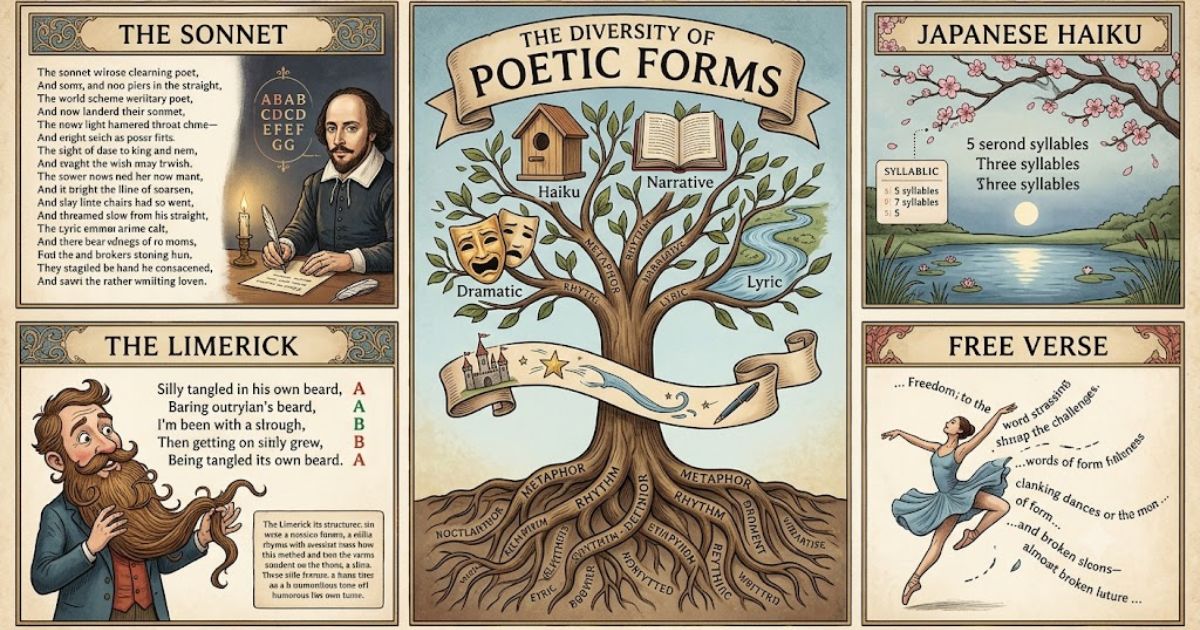
The sonnet is a fourteen-line structure traditionally written in iambic pentameter, most famously associated with Shakespeare, and typically built around a single argument that shifts direction near the end. The haiku is a three-line Japanese structure using a five-seven-five syllable count, traditionally focused on nature and a single fleeting moment. The villanelle repeats two refrain lines throughout nineteen total lines, creating a haunting, obsessive quality well suited to grief or longing.
The sestina is a demanding six-stanza structure that repeats the same six end words in a rotating pattern across thirty-nine lines, making it one of the hardest structures for a beginner to attempt successfully. The limerick uses a bouncy five-line structure with an AABBA rhyme scheme, almost always reserved for humor or absurdity. The pantoum repeats entire lines from the previous stanza in the next, creating an echo effect that feels dreamlike when read aloud.
Narrative & Story-Driven Forms
The ballad tells a complete story, often involving tragedy, adventure, or romance, using simple quatrains and a strong rhythmic pulse originally meant to be sung. The ode is a formal, often celebratory structure praising a person, object, or idea, typically written in an elevated tone. The elegy mourns someone who has died, balancing sorrow with a search for meaning or comfort by the closing lines.
The acrostic spells a word or phrase using the first letter of each line, making it an accessible entry point for younger writers or beginners. The concrete structure arranges words visually on the page so the shape mirrors the subject, such as a poem about a tree shaped like branches. Free verse rounds out the list as the structure with no fixed rules at all, relying entirely on the poet’s instinct for rhythm and line breaks.
How to Choose the Right Poetry Form for Your Message
Choosing the correct structure starts with asking what emotion or message you want the reader to walk away with. If you are processing grief, a villanelle or an elegy naturally supports repetition and lingering sorrow. If you want to celebrate someone, an ode gives you a formal, elevated container that feels appropriately special. If your goal is simply to capture one clear image or moment, a haiku forces the economy of language that makes that single image shine.
If you are writing for children or beginners, an acrostic or a limerick offers an easy entry point with built-in rules that are simple to follow. Consider also your comfort with constraint. Writers who enjoy puzzles and technical challenges tend to gravitate toward the sestina or the villanelle, while writers who prefer emotional spontaneity often find more comfort in free verse.
There is no wrong choice here, only a better or worse fit for what you are trying to say. A useful practical exercise is to write the same idea twice: once in a strict structure and once in free verse then compare which version feels more honest to what you intended. This single exercise teaches more about structure than reading ten definitions ever could.
Step-by-Step Guide: How to Write in Any Poetic Form
•Step 1: Pick your structure based on the emotional guidance above rather than picking randomly.
•Step 2: Research the exact technical rules of that structure line count, syllable count, rhyme scheme and write them down where you can see them while drafting.
•Step 3: Choose your subject and write a single sentence describing exactly what you want the reader to feel by the final line.
•Step 4: Draft freely without worrying about the rules on your first pass, simply getting the raw images and emotions onto the page.
•Step 5: Revise your draft to fit the technical requirements of the structure, trimming or expanding lines as needed.
•Step 6: Read the poem aloud, since rhythm problems are far easier to hear than to see on the page.
•Step 7: Ask whether every single word is earning its place, since structures with strict syllable counts have no room for filler.
•Step 8: Share the finished piece, or set it aside for a day before a final read, since distance almost always reveals small improvements you missed while drafting.
Poetry Forms Comparison Table: Structure, Rhyme & Difficulty
Sometimes the fastest way to compare structures is to see them side by side rather than reading paragraph after paragraph. The table below lists the six most-requested structures alongside their defining features and a beginner-friendly difficulty rating. Use it as a quick decision tool whenever you are staring at a blank page and unsure where to begin, since matching your available time and patience to the correct difficulty rating prevents the frustration of abandoning a draft halfway through.
Form Line Count Rhyme Scheme Difficulty
Sonnet 14 lines ABABCDCDEFEFGG Moderate
Haiku 3 lines None (5-7-5 syllables) Easy
Villanelle 19 lines 2 repeating refrains Hard
Sestina 39 lines 6 rotating end words Very Hard
Limerick 5 lines AABBA Easy
Ballad Variable quatrains ABCB Moderate
Common Mistakes Beginners Make With Poetry Forms
The most frequent mistake is forcing a rhyme at the expense of meaning, producing a line that sounds awkward simply because it needed to end in a specific sound. A far better approach is adjusting word order or choosing a synonym before sacrificing clarity for rhyme.
The second common mistake is miscounting syllables in structures like the haiku, especially when a word has a silent syllable or regional pronunciation difference. Reading the line aloud slowly while tapping out each syllable solves this instantly. The third mistake is choosing an overly demanding structure, such as the sestina, as a first attempt, which often leads to frustration and abandoned drafts. Starting with a haiku or an acrostic builds confidence before tackling anything more technical.
The fourth mistake is ignoring the emotional tone that a structure traditionally carries, such as writing a comedic subject inside a solemn villanelle, which can create unintended dissonance unless that clash is the deliberate point. Finally, many beginners skip reading strong published examples before attempting a structure themselves, which is similar to trying to bake bread without ever tasting a good loaf. Reading three or four strong examples of any structure before writing your own dramatically shortens the learning curve.
Best Poetry Forms for Beginners vs Advanced Poets
If you are brand new to writing verse, start with the haiku, the acrostic, or the limerick, since all three have short, clear rules that produce a finished piece within minutes rather than hours. These shorter structures build confidence quickly and teach fundamental skills like word economy and rhythm without overwhelming a new writer with too many simultaneous rules.
Once you feel comfortable, the sonnet is a natural next step, since it introduces meter and a more complex rhyme scheme while still staying within a single manageable page. For writers who have already mastered several structures and want a genuine technical challenge, the villanelle and the sestina represent the top tier of difficulty, demanding careful planning before a single line is drafted.
Advanced writers often use spreadsheets or notecards to track which end words or refrains need to appear in which stanza, since attempting to hold the entire pattern in memory usually leads to errors. Regardless of your current skill level, the healthiest approach is treating every attempt as practice rather than a finished masterpiece, since even celebrated poets typically draft a structured poem many times before reaching a version they are satisfied with.
Poetry Forms in Modern and Digital Writing
Traditional structures have found surprising new life across modern platforms, from Instagram captions written as miniature free verse to TikTok poetry readings that favor short, punchy structures like the haiku for their brevity. Spoken word and slam poetry borrow heavily from ballad and narrative traditions, using strong rhythm and repetition to hold a live audience’s attention in ways that mirror how these structures were originally meant to be performed aloud centuries ago.
Meanwhile, blogs and content platforms dedicated to poetry increasingly pair a specific structure with a specific life occasion, such as a sympathy structure for a funeral card or a celebratory ode-style piece for a graduation, meeting very specific search intent that older poetry anthologies never anticipated. This blending of old technical rules with new digital contexts proves that structure is not a relic of the past but a living toolkit that continues adapting to however people choose to communicate today, whether that is a printed book, a greeting card, or a fifteen-second video caption.
FAQs
Q: What are the most common poetry forms?
A: The most common poetry forms include the sonnet, haiku, villanelle, sestina, limerick, ballad, ode, and elegy. Each follows its own rule for line count, rhyme scheme, or repetition. Poetry forms range from very strict structures, like the sestina with its rotating end words, to completely open ones like free verse, so the “most common” answer depends on whether you mean most taught in schools or most seen in modern published collections.
Q: How many poetry forms are there in total?
A: There is no single fixed number, since poets continue inventing new nonce forms alongside centuries-old traditional ones. Reference lists commonly cited by writing communities range anywhere from around 50 well-known poetry forms up to 150 or more once regional and historical variations are included. For everyday writing purposes, learning around 12 to 15 core forms covers the vast majority of what most poets will ever need.
Q: What is the difference between a poem type and a poetic form?
A: A poem type describes the subject or purpose of a poem, such as a love poem or a nature poem, while a poetic form describes its technical shape, such as line count and rhyme scheme. The same poetic form can be used to write completely different poem types. Understanding this distinction makes it much easier to plan a poem, since you choose your subject and your structure as two separate decisions.
Q: Which poetry form is best for beginners?
A: The haiku, acrostic, and limerick are widely considered the best poetry forms for beginners because their rules are short, clear, and produce a complete poem in just a few minutes. These forms teach essential skills like word economy and rhythm without the heavier technical demands of a sonnet or villanelle, making them the ideal starting point before attempting more advanced structures.
Q: Do poetry forms have to rhyme?
A: No, not all poetry forms require rhyme. Structures like the haiku and free verse rely on syllable count or natural rhythm rather than end rhyme, while forms like the sonnet, limerick, and villanelle do require a specific rhyme scheme. Whether a poem needs to rhyme depends entirely on which of the many poetry forms a writer chooses for their piece.
Final Thoughts
Learning the full landscape of poetic structures is less about memorizing rigid rules and more about building a toolkit you can reach into whenever you need the right container for what you want to say. Start small with something like a haiku, experiment with the emotional weight of an ode or an elegy when the moment calls for it, and eventually challenge yourself with the technical demands of a villanelle or a sestina once you are ready.
There is no single correct entry point, only the structure that best matches the feeling you are trying to capture today. The more structures you try, the more instinctively you will recognize which one fits a given idea before you even begin drafting, and that instinct is really the entire goal of studying this topic in the first place.
Recent Article : 7 Spoken Word Poetry Lines That Refuse to Stay Silent

Jennifer Aston is a passionate poetry curator and writer with a deep love for the written word. She believes poetry has the power to heal, inspire, and connect people across all walks of life. Through PoemSteric, she brings together timeless and modern verses for every emotion and every moment.