
Introduction
Have you ever read a poem and felt like you were watching a movie unfold, line by line? That’s the magic of narrative poetry: poems don’t just describe a feeling, they tell you a story, complete with characters, conflict, and an ending that stays with you long after you’ve closed the book.
I still remember the first time a narrative poem actually gripped me. It was “The Raven” by Edgar Allan Poe, read aloud in a dim classroom on a rainy afternoon. By the second stanza, nobody was checking the clock. That’s the real power of this genre: it turns poetry from something you analyze into something you experience.
This guide is built to be the only resource you need on narrative poetry poems. We’ll define the genre in plain English, walk through its history, break down every major type (epic, ballad, idyll, and lay), and hand you 30+ real examples spanning ancient epics to modern verse. You’ll also learn how to spot a narrative poem instantly and how to write your own, step by step.
Whether you’re a student prepping for an exam, a teacher building a lesson plan, or simply someone who loves a good story told in verse, you’re in the right place. No fluff, no recycled definitions, just a clear, complete, and genuinely useful walkthrough of narrative poetry poems.
Key Takeaways
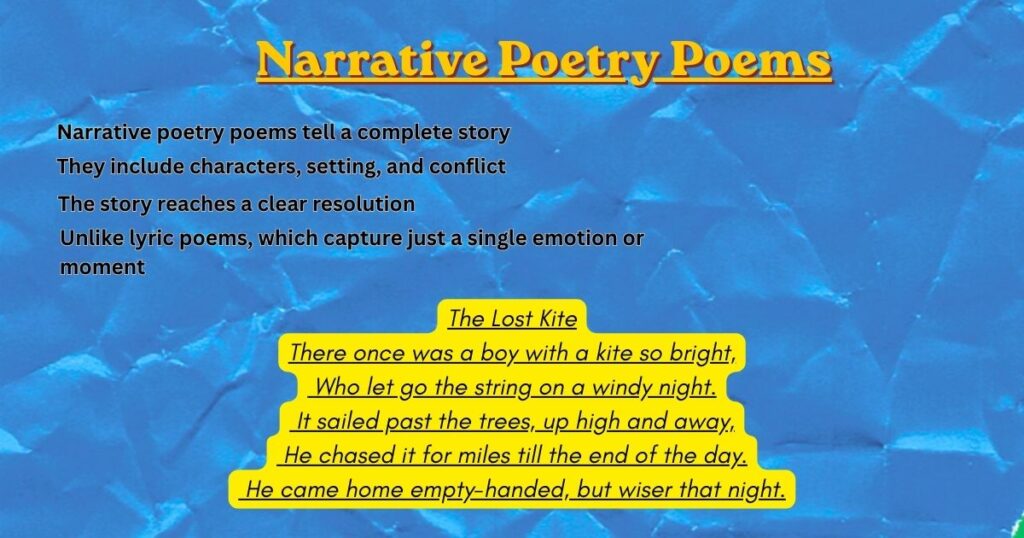
Narrative poetry poems are poems that tell a complete story with characters, setting, conflict, and resolution unlike lyric poems, which  capture a single emotion or moment.

The four main traditional types are epic, ballad, idyll, and lay, each with its own structure, length, and purpose.

Narrative poetry dates back to oral storytelling traditions thousands of years old, long before written language existed.

Famous examples range from The Iliad and The Odyssey to The Raven and The Charge of the Light Brigade.

You can identify a narrative poem in seconds by checking for three things: a narrator, a plot, and characters.

Writing your own narrative poem follows a repeatable process: pick a story, choose a structure, draft it, and revise for rhythm and clarity.

Narrative poetry isn't just a historical relic; modern poets still use it to process real, contemporary experiences.
What Are Narrative Poetry Poems? (Definition & Meaning)
At its core, a narrative poem is exactly what it sounds like: a poem that narrates meaning it tells a story from start to finish. Unlike a diary entry disguised as verse, a true narrative poem has a beginning, a middle, and an end, and it’s built around events happening to specific characters.
Think of it as the intersection between a short story and a poem. You get the emotional compression and rhythm of poetry, combined with the plot, tension, and payoff of fiction. That combination is exactly why narrative poetry poems have survived for thousands of years; they satisfy two very different cravings at once: our love of rhythm and our love of story.
Some narrative poems are massive, spanning entire books (like The Odyssey). Others are just a few stanzas long, telling a complete story in under a minute of reading time. Length isn’t what defines the genre structure.
Key Elements Every Narrative Poem Contains
If you’re trying to determine whether something qualifies as a narrative poem, check for these five ingredients:
- A narrator or speaker is someone (or something) telling the story, whether it’s a character inside the poem or an outside voice.
- Characters at least one person, creature, or entity the story revolves around.
- A plot of a clear sequence of events with a beginning, middle, and end.
- Setting a time and place where the action unfolds.
- Conflict and resolution most (though not all) narrative poems build tension and then resolve it, just like a short story would.
If a poem is missing the plot and characters, it’s probably lyric poetry instead which brings us to the next distinction, one that trips up even experienced readers.
Narrative Poetry vs. Lyric Poetry: What’s the Real Difference?
This is one of the most commonly searched questions about the topic, and yet it rarely gets a clear answer. Here’s the simplest way to think about it: narrative poetry tells a story; lyric poetry captures a feeling.
A lyric poem might describe the exact sensation of grief, joy, or longing in a single moment, no characters required, no plot needed. A narrative poem, on the other hand, needs an actual sequence of events. “The Raven” is narrative because a man is visited by a bird and slowly unravels over the course of the poem. A poem simply describing loneliness, with no events or characters, would be lyric.
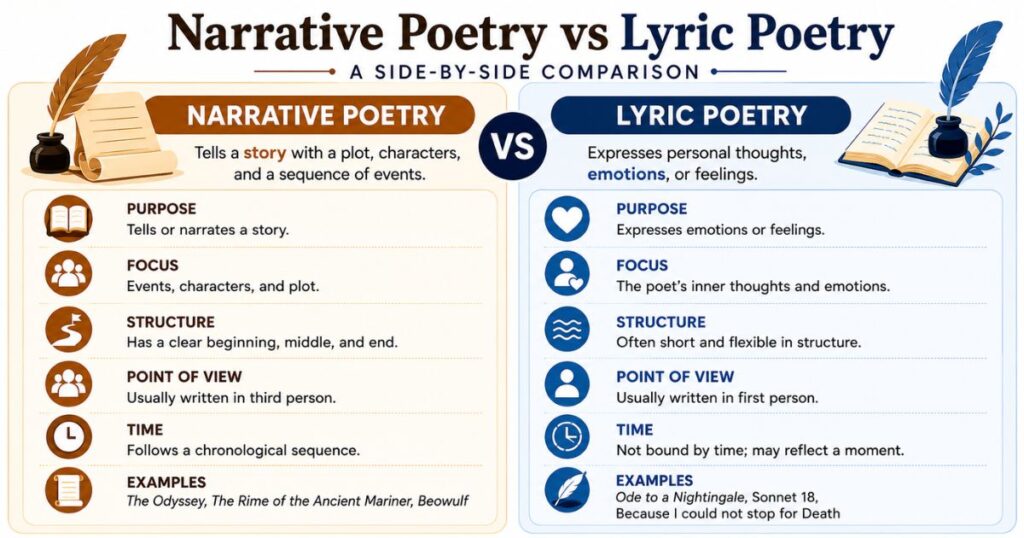
Some poems blend both this is often called “lyric narrative” poetry but for a poem to be classified as purely narrative, the storytelling elements have to be front and center, not just implied.
A Brief History of Narrative Poetry Poems (Oral Tradition to Today)
Long before anyone could read or write, narrative poetry was already doing serious work. Ancient cultures used story-poems as a memory device: rhythm, repetition, and rhyme made long, complex stories easier to memorize and pass down accurately across generations. This is exactly how epics like The Iliad and The Odyssey survived for centuries before they were ever written down.
Storytellers, or bards, would recite these poems aloud at gatherings, often accompanied by music. The structure wasn’t just artistic, it was practical. A strong rhythm and predictable rhyme scheme made a 10,000-line poem far easier to remember than plain prose ever could be.
As written language spread, narrative poetry didn’t disappear; it evolved. Medieval Europe gave us folk ballads and Arthurian romances like Tennyson’s Idylls of the King. The 19th century produced some of the genre’s most iconic (and most quoted) work, including Poe’s The Raven and Tennyson’s The Charge of the Light Brigade. Even into the 20th century, poets like Robert Frost used narrative structure to tell devastating, compact stories in poems like Out, Out.
Today, narrative poetry poems live on in spoken word, slam poetry, and verse novels proof that our appetite for a well-told story in rhythmic form hasn’t faded one bit, it’s just changed venues.
Types of Narrative Poems: Epic, Ballad, Idyll & Lay Explained
Not all narrative poems are built the same way. Traditionally, they fall into four major categories, each with its own scale, tone, and purpose.
Epic Poems: The Grand, Larger-Than-Life Stories
Epic poems are the heavyweight champions of narrative poetry, long, formal, and typically centered on a hero undertaking a dangerous journey or battle with enormous stakes. The Iliad and The Odyssey, both attributed to Homer, are the textbook examples. They involve gods, monumental conflict, and journeys that span years.
Epics are usually written in a consistent meter (Homer famously used dactylic hexameter) and often open with an invocation to a muse or higher power, a structural tradition that later epics, like Milton’s Paradise Lost, continued for centuries.
Ballad Poems: Songs That Tell a Story
Ballads are shorter, more musical, and historically meant to be sung rather than just read. They often use a simple rhyme scheme (commonly ABCB) and repeated refrains, making them easy to memorize and pass along orally much like a folk song. Edna St. Vincent Millay’s Ballad of the Harp Weaver is a perfect example: a mother’s sacrifice for her son, told with the emotional punch and rhythm of a lullaby gone tragic.
Beyond epics and ballads, two other forms round out the traditional list:
- Idyll’s shorter narrative poems, often pastoral or romantic in tone, focused on a single episode rather than a sprawling saga. Tennyson’s Idylls of the King is the most famous modern example, despite technically being an extended collection.
- Lays medieval narrative poems, typically shorter than epics, often centered on romance or adventure, popular in French and English medieval literature.
Understanding these four categories makes it far easier to classify any narrative poem you come across and to appreciate why a 700-line epic and a 12-line ballad can both belong to the same genre.
Famous Narrative Poetry Poems Everyone Should Know
Some narrative poems have become so iconic that their opening lines are recognizable even to people who don’t read poetry regularly. These are the ones worth starting with if you’re new to the genre.
“The Raven” by Edgar Allan Poe
A grieving man is visited by a talking raven that repeats a single haunting word, “Nevermore,” as he spirals deeper into despair over his lost love, Lenore. It’s dark, musical, and endlessly quotable.
“The Charge of the Light Brigade” by Alfred, Lord Tennyson
Based on a real, catastrophic military blunder during the Crimean War, this poem captures the tragic bravery of 600 soldiers who rode into near-certain death because of a miscommunicated order.
“The Iliad” and “The Odyssey” by Homer
The foundational epics of Western literature. One is about the rage of Achilles during the Trojan War; the other follows Odysseus’s ten-year journey home. Both remain required reading in classrooms worldwide for good reason.
“Idylls of the King: The Passing of Arthur” by Alfred, Lord Tennyson
A poetic retelling of King Arthur’s final battle and death, rich with mystery, loyalty, and loss.
“Annabel Lee” by Edgar Allan Poe
Poe’s last completed poem, mourning a young love taken too soon, with the narrator insisting their bond was too powerful for even death to break.
Each of these examples proves the same point: narrative poetry poems don’t age out of relevance. Centuries later, they still make readers feel something immediate and real.
Short Narrative Poems: Quick Reads With Big Impact
Not every narrative poem needs 10,000 lines to land an emotional punch. Short narrative poems prove that a complete story beginning, middle, and end can happen in a dozen lines or fewer, as long as every word is pulling weight.
Take a poem like “The Kill” by Jennifer L. Betts, which tells the story of a child’s first deer hunt. There’s no wasted setup. It drops you straight into the tension of the moment, builds anticipation with short, clipped lines, and resolves with a single decisive action. That’s the skill of short narrative poetry economy. Every line has to move the story forward because there’s no room for filler.
Robert Frost’s Out, Out is another masterclass in brevity. In under 40 lines, it tells the complete story of a boy’s accidental death on a farm, using plain, understated language that makes the tragedy land even harder. There’s no dramatic flourish, just quiet, devastating detail.
If you’re new to writing narrative poetry, short poems are actually the best place to start. Trying to write an epic before you’ve written a short story-poem is like trying to run a marathon before you’ve jogged a mile. Start small: pick one moment, one character, one decision, and tell it completely in 10–20 lines. You’ll learn the mechanics of narrative structure far faster than if you tried to tackle something epic-length first.
Narrative Poems for Kids and Beginners
Narrative poetry is one of the best genres for introducing children to poetry, precisely because kids already love stories. Instead of asking a child to appreciate abstract imagery or emotional metaphor, a narrative poem gives them something familiar: a beginning, a problem, and an ending.
Poems written for kids in this genre often lean into whimsy princesses, animals, adventures, and gentle humor. “No Prince Needed” by Jennifer L. Betts is a great modern example: it flips the classic fairy-tale rescue trope by having the princess save herself, wrapped in playful rhyme that keeps young readers engaged from the first line to the last.
If you’re a parent or teacher looking to introduce narrative poetry to a child, here’s a simple approach that works well:
- Start with a poem under 20 lines so attention doesn’t wander.
- Read it aloud first narrative poems were built for the ear as much as the eye.
- Ask three questions afterward: Who was the poem about? What happened? How did it end? This reinforces that a narrative poem is, at its core, a story.
- Encourage them to write their own four-line story-poem about something that happened to them that day.
This approach turns narrative poetry from a “school assignment” into something closer to a game and it’s often the gateway that gets a lifelong reader hooked on poetry in general.
Modern and Contemporary Narrative Poems Worth Reading
It’s a common myth that narrative poetry died out with Tennyson and Poe. In reality, contemporary poets are still using story-driven verse to process very modern experiences of grief, identity, trauma, and everyday life just with a fresher voice and looser structure.
Poets like Sharon Olds have used narrative poetry as a way of reclaiming difficult personal history, essentially becoming the narrator of their own story rather than letting it be told for them. Verse novels full-length narratives told entirely in poetic form have also surged in popularity, particularly in young adult literature. Jacqueline Woodson’s Brown Girl Dreaming, a memoir told through narrative verse, is a widely celebrated example that brought the genre to a whole new generation of readers.
Contemporary narrative poetry also shows up in unexpected places: spoken word competitions, slam poetry events, and even song lyrics that lean heavily on storytelling structure. The rhyme schemes are often looser, the language more conversational, but the core DNA narrator, character, plot, resolution remains exactly the same as it was in Homer’s time.
This matters because it proves narrative poetry isn’t a museum piece. It’s a living, evolving format that each generation reshapes to tell its own stories, in its own voice, using the same storytelling bones that have worked for thousands of years.
How to Identify a Narrative Poem in 10 Seconds
Here’s a fast, practical test you can run on any poem to check if it qualifies as narrative:
- Ask: Is someone telling a story here? If yes, keep going. If the poem is just describing a feeling or image with no events, it’s likely lyric poetry instead.
- Look for characters. Even one character is enough; a narrator alone doesn’t count unless they’re also part of the action.
- Check for a timeline. Does something happen, and then something else happens as a result? That cause-and-effect chain is the fingerprint of narrative structure.
- Look for an ending. Narrative poems typically resolve even if the resolution is tragic or ambiguous, something concludes.
If a poem checks all four boxes, you’re safely looking at a narrative poem. This quick test is especially useful for students skimming an anthology or trying to classify a poem for an assignment without reading a 20-page critical essay first.
Step-by-Step: How to Write Your Own Narrative Poem
Writing a narrative poem feels intimidating until you realize it follows the same basic bones as writing a short story: you’re just compressing it into verse.
Steps 1–3: Planning Your Story Before You Write
Choose your story
Pick something small and specific for a single event, not an entire life. A first day at a new job, a childhood memory, a moment of fear or courage. Small stories, told well, hit harder than sprawling ones told poorly.
Identify your narrator
Decide who’s telling the story. Is it a character inside the events (first-person), or an outside voice narrating what happened (third-person)? This choice shapes the entire tone of the poem.
Map the arc
Even a 10-line poem needs a beginning, a turning point, and an ending. Jot down these three beats before you write a single line of verse; it’ll save you from a poem that meanders without ever landing anywhere.
Steps 4–6: Drafting, Rhythm, and Revising
Draft without worrying about rhyme
Get the story down in plain language first. Rhyme and meter can come later chasing a rhyme scheme too early often forces you into clunky, unnatural phrasing.
Add rhythm and sound
Once the story is solid, go back and shape the language. Consider a consistent meter, a rhyme scheme (ABCB is a forgiving, beginner-friendly option), or repeated lines for emphasis on all classic tools borrowed from ballad tradition.
Cut ruthlessly
Narrative poems earn their power through compression. If a line isn’t moving the plot or deepening a character, cut it, even if you love the phrasing. Read it aloud one final time narrative poetry, remember, was born to be spoken.
30+ Narrative Poetry Poems Examples List (Bookmark This)
Here’s a comprehensive list spanning centuries, styles, and reading levels perfect for study, teaching, or simply expanding your reading list:
The Iliad by Homer
The Odyssey by Homer
The Raven by Edgar Allan Poe
Annabel Lee by Edgar Allan Poe
The Charge of the Light Brigade by Alfred, Lord Tennyson
Idylls of the King: The Passing of Arthur by Alfred, Lord Tennyson
Ballad of the Harp Weaver by Edna St. Vincent Millay
The Rime of the Ancient Mariner by Samuel Taylor Coleridge
Out, Out by Robert Frost
Paul Revere’s Ride by Henry Wadsworth Longfellow
The Canterbury Tales (General Prologue) by Geoffrey Chaucer
Beowulf by Unknown Author
Christabel by Samuel Taylor Coleridge
Goblin Market by Christina Rossetti
Mariana by Alfred, Lord Tennyson
The Ballad of Reading Gaol by Oscar Wilde
We Are Seven by William Wordsworth
The Eve of St. Agnes by John Keats
Don Juan by Lord Byron
Eugene Onegin by Alexander Pushkin
Aurora Leigh by Elizabeth Barrett Browning
The Ring and the Book by Robert Browning
A Visit from St. Nicholas by Clement Clarke Moore
Not Waving but Drowning by Stevie Smith
Marmion (Marmion and Douglas) by Sir Walter Scott
The Minuet by Mary Mapes Dodge
The Spell of the Yukon by Robert Service
The Cremation of Sam McGee by Robert Service
The Kill by Jennifer L. Betts
No Prince Needed by Jennifer L. Betts
Brown Girl Dreaming (verse memoir) by Jacqueline Woodson
The Crossover by Kwame Alexander
Liable to Floods by Owen Sheers
This list intentionally mixes ancient epics, Romantic-era classics, and modern verse novels because narrative poetry poems, at every point in history, have always been about the same thing: telling a story that sticks.
Common Mistakes to Avoid When Reading or Writing Narrative Poems
Even experienced readers and writers stumble on a few recurring issues with this genre. Here are the most common ones, and how to avoid them:
Mistake 1: Confusing narrative poetry with lyric poetry
As covered earlier, if a poem has no characters or plot, it’s not narrative no matter how emotionally powerful it is. Mislabeling the genre is one of the most common classroom errors.
Mistake 2: Forcing rhyme before the story is solid
New writers often chase a rhyme scheme from line one, which leads to a poem that sounds forced and loses its narrative thread. Always nail the story first.
Mistake 3: Overloading the poem with too many characters
A 20-line poem can’t sustain five characters with distinct arcs. Keep the cast small, one or two central figures is usually plenty.
Mistake 4: Skipping the resolution
A narrative poem that just stops, without any sense of an ending, leaves readers unsatisfied. Even an ambiguous or open ending needs to feel intentional, not accidental.
Mistake 5: Reading epics the same way you’d read a short poem
Trying to consume something like The Odyssey in one sitting, expecting quick payoff, sets you up for frustration. Long-form narrative poems reward patience; read them the way you’d read a novel, not a haiku.
Avoiding these five mistakes alone will put you ahead of most casual readers and beginner writers tackling this genre for the first time.
Why Narrative Poetry Poems Still Matter Today
In a world of scrolling feeds and 15-second videos, it might seem like narrative poetry, often long, slow, and demanding real attention, shouldn’t have a place anymore. And yet it does, arguably more than ever.
Narrative poetry poems do something few modern formats manage: they combine story with compression. A well-written narrative poem delivers the emotional payoff of a novel in a fraction of the words, forcing every single line to earn its place. In an attention economy, that kind of density is genuinely valuable.
There’s also the human need the genre has always served using story to make sense of experience. Whether it’s Homer explaining the cost of war through Achilles’ rage, or a contemporary poet processing grief through a personal narrative, the function hasn’t changed in three thousand years: turning raw experience into something shaped, shareable, and meaningful.
Finally, narrative poetry remains one of the most effective teaching tools in education, precisely because story is how humans naturally retain information. Long after a student forgets a lyric poem’s imagery, they’ll still remember what happened to the boy and the buzz saw in Out, Out because it’s a story, and stories stick.
FAQs
Q: What are narrative poetry poems?
A: Narrative poetry poems are poems that tell a complete story, including a narrator, characters, a setting, and a clear plot with a beginning, middle, and end. Unlike lyric poetry, which focuses on capturing a single feeling or moment, narrative poetry poems are built around events that unfold over time. Examples range from massive epics like The Iliad to short, modern poems that tell a full story in just a few stanzas.
Q: What is the difference between narrative and lyric poetry?
A: Narrative poetry tells a story with characters and a plot, while lyric poetry expresses a single emotion, thought, or moment without needing events or characters. A narrative poem might follow a soldier through a battle from start to finish; a lyric poem might simply capture the feeling of watching a sunset. Some poems blend both styles, but pure narrative poetry always centers on storytelling.
Q: What are the main types of narrative poems?
A: The four traditional types are epic, ballad, idyll, and lay. Epics are long, formal poems about heroic journeys, like The Odyssey. Ballads are shorter and musical, often meant to be sung. Idylls focus on a single romantic or pastoral episode. Lays are medieval narrative poems, typically shorter than epics, centered on adventure or romance.
Q: What are some famous examples of narrative poetry poems?
A: Some of the most famous narrative poetry poems include The Raven by Edgar Allan Poe, The Charge of the Light Brigade by Alfred, Lord Tennyson, The Iliad and The Odyssey by Homer, and Ballad of the Harp Weaver by Edna St. Vincent Millay. These poems remain widely studied because they combine strong storytelling with memorable, rhythmic language.
Q: How do you write a narrative poem step by step?
A: Start by choosing a small, specific story and deciding who your narrator is. Map out a simple arc, a beginning, turning point, and ending before writing any lines. Draft the story in plain language first, then add rhythm and rhyme. Finally, revise by cutting anything that doesn’t move the plot forward, and read it aloud to check its flow.
Q: Is narrative poetry still written today?
A: Yes. Narrative poetry poems are very much alive today through verse novels, spoken word performances, and slam poetry. Contemporary poets like Jacqueline Woodson and Kwame Alexander use narrative structure to tell personal, modern stories, proving the genre has simply evolved rather than disappeared.
Final Thoughts
Narrative poetry poems sit at a rare intersection: part story, part song, part emotional gut-punch and that combination is exactly why the genre has survived, unbroken, for thousands of years. From Homer’s battlefield epics to a modern verse memoir like Brown Girl Dreaming, the throughline never changes: a narrator, a character, a story worth telling, and language shaped carefully enough to make you feel it.
If you’re new to the genre, don’t start with the 700-line epics. Start small. Read “The Kill” or “No Prince Needed.” Notice how much of the story fits into so few lines. Then, when you’re ready, work your way up to the Homeric epics that started it all.
And if you’ve been inspired to try writing one yourself, good. Pick a small, true moment from your own life, follow the six-step process above, and don’t worry about it being perfect. Every narrative poem on the list above started as someone’s first, imperfect draft too.
Recent Article : Lyric Poem Poetry Explained: Definition, Types & Examples

Jennifer Aston is a passionate poetry curator and writer with a deep love for the written word. She believes poetry has the power to heal, inspire, and connect people across all walks of life. Through PoemSteric, she brings together timeless and modern verses for every emotion and every moment.