
Introduction
Planning a wedding involves hundreds of small decisions, but few feel as personal as choosing the words that will be spoken during the ceremony itself. Wedding poems give couples a way to add depth, emotion, and personality to a day that can otherwise blur into logistics seating charts, vendor calls, and timelines. A well-chosen reading, spoken aloud by a parent, sibling, friend, or the officiant, has the power to slow the room down for sixty seconds and remind everyone why they are there.
This guide brings together more than sixty poems and readings across every style and tone a couple could want: romantic, traditional, short, funny, religious, modern, culturally inclusive, and even a few borrowed from beloved films and television shows. Rather than simply listing titles, each section explains who the poem suits best, when to use it, and why it tends to resonate with real couples and their guests.
Whether you’re searching for a single line for your invitation, a longer reading for the ceremony, or a poem that captures a very specific kind of love story, this collection is built to make that search easier. By the end, you’ll also know exactly how to choose, personalize, and place wedding poems throughout your celebration, not just where to find them.
Key Takeaways
Before diving into the full list, here’s a quick summary of what actually matters when picking readings for your big day:
• Wedding poems work best when they match your relationship’s tone, not just wedding tradition.
• Short readings tend to hold a ceremony crowd’s attention better than long ones.
• Romantic, funny, religious, and modern poems can all appear in the same ceremony if the pacing feels natural.
• Who reads the poem matters as much as the poem itself picks someone comfortable speaking to a crowd.
• Poems can be lightly personalized, as long as you respect the original structure and meaning.
• Inclusive options exist for every kind of love story, including same-sex couples and second marriages.
• Placement matters: some readings suit the ceremony, others suit toasts, programs, or invitations.
Romantic Poems for Wedding Ceremonies and Vows
Romantic wedding poems remain the most requested category for couples building their ceremony, and it’s easy to see why. These are the readings couples turn to when they want their vows to sound as tender as the relationship actually feels. Classic love poetry Shakespeare’s meditations on steadfast love, Elizabeth Barrett Browning’s devotional sonnets, or Pablo Neruda’s quietly intense verses continues to top every list of the best ceremony readings because it speaks to something universal: the decision to choose one person, fully, for the rest of your life.
Contemporary romantic poems have earned their place too. E. E. Cummings is frequently requested for his unconventional structure and intimate tone, which feels less like formal poetry and more like a private conversation between two people. Rumi’s writing on love and unity offers a spiritual, borderless kind of romance that suits interfaith or non-religious ceremonies equally well.
If you’re choosing a romantic wedding poem for your vows specifically, look for lines about partnership rather than pursuit. Verses about steadiness, home, and shared identity tend to land better mid-ceremony than poems about chasing or longing, which suit courtship more than commitment. A simple test: read the poem aloud to your partner in private first. If it makes you feel closer rather than performative, it’s the right one.
Couples renewing their vows after several years together often gravitate toward this category as well, since these poems speak to enduring love rather than new love proof that romantic readings aren’t reserved for first-time brides and grooms alone.
Traditional Poems Rooted in Classic Literature
Not every couple wants a poem written specifically about marriage; sometimes the most moving reading comes from a novel, play, or classic text repurposed for the occasion. Traditional readings drawn from literature carry an emotional weight that feels timeless, largely because the source material has already stood the test of decades or centuries.
Extracts from novels like Jane Eyre, The Great Gatsby, and Les Misérables are increasingly popular as ceremony readings because they capture devotion, hope, and permanence without sounding like a greeting card. Shakespeare’s sonnets remain the anchor of this category Sonnet 116, in particular, is still one of the most requested wedding ceremony poems for couples who want a literary, slightly formal tone.
What makes traditional readings work is context. A line pulled from a novel about long-distance longing or reunion can feel deeply personal if it mirrors your own story, say, a couple who met while living in different countries, or who waited years before getting engaged. Ask your officiant or reader to introduce the extract briefly before reading it aloud; a single sentence of context (“this is from the book that was open on the nightstand the night we met”) turns a borrowed line into something entirely your own.
This category also works well for couples who love books more than poetry collections, since it lets literary fans include their favorite authors without needing the text to be a poem in the traditional sense.
Short Poems for Quick, Meaningful Wedding Readings
Short poems for ceremony use are ideal for couples who want the emotional impact of a reading without stretching out the timeline. Guests’ attention naturally dips after the two-minute mark during a ceremony, which is why officiants increasingly recommend one tight, well-delivered short poem over a long one that risks losing the room.
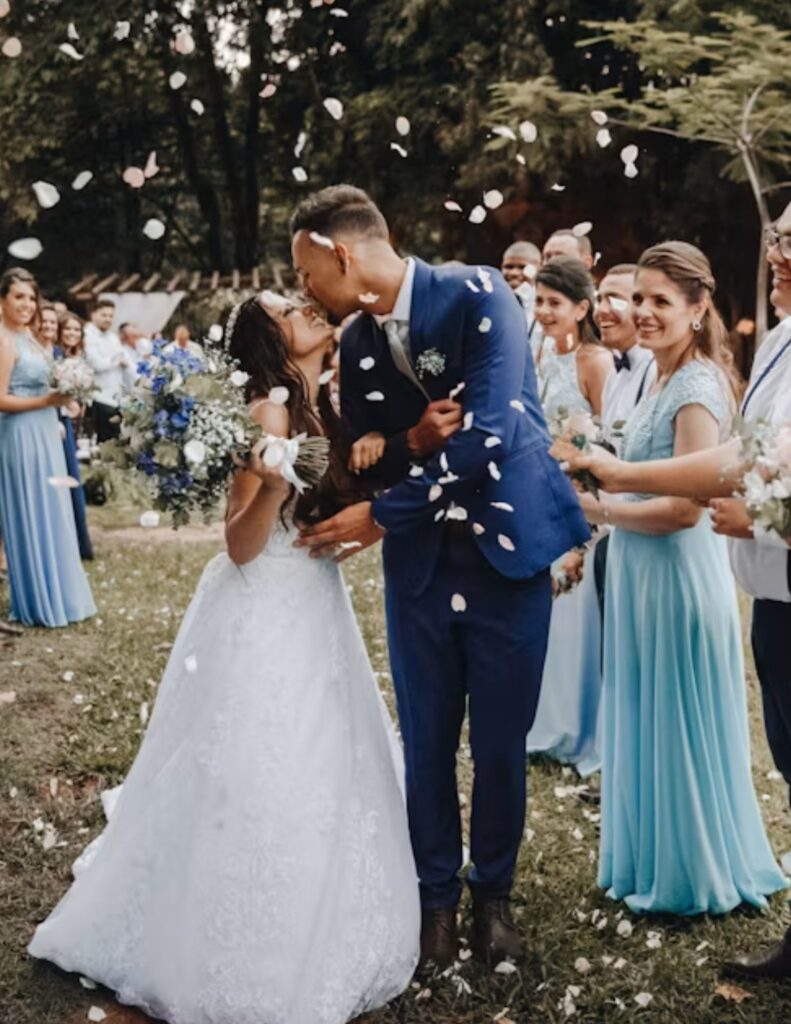
Wedding photos like this one hold real importance in a person’s life because they capture one of life’s biggest milestones, the moment two people officially start their journey together. A wedding kiss moment, surrounded by cheering guests and flying petals, becomes a memory that’s looked back on for years to come, especially when it’s paired with a heartfelt wedding poem read during the ceremony.
For the couple, it’s proof of how loved and celebrated they felt on their big day. For friends and family, being part of that wedding ceremony moment often becomes just as special, since weddings bring everyone together in a way few other events do, and a well-chosen wedding poem often makes that moment even more memorable.
Poems Under One Minute
A poem that takes under a minute to read aloud roughly 60 to 90 words is often the most powerful choice precisely because of its restraint. These readings work well placed right before the vows, giving guests a brief pause to absorb the moment. Rainer Maria Rilke’s shorter reflections on love and distance are commonly used here, as are single stanzas pulled from longer classic works. The key is picking a poem where every line earns its place; with so little room, there’s no space for filler.
One-Line Wedding Quotes You Can Use as Readings
Sometimes a single line does more work than an entire stanza. Quotes from writers like John Keats or philosophers like Aristotle on the nature of love and partnership are often printed on programs, engraved on rings, or spoken as a closing line by the officiant right before the couple is announced as married. These one-line readings are especially popular for couples who want a literary touch without committing to a full recitation.
Funny Poems to Lighten Your Wedding Mood
Not every ceremony needs to be solemn from start to finish, and funny readings have become a favorite way to remind guests that the couple doesn’t take themselves too seriously. These readings work particularly well for couples who bicker affectionately, have a shared sense of humor, or simply want to break the tension before an emotional vow exchange.
Popular choices in this category tend to poke fun at everyday relationship habits leaving the toilet seat up, hogging the remote, or one partner always running late while still landing on a sincere note by the final line. This combination of humor and heart is what separates a genuinely funny wedding poem from one that feels flippant or out of place at a ceremony.
Funny readings are especially well suited to the reception rather than the ceremony itself, particularly during speeches or toasts, where a lighter tone is expected. If you do want humor during the ceremony, ask your reader to deliver it with a straight face until the punchline comedic timing matters just as much in a poem as it does in stand-up.
A word of caution: run any funny wedding poem past both partners before the big day. What feels like an inside joke to you might land differently with grandparents in the front row, so always weigh your audience alongside your own sense of humor.
Religious and Spiritual Poems for Weddings
For couples having a religious or faith-centered ceremony, faith-based readings offer a way to honor tradition while still keeping the moment personal. Passages like Ecclesiastes 4 or Proverbs 31 are staples in Christian weddings, often read by a family member during the ceremony to bridge the gap between scripture and celebration.
The Prayer of Saint Francis of Assisi is another frequent choice, valued for its focus on selflessness and service qualities many couples want to carry into married life. For interfaith or multicultural ceremonies, extracts from a Native American wedding blessing or a traditional wedding prayer can honor both partners’ backgrounds without favoring one tradition over the other.
If your ceremony blends faiths or includes guests from different religious backgrounds, consider pairing a scripture reading with a secular poem later in the program. This lets you honor personal beliefs without making any single guest feel excluded from the moment. Many officiants are happy to help sequence readings this way if you mention the goal during your ceremony planning meeting.
Spiritual but not strictly religious poems also belong in this category. Writers like Kahlil Gibran approach love and partnership with a reflective, almost sacred tone without requiring a specific faith background, making his work a common bridge between religious and secular ceremonies.
Modern Poems for Contemporary Couples
Modern poems for couples who want their ceremony to feel current rather than borrowed from another era have grown significantly in popularity, especially as more people discover contemporary poets through social media. These poems tend to use plainer language and everyday imagery, which can feel more relatable than centuries-old verse particularly for guests less familiar with classic poetry.
Contemporary writers often focus on the ordinary, unglamorous parts of love: shared chores, quiet mornings, learning someone’s habits over time. That grounded approach resonates with couples who want their reading to sound like their real relationship rather than an idealized version of romance.
Because modern poems are still under copyright in most cases, always confirm you have the right to read a specific piece publicly, and credit the poet by name during the reading as a simple courtesy. Many modern poets are also open to couples reaching out directly for permission, and some even respond with a personal note for the occasion.
This category pairs particularly well with informal, backyard, or destination weddings where the overall tone already leans casual and personal rather than traditional.
LGBTQ+ and Inclusive Poems for Every Love Story
Representation matters when choosing ceremony readings, and LGBTQ+ and inclusive poems ensure every couple can find language that reflects their own relationship rather than defaulting to poems written with only one kind of couple in mind. Writers like Walt Whitman and Bell Hooks are frequently cited in this space for their broad, non-gendered explorations of love, identity, and connection.
Many modern poets writing specifically about same-sex relationships bring a directness and honesty that resonates deeply with couples who have spent years navigating a world that wasn’t always built with their relationship in mind. Including this kind of poem in a ceremony isn’t just about representation for the couple themselves it also signals inclusivity to LGBTQ+ guests in the audience.
If you’re planning an inclusive ceremony, it’s worth briefing your officiant in advance so pronouns, terminology, and any references to “bride and groom” in existing scripts are adjusted appropriately. A poem chosen with intention loses its impact if the surrounding ceremony language doesn’t match.
This category also works beautifully for vow renewal poems, particularly for couples who married before certain legal protections existed and want their renewed vows to reflect a hard-won milestone.
Poems and Readings from Movies, TV Shows, and Pop Culture
For couples who bonded over a shared love of film and television, readings and speeches borrowed from pop culture offer an unexpected but deeply personal alternative to classic poetry. A reading lifted from Four Weddings and a Funeral, The Wedding Singer, or even a beloved sitcom can hit harder for guests than an unfamiliar classical poem, simply because everyone in the room recognizes the reference.
These readings work particularly well when the couple has a running joke, a shared favorite show, or a specific line that has become meaningful to their relationship over time. A speech from a well-loved character, delivered with a knowing smile from the reader, often gets one of the biggest reactions of the entire ceremony.
The key to making a pop culture reading feel intentional rather than gimmicky is placement and delivery. Use it as a lighter moment early in the ceremony or during a toast, rather than as the single most emotionally weighted reading of the day, and let the surrounding readings carry the more traditional emotional beats.
How to Choose the Right Wedding Poems for Your Ceremony
With so many options available, the real challenge isn’t finding a poem, it’s narrowing down which one actually fits your ceremony. Here’s a simple, step-by-step approach couples can use to choose the right readings without spending weeks scrolling through lists.
Decide Who Will Read the Poem
Before picking the poem itself, decide who will be reading it. A shy sibling who’s terrified of public speaking should be given a short, simple reading, while a confident officiant or close friend comfortable performing can handle a longer, more dramatic piece. Matching the poem’s length and tone to the reader’s comfort level prevents an otherwise beautiful reading from falling flat due to nerves.
Match the Poem’s Tone to Your Ceremony Style
A formal, black-tie wedding calls for a different register than a relaxed backyard celebration. If your ceremony is traditional, lean toward classic literature or faith-based readings. If it’s casual and personal, modern or even funny poems for the reception will feel far more natural. Ask yourself: would this poem feel out of place if it were read at a completely different kind of wedding? If yes, keep looking.
Once you’ve settled on who’s reading and what tone fits, narrow your shortlist to two or three options and read them aloud timing them with a phone stopwatch. Anything under two minutes is generally safe for a ceremony setting. Finally, run your final choice past your officiant, since they’ll often have practical suggestions about pacing and placement based on ceremonies they’ve run before.
Where to Use These Poems Throughout Your Wedding Day
These readings don’t have to be confined to the ceremony alone in fact, spreading readings across the full day often creates a more cohesive, memorable experience for guests. During the ceremony itself, a reading works well right before the vows, giving the room a moment of reflection before the couple speaks.
Poems for wedding speech moments are increasingly common too, with best men, maids of honor, and parents opening or closing a toast with a few lines of poetry rather than launching straight into stories. This adds a layer of polish to a speech and gives nervous speakers a strong, prepared opening line to fall back on.
Printed programs, place cards, and even the back of the menu are all opportunities to feature a short verse or wedding blessing that guests can read at their own pace. Some couples also include a poem for wedding invitations, setting the tone for the celebration before guests even arrive.
Finally, don’t overlook the first dance or the final send-off: a short poem read by the officiant just before the couple’s exit can serve as a beautiful, quotable closing note that guests remember well after the day is over.
Save-the-dates, thank-you cards, and even a wedding website’s homepage are smaller, easy-to-miss opportunities to add a line of poetry that guests will encounter before and after the event itself. Many couples now include a single verse at the bottom of their thank-you notes as a way of tying the whole celebration together, from the very first invitation to the last piece of correspondence sent months later. It costs nothing extra and adds a surprising amount of polish to the overall guest experience.
How to Personalize These Poems for Your Vows
Reading a poem word-for-word is perfectly acceptable, but many couples want their vows to feel unmistakably their own. Personalizing an existing poem is a straightforward way to get the best of both worlds professional-quality language paired with details specific to your relationship.
Start by identifying the poem’s core structure: is it built around repeated phrases, a list of promises, or a single central image? Once you understand that structure, you can swap in personal details a shared nickname, the city where you met, an inside joke without disrupting the rhythm of the original piece.
Always credit the original poet when reading a personalized version aloud, even if you’ve adjusted several lines. A simple introduction like “inspired by [poet’s name]” respects the source material while making clear that what follows has been adapted for your specific love story.
If you’re uncomfortable editing an existing poem, consider instead writing a short original piece using the borrowed poem purely as a structural template. Many couples find that once they start filling in their own details, an entirely new piece of writing takes shape, one that no other couple could read at their wedding, because it belongs entirely to yours.
It also helps to involve your reader early in this process, rather than handing them a finished script the week of the wedding. Someone reading a personalized piece aloud will deliver it far more naturally if they’ve had time to sit with the words, understand the references, and practice the pacing at least once out loud. A rushed reader can undercut even the most carefully personalized poem, while a well-prepared one can make even a simple, unedited classic feel entirely new.
Common Mistakes Couples Make When Choosing Ceremony Poems
Even with a strong shortlist, couples often run into the same avoidable mistakes when finalizing their wedding poem choices. The most common is picking a poem for its reputation rather than its fit, choosing something because it’s famous, rather than because it actually reflects the relationship.
A second frequent mistake is underestimating length. A poem that reads quickly on a screen can feel much longer when delivered slowly and clearly in front of a live audience, especially if the reader pauses for effect. Always do a live timed read-through, ideally with the actual reader, at least once before the wedding day.
Choosing too many readings is another common pitfall. Three well-placed poems across the day will land far better than six crammed into a twenty-minute ceremony, where the emotional impact of each one starts to blur together for guests.
Finally, couples sometimes forget to consider their audience entirely. A poem heavy with references only the couple understands, or humor that only lands with one side of the guest list, can leave part of the room feeling disconnected from the moment. The best ceremony readings manage to feel personal to the couple while still remaining accessible to everyone listening.
One last mistake worth naming: skipping the sound check. A poem that sounds beautiful in a quiet room can fall apart outdoors with wind noise, or indoors with a microphone that cuts in and out. Whenever possible, have your reader do a quick run-through with the actual microphone and sound setup before guests arrive, so the words land the way you intended rather than getting lost to feedback or background noise.
FAQs
Q: What are the best wedding poems to read at a ceremony?
A: The best wedding poems are the ones that match your relationship’s tone rather than simply being the most famous. Classic choices like Shakespeare’s Sonnet 116 or Elizabeth Barrett Browning’s sonnets suit formal ceremonies, while modern or personalized wedding poems work better for casual celebrations. Ultimately, the strongest reading is one that feels honest when spoken aloud rather than performative or generic.
Q: What poems can be read at a wedding ceremony?
A: Almost any poem can be read at a wedding ceremony as long as its tone fits the moment: romantic sonnets, short verses, religious passages, extracts from novels, and even lines from films are all common. Many couples mix categories, opening with a traditional reading and closing the ceremony with something more personal or lighthearted, depending on their overall style.
Q: Are there short wedding poems suitable for vows or readings?
A: Yes, short wedding poems, often under 90 words, are increasingly popular because they hold a ceremony audience’s attention without dragging out the timeline. Single stanzas from longer classic poems, or brief modern verses focused on partnership and commitment, work particularly well right before the couple exchanges vows.
Q: Can you use funny or light-hearted poems in a wedding?
A: Absolutely. Funny wedding poems are a great way to show personality and ease tension before an emotional moment, especially for couples with a playful relationship. They tend to work best during toasts or right before the vows, giving the ceremony a natural mix of humor and sincerity rather than staying serious from start to finish.
Q: How do you choose the right wedding poem for your ceremony?
A: Start by deciding who will read the poem and match its length and tone to their comfort level. Then consider your ceremony’s overall style: formal readings suit traditional weddings, while modern or funny wedding poems suit casual ones. Time your shortlist aloud, and confirm the final choice with your officiant before the big day.
Final Thoughts
Choosing wedding poems isn’t about finding the single “correct” reading, it’s about finding language that sounds like the two of you when it’s spoken out loud in front of the people who matter most. Whether that means a 400-year-old sonnet, a line borrowed from a favorite film, or a poem personalized with your own private jokes, the right choice is simply the one that feels true.
Use this guide as a starting point rather than a final answer. Read a handful of options aloud with your partner, pay attention to which ones make you both go quiet for a second, and build your ceremony around those. That reaction however small is usually the clearest sign you’ve found the right wedding poem for your day.
Recent Article : 9 Sarah Kay Poems That Will Make You Feel Everything At Once

Jennifer Aston is a passionate poetry curator and writer with a deep love for the written word. She believes poetry has the power to heal, inspire, and connect people across all walks of life. Through PoemSteric, she brings together timeless and modern verses for every emotion and every moment.