
Introduction
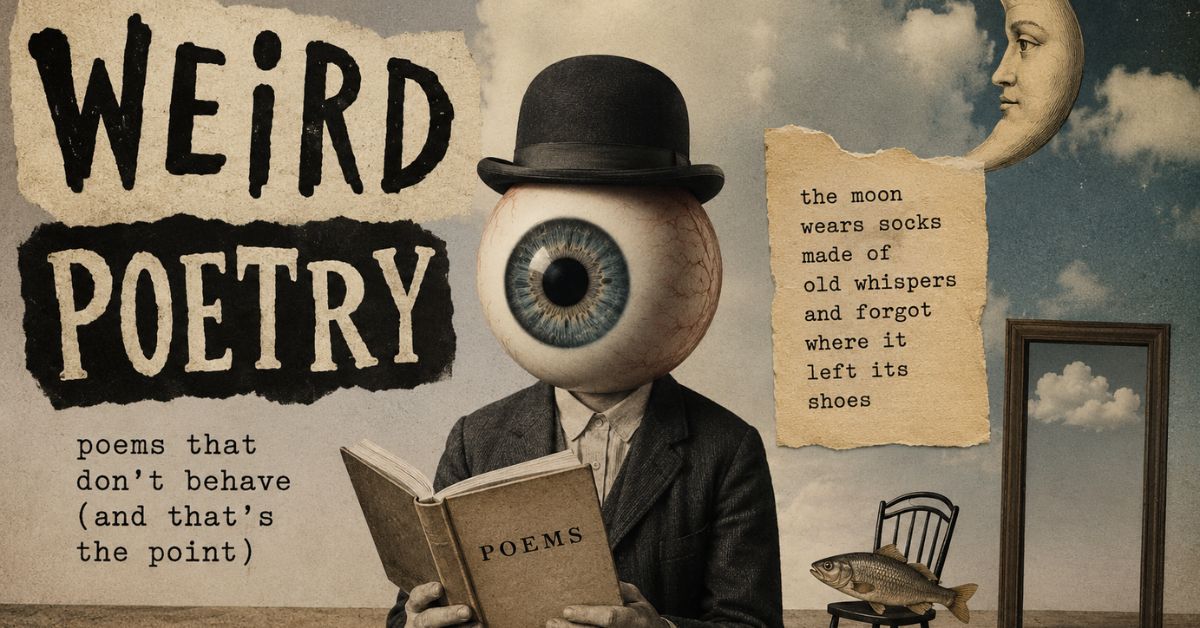
Some poems rhyme about roses. Others rhyme about a walrus eating socks for breakfast. If you have ever stumbled across a poem that made you laugh, scratch your head, or read a line twice just to be sure you read it right, you already know the strange charm of strange poems. This is a genre that refuses to behave. It bends logic, plays with sound, and turns everyday nonsense into something oddly beautiful. In this guide, we will explore what makes a poem weird, meet the poets who made a career out of being delightfully strange, and share original odd poems across categories like short, funny, surreal, and kid-friendly. By the end, you will not only enjoy 25 nonsense poems but understand why this quirky corner of poetry deserves a permanent spot on your reading list.
Key Takeaways
● Weird poems use nonsense, absurdism, and surrealism to break normal rules of logic and language.
● Pioneers like Edward Lear and Lewis Carroll built entire literary traditions around delightful strangeness.
● Quirky poems exist in many flavors: short, funny, surreal, kid-friendly, romantic, and modern.
● Writing your own weird poem is easier than it looks once you learn a few simple techniques.
● This genre matters because it gives readers and writers permission to be playful, imperfect, and imaginative.
What Makes a Poem “Weird“? Understanding the Genre
A weird poem is one that intentionally steps outside the expected. It might use invented words, illogical scenarios, or imagery that should not work together but somehow does. Think of a poem where a teapot falls in love with the moon, or where grammar rules quietly dissolve line by line. What ties these poems together is not a single style but an attitude: a willingness to prioritize imagination and sound over strict sense.
Peculiar poems often share a few recognizable traits. They use unexpected juxtapositions, placing ordinary objects in impossible situations. They lean on rhythm and rhyme even when the meaning wobbles. And they frequently carry a wink of humor, letting the reader know the poet is in on the joke.
Nonsense vs. Absurdist Poetry: What’s the Difference?
Nonsense poetry, popularized by writers like Lewis Carroll, plays primarily with language itself, inventing words and twisting grammar until meaning becomes secondary to sound and rhythm. Absurdist poetry, on the other hand, keeps the language mostly intact but places recognizable words into impossible or illogical situations, creating humor or unease through contradiction rather than invented vocabulary. Both fall comfortably under the wider umbrella of offbeat poems, and many poets blend the two freely within a single piece.
Famous Weird Poets You Should Know
You cannot talk about weird poems without tipping your hat to the poets who built the genre from the ground up. These writers proved that strangeness could be just as literary as sonnets about love or nature, and their influence still shapes how modern poets approach playful, offbeat verse.
Edward Lear made limericks synonymous with silliness in the 1800s, filling them with owls marrying pussycats and men with beards full of birds. Lewis Carroll pushed things further, inventing entire vocabularies for poems like his famous nonsense verse about a fearsome creature in a tulgey wood. In the twentieth century, Spike Milligan brought a comedian’s timing to poetry, while Shel Silverstein and Ogden Nash proved that weird, funny poems could sit comfortably on a child’s bookshelf and an adult’s coffee table alike.
Pioneers of Nonsense: Edward Lear and Lewis Carroll
Edward Lear is often credited as the father of the modern limerick, using tight rhyme schemes to deliver maximum absurdity in minimum space. Lewis Carroll took a more architectural approach, building entire imaginary creatures and settings through invented language, proving that a poem could feel meaningful even when half its words did not technically exist. Together, they set the template that nearly every weird poem written since has borrowed from in some way.
Short Strange Poems That Pack a Punch
Short silly strange poems prove that strangeness does not need space to land. A few lines are often enough to surprise a reader and leave a lasting image.
The Umbrella’s Confession
I opened up on a sunny day,
just to see what people say.
They stared at me like I was mad
turns out rain was what they had.
Breakfast Logic
The toaster hummed a lullaby,
the cereal winked its single eye,
and I, still half asleep, agreed
that spoons make excellent company.
These short bizarre poems work because they set up a small, believable world and then twist it in the final line, rewarding the reader’s attention with a quiet punchline.
Funny Nonsense Poems to Make You Laugh Out Loud
Funny strange poems combine comic timing with strange imagery, and they are often the easiest entry point for readers new to the genre.
My Dog Thinks He’s a Cat
He sits in boxes far too small,
ignores me when I softly call,
knocks my coffee off the ledge,
then naps upon the windowsill’s edge.
I’ve stopped asking why he’s like this
Some mysteries deserve a miss.
The Sock That Started It All
One sock went missing from the drawer,
the other wept upon the floor.
Detectives searched from wall to wall
turns out the dryer ate them all.
Humor in weird poems usually comes from treating an absurd premise with complete seriousness, which is exactly what makes readers laugh out loud.
Odd Poems About Everyday Life
Ordinary routines make excellent material for nonsense poems because the contrast between the mundane and the bizarre is where the fun lives.
Grocery List, Re-imagined
Milk, eggs, bread, a jar of dreams,
three apples and some borrowed schemes,
a pound of patience, slightly bruised,
and hope, in case the coffee’s used.
The Traffic Light’s Opinion
Red said wait, and green said go,
yellow simply loves the show
three lights arguing all day long
about who’s right and who’s wrong.
Weird poems about everyday life turn boring routines like grocery shopping or commuting into small adventures, which is part of why readers connect with them so easily.
Quirky Poems for Kids: Silly and Safe
Peculiar poems for kids keep the absurdity light, silly, and completely harmless, focusing on gentle nonsense rather than dark or confusing themes.
The Backwards Day
On Tuesday, shoes went on our hands,
and mittens covered both our lands.
We ate dessert before the meal
and thought that this was quite the deal.
A Very Confused Cloud
A cloud once tried to touch the ground,
it bounced back up without a sound.
“I meant to rain,” it softly sighed,
then floated off, embarrassed, and shy.
These offbeat poems for kids are perfect for classrooms, bedtime reading, or simply introducing children to poetry without intimidating them with heavy themes.
Surreal and Dreamlike Strange Poems
Surreal silly strange poems borrow from dream logic, where scenes shift without warning and ordinary rules of cause and effect quietly disappear.
The Staircase That Led Nowhere
I climbed the stairs for hours it seemed,
each step dissolving as I dreamed.
At the top, a door stood tall
behind it, nothing there at all.
Clock Without Hands
The clock forgot to keep the time,
its hands had wandered off to climb
a mountain made of yesterday,
leaving only now to stay.
Surreal bizarre poems reward slow reading, since much of their power comes from the images lingering after the poem ends rather than a clear conclusion.
Weird Love Poems With a Twist
Even love poems can wear a weird poems label when the romance is filtered through strange or unexpected imagery.
Love, Measured in Socks
I love you like a matching sock,
rare enough to make me stop,
searched for through the laundry pile,
worth every missing, wasted mile.
Weird love poems soften traditional romance with humor or strangeness, making them feel more honest and less like a greeting card cliche.
Modern Offbeat Poems From Contemporary Poets
Strange poems have not stayed frozen in the Victorian era. Contemporary poets continue experimenting with strange imagery, fragmented structure, and unconventional formatting, often publishing directly on platforms like Instagram, Sub-stack, and poetry blogs. Modern odd poems frequently tackle anxiety, technology, or modern absurdities like doom scrolling and notification fatigue, wrapping heavier themes in playful, offbeat language. This evolution shows that weirdness in poetry is not a passing trend but a living, adaptable tradition.
How to Write Your Own Weird Poem
Writing a weird poem is far more approachable than it sounds. Follow these steps to create your own.
1. Pick an ordinary object or routine, such as a toothbrush, a bus stop, or Monday mornings.
2. Ask “what if” questions about it. What if the object had feelings? What if the routine ran backwards?
3. Write down the first strange image that comes to mind without editing yourself.
4. Add rhythm or rhyme if it fits, but do not force it if the poem reads better without it.
5. End on a twist, a punchline, or an unresolved image that lingers.
6. Read it aloud. If it makes you smile or raises an eyebrow, you have written a weird poem.
The biggest secret to this genre is permission. Weird poems do not need to make perfect sense, and that freedom is often what makes them fun to write.
Where to Find More Nonsense Poems Online
Beyond this collection, readers can explore quirky poems through poetry archives, independent poetry blogs, and platforms like Sub-stack, where many contemporary poets publish nonsense and absurdist work regularly. Community spaces on Reddit also host active discussions where poetry lovers share their favorite strange finds and even original attempts at the genre.
Common Mistakes When Writing Peculiar Poems
Many beginners assume offbeat poems just mean random words strung together, but true strangeness needs an internal logic, even if that logic only makes sense within the poem itself. Another common mistake is over-explaining the joke or the twist, which drains the surprise that makes weird poems memorable. Finally, some writers force rhyme so hard that the poem loses its natural rhythm. Unusual poems work best when the strangeness feels effortless rather than forced.
Why Weird Poems Matter in Modern Poetry
Weird poems matter because they give both readers and writers permission to play. In a literary world that often prizes seriousness, this genre reminds us that poetry can also be joyful, silly, and unapologetically strange. It lowers the barrier to entry for new poets who feel intimidated by traditional forms, and it offers seasoned readers a refreshing break from heavier themes. Silly strange poems prove that imagination, not perfection, is the real engine of great writing.
FAQs
Q: What exactly makes a poem count as a weird poem?
A: A weird poem is one that deliberately breaks normal rules of logic, grammar, or subject matter to create surprise, humor, or striking imagery. It might use invented words, illogical scenarios, or unexpected pairings of ideas. Weird poems don’t need to make literal sense; they succeed when their internal rhythm and imagination feel intentional rather than random, drawing readers into a small, strange world of their own.
Q: Who are the most famous writers of weird poems?
A: Edward Lear and Lewis Carroll are widely considered the founders of the genre, using limericks and invented vocabulary to popularize nonsense verse in the 1800s. Later, Spike Milligan, Shel Silverstein, and Ogden Nash brought comic timing and playful strangeness to a wider, modern audience, proving that weird poems could appeal to both children and adults.
Q: Are weird poems appropriate for children?
A: Yes, many weird poems are written specifically with children in mind. Poets like Shel Silverstein built entire careers on silly, harmless nonsense that entertains kids without confusing or upsetting them. When choosing weird poems for a classroom or bedtime reading, look for lighthearted absurdity rather than darker or more surreal themes better suited to adult readers.
Q: How do I start writing my own weird poem?
A: Start with something ordinary, like a toothbrush or a Monday morning, and ask playful ‘what if’ questions about it. Write down the first strange image that comes to mind without overthinking it, add rhyme only if it feels natural, and finish on a twist or unresolved image. The goal is effortless imagination, not perfect logic, so give yourself permission to be a little silly.
Q: What is the difference between nonsense poetry and absurdist poetry?
A: Nonsense poetry plays mainly with language itself, often inventing new words and bending grammar so that sound matters more than meaning, as seen in much of Lewis Carroll’s work. Absurdist poetry keeps real words and grammar intact but places them into impossible or illogical situations. Both styles fall under the broader category of weird poems and are frequently combined by poets.
Final Thoughts
Weird poems remind us that poetry does not need to be polished or profound to matter. Sometimes the strangest lines are the ones that stick with us longest, precisely because they surprise us into paying attention. Whether you came here to laugh, to find inspiration, or to write your own strange verses for the first time, this collection is proof that a little nonsense goes a long way. Try writing one yourself today, you might discover your favorite new hobby hiding behind a very odd poem.
Recent Article : What Are Aesthetic Poems? 15 Dreamy Examples to Read Now

Jennifer Aston is a passionate poetry curator and writer with a deep love for the written word. She believes poetry has the power to heal, inspire, and connect people across all walks of life. Through PoemSteric, she brings together timeless and modern verses for every emotion and every moment.