
Introduction
A name is never just a name. It is a story, a hope, a history, and sometimes even a prayer. The moment someone gives you a name, they are giving you something you will carry for the rest of your life. That is exactly what makes name poems so powerful.
Name poems are one of the most personal forms of poetry that exist. They are poems that are built around a name, usually a person’s first name and they use that name as the foundation to explore personality, feelings, memories, identity, or meaning. Whether you are a student, a teacher, a parent, or just someone who loves words, name poems give you a simple but deeply meaningful way to celebrate a person through poetry.
The good news? You do not need to be a professional poet to write name poems. You just need a name, a little thought, and a few easy steps. This guide will walk you through everything, what name poems are, why they matter, the different types, and a complete step-by-step process to write your own, even if you have never written a poem before.
Key Takeaways
- Name poems are poems built around a person’s name, designed to reflect their identity, personality, or story.
- The most common type is the acrostic name poem, where each letter of the name starts a new line.
- There are several other formats including free verse, narrative, and diamante name poems.
- Writing name poems follows a clear step-by-step process that anyone can follow.
- Name poems work beautifully as gifts, classroom activities, and creative writing exercises.
- You do not need poetic experience. Name poems are beginner-friendly by design.
- The most important rule in name poems is to write from genuine feeling, not just clever words.
What Are Name Poems? A Clear Definition for Beginners
Name poems are a category of poetry that use a person’s name as the central theme or structural foundation of the poem. The poem is written about the person whose name is being used, and it often explores who they are, what makes them special, what their name means, or how others feel about them.
The most well-known type of poem is the acrostic poem. In an acrostic poem, you take the letters of a name and write them vertically down the left side of the page. Each letter then becomes the first letter of a new line. The full poem, read across, tells you something about the person. It is a simple format that works for names of any length.
However, name poems are not limited to acrostics. Free verse name poems explore a name through storytelling and emotion without any fixed structure. Narrative name poems tell the full story of a name where it came from, who gave it, and what it means. There are also hybrid formats that combine elements of multiple styles.
At their core, name poems are about identity. They take the most personal thing about a person by their name and turn it into a piece of art. That is why name poems feel so meaningful when you receive one. They say, “I thought about you. I thought about your name. I thought about who you are.” And that kind of attention is rare and beautiful.
Why Name Poems Matter | The Emotional Power Behind a Name
Before you start writing name poems, it helps to understand why names carry so much weight in poetry and in life. Your name is the first label the world gave you. It often carries cultural history, family meaning, religious significance, or simply the dreams your parents had for you. Poets have known for a long time that a name is never just a word.
When you write name poems, you are doing something meaningful. You are treating someone’s name as worthy of attention and art. Think about how it feels when someone gets your name right, pronounces it correctly, and speaks it with care. Now imagine someone writing a whole poem about it. That is a powerful emotional experience.
Name poems are also important because they help people explore their own identity. Writing a name poem about yourself forces you to ask: What does my name mean? Who gave it to me? How do I feel about it? Do I carry it proudly? These are not small questions. They can lead to surprisingly deep answers that help you understand yourself better.
In many cultures, names are treated almost as sacred things. Some communities hold naming ceremonies. Some religions have rituals around giving names. Name poems honour this tradition in a creative way. They say that your name is not just a sound, it is a story worth telling.
Types of Name Poems You Should Know
Not all name poems look the same. There are several different formats, and each one works differently. Understanding the types helps you choose the best format for your purpose.
Acrostic Name Poems
The acrostic is the most popular type of poem. In an acrostic, you write the name vertically one letter per line and each letter starts the first word of that line. The lines together form a poem that describes the person.
For example, for the name ADAM:
- A Always calm, even in storms
- D Devoted to the ones he loves
- A Adventurous in every quiet way
- M Making the world warmer just by being in it
Acrostic name poems are great for beginners because the structure gives you a clear starting point. You do not have to decide how many lines to write the name tells you. They also work for all ages, making them a favorite in classrooms and family settings.
Free Verse Name Poems
Free verse name poems do not follow a fixed structure. They do not rhyme, they do not have a set number of lines, and they do not use the letters of the name as a guide. Instead, they explore the name through open, flowing language that feels natural and honest.
Free verse name poems are often the most emotionally powerful because they give you complete freedom to say exactly what you feel. You might write about the sound of the name, the feeling it gives you, the person it belongs to, or the story behind how the name was chosen.
Narrative Name Poems
Narrative name poems tell a story. They might describe the moment a name was given, the journey of a person who carries the name, or the way the name has shaped someone’s life. These are longer, more detailed, and more literary than acrostic poems. They read almost like short stories written in poetic form.
Narrative name poems are excellent for honoring someone on a significant occasion: a birthday, a graduation, a retirement, or a tribute. They give you space to include real details, specific memories, and genuine emotion.
Diamante Name Poems
A diamante poem is a seven-line poem shaped like a diamond. While not always written about names, it can be adapted as a unique type of name poem. You start and end with a noun (the name and a quality of the person), and the middle lines build with adjectives, verbs, and related nouns. This format works well when you want to show contrast or growth for example, exploring who a person was as a child versus who they are now.
How to Write Name Poems from Scratch
This is the heart of this guide. Follow these steps in order and you will have a complete name poem by the end.
Choose the Name
Start by deciding whose name you are writing about. It could be your own name, the name of a friend, a family member, a child, or even a historical figure. The more you know about the person, the richer your poem will be. If you are writing about yourself, this is a great opportunity for honest self-reflection.
Research the Meaning and Origin of the Name
This step is something most people skip, and that is a mistake. Every name has a meaning and an origin, and these can give your poem real depth. Look up the name’s meaning online or in a name dictionary. Find out where the name comes from: is it Arabic, Hebrew, English, Latin, Urdu? Who in the family gave this name, and why? Write down anything interesting you find. These details are golden material for your name poem.
Brainstorm Words, Traits, and Memories
Grab a piece of paper and write down everything that comes to mind when you think about this person. Think about their personality traits, their habits, the way they laugh, things they love, things they have done, how they make you feel, and any strong memories you share. Do not edit yourself at this stage, just write everything down freely. You will sort through it later. For acrostic name poems, also brainstorm words that start with each letter of the name.
Pick Your Name Poem Format
Look at the name you are writing about and the material you have brainstormed. Now decide which format works best. If the name is short (3–5 letters), an acrostic is easy and effective. If you have a lot of emotional material and a story to tell, free verse or narrative works better. If you want something visual and school-friendly, the diamante format is a good choice. There is no wrong answer, just pick the one that feels right for what you want to say.
Write Your First Draft
Start writing without worrying about perfection. For an acrostic, write the name down the left side and fill in each line. For free verse, just start writing what you feel about the person and their name. Do not stop to fix mistakes, just keep going. The goal of a first draft is to get the words out. You will make it better in the next step.
Revise and Refine
Read your first draft aloud. This is one of the best writing tips that experienced poets use. Hearing your words helps you catch lines that feel awkward, repetitive, or weak. Ask yourself: Does every line say something real and specific? Are there any lines that feel generic or filler? Replace weak lines with stronger, more specific images. For name poems, the most powerful lines are always the specific ones: a real memory, a true feeling, a genuine detail.
Title or Dedication
Name poems often work beautifully with a simple title. It can be as simple as the name itself, or something like “For Layla” or “A Poem for My Father.” A dedication at the top “Written for [name] on [occasion]” makes the poem feel even more intentional and special. This final touch turns your writing into a true gift.
Real Examples of Name Poems
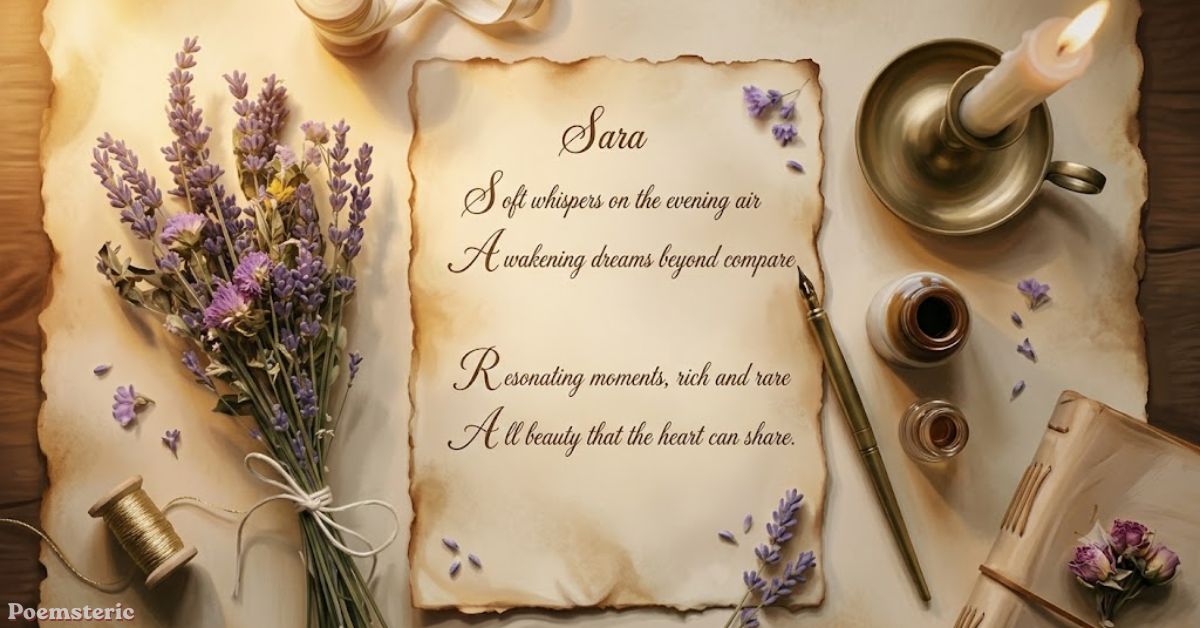
Acrostic Name Poem Example “SARA”
S Softness lives in everything she touches
A Always the first to notice when someone is hurting
R Roots that run deep, family that she carries with pride
A A light that does not ask to be seen, but always is
Free Verse Name Poem Example “For Layla”
Your name sounds like the end of a long day —
that moment when the lights go soft
and everything heavy finally gets to rest.
Layla.
Three syllables that someone chose for you
before they even knew your face.
They must have known anyway.
Because you are exactly what a name like that sounds like —
something beautiful that arrives after the hard part is over.
Name Poems for Special Occasions | When and Why to Write Them
Name poems are incredibly versatile gifts and they work for almost any occasion. A birthday is the most natural time you are already celebrating a person, and a name poem makes that celebration personal in a way a store-bought card simply cannot. Writing name poems as graduation gifts, wedding tributes, baby shower cards, or retirement speeches gives the recipient something they will keep long after the event is over.
Teachers use name poems at the start of the school year as an ice-breaker activity. Each student writes a name poem about themselves and shares it with the class. This builds community and helps students practice descriptive writing and self-expression at the same time. Parents write name poems to put in their child’s baby book or birthday scrapbook. Friends exchange name poems as acts of appreciation. The occasions are endless because the poem is as personal as the name itself.
Common Mistakes Writers Make With Name Poems (And How to Avoid Them)
Even simple poetry has pitfalls. Here are the most common mistakes people make when writing name poems, and how to avoid them.
Using generic descriptions
The most common mistake in name poems is using lines like “kind and caring” or “always smiling.” These words could describe anyone. Strong name poems use specific details not “she is kind” but “she once drove three hours in the rain just to bring soup to a sick friend.” Specificity is what makes name poems feel real.
Forcing rhymes
Name poems do not need to rhyme. When you force a rhyme, the poem often sounds awkward or unnatural. It is much better to write something honest and unrhymed than something rhymed but false. Free verse is your friend here.
Ignoring the meaning of the name
Many writers forget that the actual meaning of the name can be the most powerful part of the poem. If a name means “light” in Hebrew, that is material. If a name was given after a grandmother who passed away, that is the story. Do not skip Step 2.
Writing too generally
Name poems that stay at the surface level listing nice qualities without depth feel flat. Push yourself to go deeper. What does this person’s presence actually feel like? What would be missing from the world without them? Those deeper answers make name poems memorable.
Tips to Make Your Name Poems Stand Out
If you want your name poem to be truly special, these tips will help you go from good to great.
Use sensory language. Instead of saying someone is warm, describe the feeling of being around them the way the room feels different when they walk in, the sound of their laugh, the smell of their cooking. Sensory details make name poems come alive for the reader.
Draw on real memories. The most powerful name poems are always rooted in real, specific moments. A shared memory, a private joke, a moment that only you two know about these make a poem feel irreplaceable. Anyone can write “you are brave.” Only you can write about the specific moment they were brave and what it meant to you.
Read your poem aloud before you finalize it. Poems live in sound, not just on paper. Hearing your name poem out loud reveals whether it flows naturally or feels clunky. If a line trips you up when you say it, rewrite it.
Keep it honest. Name poems do not have to be all praise. Some of the most moving name poems acknowledge complexity: someone who struggled but grew, someone whose name they had to fight to keep, someone who is gone now but whose name still matters. Honesty makes poetry memorable.
Name Poems in the Classroom | A Teaching Tool That Works
Name poems have been used in classrooms for decades, and for good reason. They are one of the best poetry writing activities for students of any age because they remove the intimidation of “what do I write about?” The answer is always the student’s own name.
For younger students, acrostic name poems are a natural starting point. The structure is simple, the topic is familiar, and the result is always meaningful because it is about them. Teachers can use name poems at the beginning of the year to help students introduce themselves in a creative way.
For older students, free verse and narrative name poems open up deeper conversations about identity, heritage, family history, and self-expression. Students can explore where their name comes from, whether they like their name, how people mispronounce it, and what their name means to them culturally. These conversations are rich and real.
Name poems also work beautifully as collaborative classroom activities. Students can write name poems about a classmate and exchange them as a community-building exercise. When a student receives a poem written by someone else about their name, it is a powerful experience of being seen and appreciated.
FAQs
What exactly is a name poem?
A name poem is a poem that uses a person’s name as its central theme or structure. The most popular form is the acrostic, where each letter of the name begins a new line. However, name poems can also be written in free verse, narrative style, or other poetic formats. The defining quality of name poems is that they are personal; they are about the specific person whose name is used, exploring their personality, identity, story, or meaning.
Do name poems have to rhyme?
No, name poems absolutely do not have to rhyme. In fact, trying to force a rhyme often makes name poems feel unnatural or generic. Most experienced poetry writers recommend writing name poems in free verse without a rhyme scheme because it allows you to say exactly what you mean without having to search for a matching word. The emotional honesty of name poems is far more important than whether the lines rhyme.
How long should a poem be?
The length of name poems depends on the format you choose. An acrostic name poem is automatically determined by the length of the name; a four-letter name gives you four lines, an eight-letter name gives you eight lines. Free verse and narrative name poems can be as short as six lines or as long as several stanzas. There is no rule. The right length is however long it takes to say what you genuinely want to say nothing more, nothing less.
Can children write name poems?
Yes, absolutely. Name poems are one of the most child-friendly forms of poetry. The acrostic format in particular is perfect for young writers because it gives clear structure and a familiar topic their own name. Children as young as second or third grade can write acrostic name poems with simple guidance. As students get older, they can progress to free verse and narrative name poems that allow for deeper self-expression. Name poems are widely used in elementary and middle school classrooms for exactly this reason.
What is the best occasion to give someone a name poem as a gift?
Name poems make meaningful gifts for almost any occasion. Birthdays are the most natural fit you are already celebrating the person, and a custom name poem makes the celebration feel uniquely personal. Name poems also work beautifully as graduation gifts, wedding tributes, new baby announcements, thank-you messages, or simple acts of appreciation for someone you care about. Because name poems are personalized by nature, they tend to be kept and treasured long after other gifts are forgotten.
Final Thought
Name poems are not complicated. They are just honest. When you take someone’s name, the very first thing they were given in this world and you build a poem around it, you are saying something important: this person matters enough to have words written for them. That is not a small thing.
Whether you write a four-line acrostic on a birthday card or a full narrative poem for someone you love, the act of writing name poems is an act of attention. It says: I noticed you. I thought about your name. I thought about who you are. And I put it into words. Start with one name. Take your time. Follow the steps. Write something true. That is all a great name poem needs to be.
Recent Article : Funny Short Poems

Jennifer Aston is a passionate poetry curator and writer with a deep love for the written word. She believes poetry has the power to heal, inspire, and connect people across all walks of life. Through PoemSteric, she brings together timeless and modern verses for every emotion and every moment.