
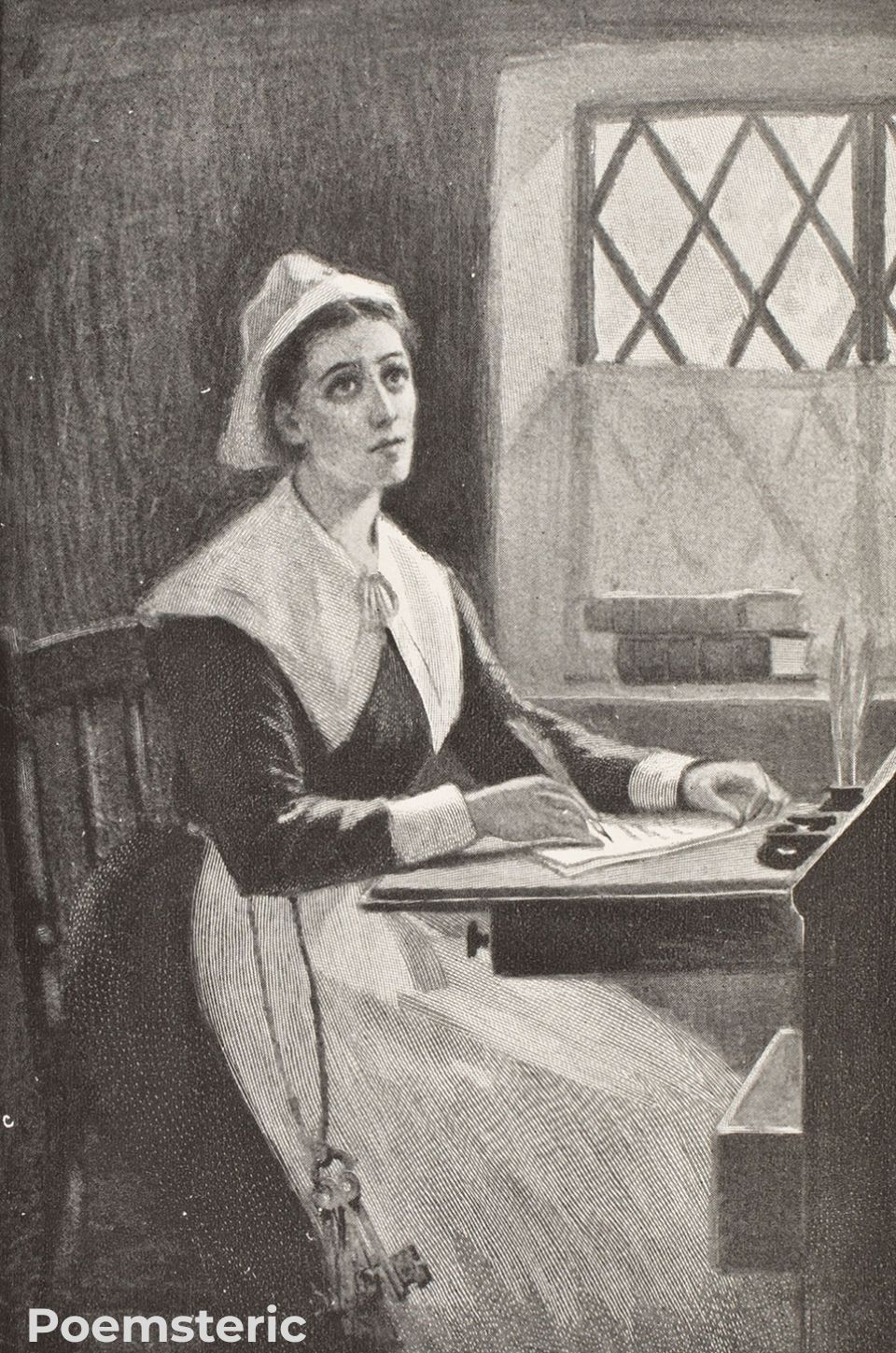
Anne Bradstreet stands as one of the most remarkable figures in early American literature. Born in England and later crossing the Atlantic to settle in the Massachusetts Bay Colony, she became the first woman to have her poetry published in the New World. Her work bridges the gap between Puritan devotion and deeply personal expression, offering readers an intimate glimpse into colonial life through the eyes of a wife, mother, and intellectual. More than three centuries after her death, Anne Bradstreet continues to inspire scholars, students, and poetry lovers who discover her unique voice.
From Northamptonshire to New England: A Life Transformed
Anne Bradstreet entered the world in 1612, born Anne Dudley in Northamptonshire, England. Her father, Thomas Dudley, served as steward to the Earl of Lincoln, a position that granted the family access to an impressive library and intellectual circles. This early environment shaped young Anne’s mind in ways that formal schooling never could. She spent her childhood surrounded by books, absorbing the works of Virgil, Homer, and Spenser while most girls of her social class learned only domestic skills.
The decision to leave England came in 1630 when Anne was just eighteen years old. She boarded the Arbella with her parents, her husband Simon Bradstreet, and hundreds of other Puritan settlers bound for Massachusetts. The voyage lasted over two months, a grueling journey across rough seas that tested the resolve of even the most dedicated colonists. When they finally reached Salem in July 1630, Anne confronted a harsh and unfamiliar landscape. She later wrote that her heart rose when she first saw the new world, a mixture of hope and anxiety that would define her life in America.
The family moved several times during those early years, settling briefly in Salem, Charlestown, and Cambridge before finding a permanent home in Andover in 1645. Each move brought new challenges. The wilderness offered little comfort compared to the refined estate where Anne grew up. Yet these experiences deepened her faith and sharpened her observational powers, qualities that would later distinguish her poetry from the dry religious verses common among her contemporaries.
The Self-Taught Scholar: How Anne Bradstreet Mastered Literature Without School
Anne Bradstreet never attended a formal school. In seventeenth-century England, education remained largely closed to women, regardless of social standing. What Anne possessed, however, proved far more valuable than classroom instruction. She had a brilliant mind, a supportive father who valued learning, and unlimited access to one of the finest private libraries in England.
Thomas Dudley recognized his daughter’s exceptional intelligence and encouraged her studies. While her brothers might have received tutoring in Latin and Greek, Anne taught herself through careful reading and imitation. She studied the classical poets, memorized passages from the Bible, and practiced writing verses in the style of Edmund Spenser and Philip Sidney. This self-directed education created a unique literary foundation. Unlike university-trained writers who followed rigid conventions, Anne developed a voice that was learned yet natural, sophisticated yet accessible.
Her reading habits continued throughout her life in New England. Even while raising eight children and managing a household, she found time for books. This dedication to learning set her apart from other colonial women and prepared her for the literary achievement that would eventually make her famous. The combination of classical knowledge and lived experience gave her poetry a depth that readers still appreciate today.
Love, Loss, and Legacy: Her Marriage to Simon Bradstreet
Anne married Simon Bradstreet when she was only sixteen years old. He was twenty-five, a recent graduate of Cambridge University who had come to work as an assistant to her father. Their marriage lasted forty years and produced eight children, a remarkable partnership by any standard of the seventeenth century.
Simon supported Anne’s intellectual pursuits in ways that many husbands of the time would not have tolerated. He encouraged her writing, discussed poetry with her, and accepted her as a true companion rather than merely a domestic helper. Their relationship appears frequently in her verses, most notably in “To My Dear and Loving Husband,” where she declares, “If ever two were one, then surely we.” This line captures the depth of their connection, a union that transcended the practical arrangements typical of Puritan marriages.
The couple faced numerous separations when Simon traveled on colonial business. He served as a diplomat, administrator, and eventually governor of Massachusetts, duties that took him away from home for extended periods. Anne transformed these absences into art, writing some of her most moving poems during his trips to England. She also endured significant losses with him, including the destruction of their Andover home by fire in 1666. Through every trial, their bond remained strong, providing Anne with both emotional stability and creative inspiration.
The Tenth Muse: America’s First Published Female Poet
- The Unauthorized Publication That Changed Everything
In 1650, a collection of Anne Bradstreet’s poems appeared in London under the title “The Tenth Muse Lately Sprung Up in America.” The book arrived in printshops without her knowledge or consent. Her brother-in-law, Reverend John Woodbridge, had carried the manuscript to England and arranged for its publication, believing that the world should recognize his sister’s extraordinary talent.
Anne initially felt embarrassed by this exposure. Puritan culture expected women to remain humble and silent in public matters, especially intellectual ones. She feared that readers would accuse her of seeking fame or neglecting her domestic duties. In “The Author to Her Book,” she describes her poems as an “ill-formed offspring of my feeble brain,” apologizing for their imperfections while acknowledging their existence. This complex attitude pride mixed with modesty, ambition tempered by religious duty characterizes much of her work.
Despite her reservations, the publication succeeded. The book attracted attention on both sides of the Atlantic, earning praise from readers who marveled that such sophisticated verse could emerge from the rough colonies. It established Anne Bradstreet as a literary figure of genuine importance, the first American poet of either sex to achieve international recognition.
- London to Massachusetts: How Her Words Crossed the Ocean
The journey of Anne’s poetry from her writing desk in Massachusetts to the printing presses of London required determination and fortunate connections. John Woodbridge played the crucial role, but the underlying achievement belonged entirely to Anne. She had written enough high-quality verse to fill a book while managing a large household in a frontier settlement.
The physical manuscript traveled by ship, a voyage that took weeks and exposed the pages to salt air, dampness, and rough handling. Once in London, Woodbridge found a publisher willing to take a chance on an unknown colonial author. The result was a 216-page volume that included long philosophical poems on topics ranging from the four humors to the vanity of worldly wealth. These early works show the influence of French poet Guillaume de Salluste Du Bartas, whose epic style Anne admired and imitated.
The success of this first edition encouraged a second printing in 1678, expanded to include her shorter domestic poems. These later verses, written in a simpler style closer to her natural voice, are generally considered her finest work. They reveal a woman who had grown confident in her art, no longer needing to prove her learning through elaborate classical references.
Anne Bradstreet’s Most Famous Poems Explained
Anne Bradstreet wrote poetry that spoke to the heart of human experience while remaining deeply rooted in her Puritan faith and colonial life. Her most celebrated works reveal a woman of remarkable intelligence who transformed personal moments into universal art. These poems continue to resonate with readers centuries after they were written because they address timeless themes: love, loss, motherhood, and the struggle to find meaning in suffering. Understanding these famous works provides essential insight into both Anne Bradstreet’s genius and the broader landscape of early American literature.
The Author to Her Book
This poem uses the extended metaphor of a book as a child sent out into the world before its mother could properly dress it. Anne describes her verses as “brat” with blemishes that she tried unsuccessfully to correct. The metaphor allows her to discuss authorship while maintaining the modest stance expected of women. She criticizes her own work harshly, yet the very act of publishing such a sophisticated poem undermines her self-deprecation. Modern readers recognize this as a clever strategy, a way of claiming authority while appearing to reject it.
To My Dear and Loving Husband
Perhaps Anne Bradstreet’s most beloved poem, this twelve-line declaration of marital love stands out in Puritan literature for its emotional intensity. She values her husband’s love more than gold or riches, stating that “rivers cannot quench” her desire for him. The poem challenges the stereotype of cold, repressed Puritan relationships, showing instead a passionate bond sanctified by faith. The final couplet looks forward to their reunion in heaven, where they shall “live forever” in a love that death cannot end.
Verses upon the Burning of Our House
On July 10, 1666, fire destroyed the Bradstreet home in Andover, consuming their possessions and nearly taking their lives. Anne’s response to this disaster reveals the strength of her religious convictions. After an initial moment of sorrow—”And to my God my heart did cry / To straighten me in my distress”—she accepts the loss as divine will. The poem moves from personal grief to theological reflection, renouncing worldly goods in favor of heavenly treasures. Yet beneath the pious surface, readers sense genuine pain and the effort required to transform tragedy into spiritual submission.
Before the Birth of One of Her Children
Childbirth in the seventeenth century was dangerous, and Anne faced this danger eight times. This poem, addressed to her husband, confronts the possibility that she might die in delivery. She asks him to remember her fondly, to care for their children, and to find comfort in the thought that she rests with God. The poem combines practical concerns who will rock the cradle, who will knit the stockings with profound meditations on mortality. It offers rare insight into the fears that accompanied motherhood in an age without modern medicine.
Contemplations
Anne Bradstreet’s longest poem, “Contemplations” consists of thirty-three stanzas reflecting on nature and creation. Walking through the New England landscape, she observes the seasons, the trees, and the creatures, finding in each evidence of divine craftsmanship. The poem shows her scientific curiosity as well as her religious faith, noting how the “nimble squirrel” leaps from branch to branch and how the oak tree outlives human generations. This work connects her personal experience with universal themes, demonstrating how the colonial environment shaped American literature from its earliest days.
In Reference to Her Children
Written in 1659 when her eight children ranged in age from seventeen to six, this poem uses the metaphor of a mother bird with her brood. Anne describes raising them in the nest, teaching them to fly, and finally watching them scatter to their own homes. The tone is affectionate but realistic, acknowledging the “trouble” they caused while celebrating their growth. The poem captures the universal experience of parenting—pride mixed with worry, love combined with exhaustion—in language that remains fresh centuries later.
The Prologue
Anne placed this poem at the beginning of her early work, using it to defend her right to write despite her gender. She acknowledges that “men have precedence and still excel” in public arts, asking only that her “mean” verses receive fair consideration. The apparent humility masks a bold claim: she writes not for fame but because her mind requires expression. This prologue establishes the themes that run through her entire career, the tension between female ambition and social expectation that makes her work so compelling to modern readers.
Anne Bradstreet’s Writing Style and Major Themes
Anne Bradstreet’s writing evolved significantly over her lifetime, reflecting both her growing confidence as an artist and the changing circumstances of her colonial life. Anne Bradstreet developed a distinctive voice that balanced Puritan orthodoxy with personal feeling. Her early poems favour elaborate conceits and learned allusions, showing the influence of Renaissance epic poetry. Later in life, she moved toward simpler language and domestic subjects, finding the universal in the particular. This evolution suggests a writer growing into confidence, no longer needing to prove her education through complexity.
Her major themes include the nature of faith, the trials of colonial life, the joys and sorrows of family, and the challenge of being a woman intellectual. She writes about illness, fire, and death with unflinching honesty, yet always returns to trust in divine providence. Her poems on marriage and motherhood offer some of the most positive portrayals of domestic life in early American writing, celebrating love without sentimentality and labor without complaint.
What Killed Anne Bradstreet? The Mystery of Her Final Days
Anne Bradstreet died on September 16, 1672, in Andover, Massachusetts. She was approximately sixty years old, a respectable age for the seventeenth century but not an exceptionally long life. The exact cause of her death remains uncertain, though historical evidence suggests tuberculosis or complications from her many pregnancies.
Her final years were marked by illness that limited her activities. Letters from the period describe her as “sickly,” though she continued to write when health permitted. The last poem in her posthumous collection, “As Weary Pilgrim,” speaks of longing for rest after a difficult journey, suggesting that she faced her death with the same faith that characterized her life.
Simon Bradstreet survived her by fifteen years, eventually remarrying and continuing his public career. He honored her memory by preserving her manuscripts and supporting the expanded edition of her poems published in 1678. Her grave in Andover has been lost, but her literary legacy remains secure.
Anne Bradstreet’s Legacy in American Literature
For nearly two centuries after her death, Anne Bradstreet remained largely forgotten outside scholarly circles. The Romantic poets who celebrated individual expression found little to admire in her careful, religious verses. It was not until the twentieth century that critics rediscovered her work, recognizing in her struggles a precursor to modern feminist concerns.
Poet John Berryman paid tribute to her in his 1956 poem “Homage to Mistress Bradstreet,” a complex meditation on her life and his own. Adrienne Rich’s 1976 essay “Anne Bradstreet and Her Poetry” argued for her importance as a woman who “dared to write” despite cultural constraints. These reconsiderations placed Anne Bradstreet at the center of American literary history, where she remains today.
Her influence extends to contemporary poets who explore the intersection of domestic life and artistic ambition. Writers like Maxine Kumin and Sharon Olds have acknowledged debts to her example, the woman who proved that kitchens and nurseries could produce poetry as lasting as any written in university studies.
Best Books and Collections to Start Reading Anne Bradstreet
Readers new to Anne Bradstreet should begin with “The Works of Anne Bradstreet,” edited by Jeannine Hensley and available in the John Harvard Library edition. This volume contains her complete poems and prose, including the recently discovered “Meditations Divine and Moral.” The editor’s introduction provides essential biographical and historical context.
For those seeking a shorter introduction, “To My Husband and Other Poems” offers a selection of her most accessible verses. This collection emphasizes her domestic lyrics, the poems that speak most directly to modern readers about love, loss, and family life.
Scholars interested in her intellectual development should consult “The Tenth Muse” in its original 1650 edition, available through early English books online. Comparing this early work with her later poems reveals how she refined her style and found her authentic voice over three decades of writing.
Quick Answers: What Everyone Asks About Anne Bradstreet
Which poem made her famous?
“To My Dear and Loving Husband” remains her most widely read and anthologized work. Its direct emotional appeal transcends historical distance, allowing modern readers to connect immediately with her experience of married love.
Did she see her own success?
Anne lived to see the first edition of her poems published in 1650, though she felt ambivalent about the publicity. She did not survive to see the 1678 expanded edition, which included her finest domestic lyrics and established her lasting reputation.
What illness ended her life?
The specific disease remains unknown, but tuberculosis or complications from childbirth are most likely. She had suffered from poor health for several years before her death in 1672.
How did she learn to write so well?
Anne educated herself through extensive reading in her father’s library. She studied classical and contemporary poets, practiced imitation, and developed her craft through decades of private writing before any public publication.
Why is The Author of Her Book so Important?
This poem offers rare insight into early modern attitudes toward female authorship. Anne’s metaphor of the book as an unruly child allowed her to discuss publication while maintaining social propriety, a strategy that many later women writers would adopt.
Final Thoughts: Why Anne Bradstreet Still Matters Today
Anne Bradstreet speaks to contemporary readers because she faced challenges that remain familiar. She balanced work and family, struggled with self-doubt, and fought to express her authentic voice within limiting social structures. Her poetry reminds us that the domestic sphere has always contained profound human experience worthy of artistic treatment.
She also matters as a founder of American literature. Before Walt Whitman celebrated the self, before Emily Dickinson explored interiority, before Robert Frost found metaphors in New England nature, Anne Bradstreet established the possibilities of verse in the New World. She proved that the colonies could produce art equal to anything from London, and that women could create lasting literature while fulfilling traditional roles.
Reading Anne Bradstreet today offers more than historical curiosity. It provides models for integrating faith and creativity, for finding significance in daily life, and for speaking honestly about love and loss. The mother of American poetry remains, in the best sense, a living voice.
Recent Article : 21 Heart Touching Love Poems for Him: Long, Short & Deep Verses to make him cry

Jennifer Aston is a passionate poetry curator and writer with a deep love for the written word. She believes poetry has the power to heal, inspire, and connect people across all walks of life. Through PoemSteric, she brings together timeless and modern verses for every emotion and every moment.