
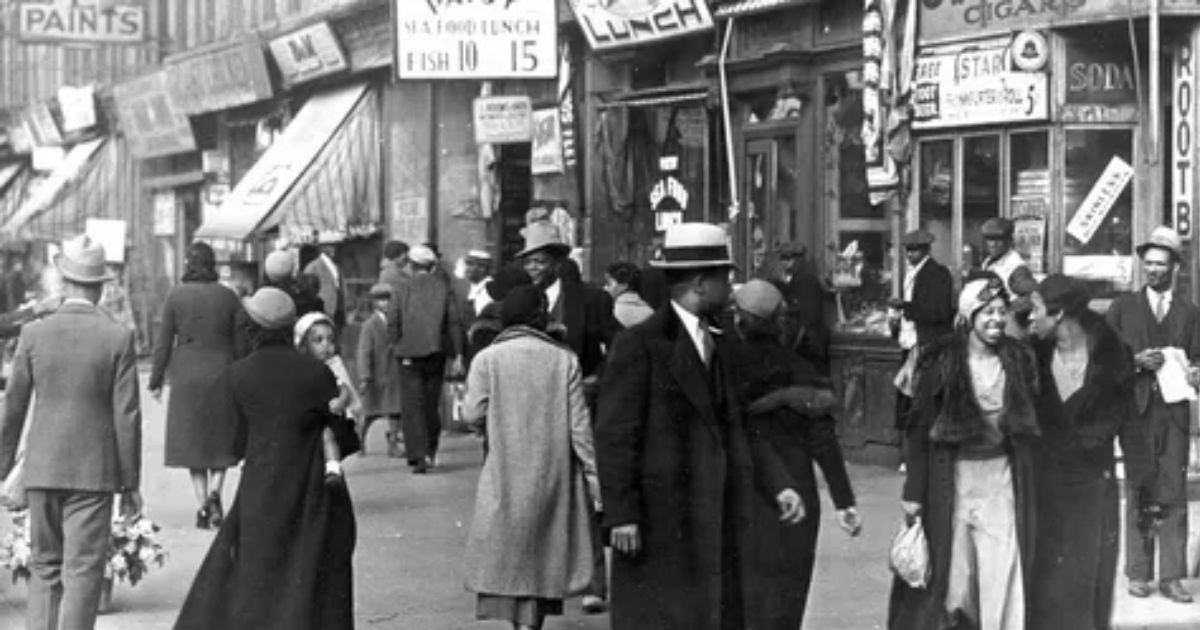
The Harlem Renaissance glows in American memory as a golden age of Black creativity. Jazz poured from Harlem’s nightclubs into the national consciousness. Poets like Langston Hughes and Countee Cullen filled magazines with verse that sang of racial pride and human dignity. Painters captured African American life with a beauty and complexity that contradicted every stereotype. This is the story you learned in school: the “cultural flowering” of the 1920s, a celebration of art and identity that lifted a people and transformed a nation.
But this story is incomplete. It is sanitized. The real Harlem Renaissance was messier, angrier, more dangerous, and far more complicated than any textbook admits. It emerged from blood and surveillance, from queer nightlife and gangster money, from women who built the movement while men took the bows. Understanding the Harlem Renaissance in its full complexity does not diminish its achievement. It makes the achievement more remarkable, more human, and more relevant to our own troubled moment.
Historians still argue about this era. Some insist it ended with the Great Depression in the 1930s. Others trace its echoes forward into hip-hop and contemporary Black art, finding continuous threads where others see rupture. Some celebrate its racial pride and cultural nationalism. Others critique its class tensions, its compromises with white patrons, its exclusions of working-class voices. These debates matter because how we remember the past shapes how we understand the present. A Harlem Renaissance that was only about beautiful art is a heritage object. A Harlem Renaissance that was about power, survival, and contested memory is a living tradition.
Here are seven truths about the Harlem Renaissance that most history books oversimplify or ignore entirely. Each one changes how we see this pivotal moment in American culture. Each one connects to questions we are still struggling to answer.
Truth 1: It Started With Blood, Not Beauty (1919)
The Harlem Renaissance did not begin with a poem or a painting or a jazz composition. It began with corpses in the streets. It began with returning veterans defending their neighbourhoods against white mobs. It began with the recognition that cultural assertion could be a form of self-defence.
The Red Summer: When Racial Terror Sparked Art
The summer of 1919 earned its name honestly and in blood. White mobs attacked Black communities across America with a ferocity that shocked even a nation accustomed to racial violence. In Washington D.C., returning Black veterans who had served their country in the First World War organized to defend their neighborhoods against rampaging whites. The violence lasted four days. In Chicago, a Black teenager named Eugene Williams drifted into a whites-only section of Lake Michigan. A white man threw stones at him until he drowned. When police refused to arrest the attacker, Black residents protested. White mobs responded with a week of rioting that left thirty-eight people dead and over five hundred injured. In Elaine, Arkansas, Black sharecroppers who dared to organize for fair wages faced a massacre that killed hundreds, possibly more. The bodies were buried in mass graves. The exact death count remains unknown.
James Weldon Johnson, the writer, diplomat, and activist who would become a central figure in the Harlem Renaissance, investigated these atrocities for the NAACP. His reports did not flinch from the horror. They documented burned homes, beaten bodies, and official complicity. They also identified something new in the Black response: a refusal to accept violence passively, a determination to meet force with force where necessary, and a parallel determination to assert dignity through culture. The “New Negro” that Alain Locke would later celebrate in his landmark 1925 anthology “The New Negro: An Interpretation” was forged not in aesthetic salons but in the furnace of racial combat. The violence of 1919 convinced a generation that representation mattered desperately, that controlling the image of Black life was as urgent as protecting Black bodies. If white America would kill Black people in the streets, then Black artists would assert Black humanity in the galleries, the concert halls, and the printed page. The Harlem Renaissance was, in significant part, a defensive weapon wielded by a community under siege.
The Harlem Hellfighters’ Explosive Return
The 369th Infantry Regiment arrived home from France in February 1919 as conquering heroes. These Black soldiers had spent more time in continuous combat than any other American unit. They had never lost a trench to the enemy or surrendered a prisoner. They had earned the nickname “Harlem Hellfighters” not from American commanders but from their German enemies, who respected their ferocity. Their victory parade up Fifth Avenue drew millions of spectators. They marched from lower Manhattan to Harlem, their band playing, their flags flying, their uniforms bearing the Croix de Guerre from a grateful French government.
James Reese Europe led the regimental band. He was already a musical pioneer, having introduced ragtime and early jazz to American concert audiences before the war. In France, he had introduced this music to European audiences, playing for everyone from ordinary soldiers to the French president. Now he brought it home with military precision and revolutionary swagger. The music was protest and pride simultaneously, order and ecstasy intertwined. The crowd heard something new: Black American culture asserting itself on the main streets of the nation’s largest city, unapologetic and magnificent.
Many scholars argue that 1919’s violence accelerated cultural resistance. The Hellfighters returned to a nation that celebrated their service with public parades while beating their neighbors in private streets. The gap between official celebration and actual treatment could not have been clearer. Their parade was a claim to full citizenship that white America was not ready to honor. The music they played, the pride they displayed, the very fact of their organized public presence these became models for the cultural assertion that would define the Harlem Renaissance.
The Harlem Renaissance began here in the gap between Black achievement and white refusal, between military valor and domestic terror, between the promise of American democracy and the reality of American racism. Understanding this origin does not reduce the movement to politics. It reveals the courage required to create beauty in such circumstances.
Truth 2: Queer Harlem Ran the Movement
Textbooks mention Langston Hughes’s jazz rhythms, his blues cadences, his speaking voice that seemed to capture ordinary Black speech in poetic form. They rarely discuss his sexuality. They celebrate the nightlife of 1920s Harlem, the energy and innovation of its clubs and cabarets, but they sanitize the queerness that was central to this culture. The reality is that queer culture was not peripheral to the Harlem Renaissance, not a hidden subculture operating at the margins. It was central to the movement’s energy, its aesthetic innovations, and its social networks.
The Pansy Craze & 7,000-Person Drag Balls
The Hamilton Lodge Ball was an annual event that grew from a small gathering in the 1880s to a massive celebration by the 1920s. By 1930, police estimated seven thousand attendees, making it one of the largest public events in Harlem. Black and white, working-class and wealthy, queer and straight gathered to watch men in elaborate gowns and women in tailored tuxedos compete for prizes in categories that were specific and judged with serious attention: “most elaborate gown,” “best female impersonation,” “most perfect male impersonation,” “best walking,” “best face.”
Police raids were common. Arrests happened, sometimes in large numbers. The balls continued anyway, growing larger year by year. This was not a hidden subculture operating in shadows. It was public, commercial, and celebrated. It was covered, sometimes scandalously, in the white press. It was covered, sometimes defensively, in the Black press. The “pansy craze” of the 1920s and early 1930s made Harlem a destination for queer nightlife across the racial spectrum, drawing visitors from downtown Manhattan, from other cities, from Europe.
Historical records suggest this culture influenced the broader Harlem Renaissance in ways we are still uncovering. The emphasis on performance, on costume, on the fluidity of identity, on the transformation of the self through art these aesthetic values appear throughout the era’s literature, music, and visual art. The drag ball was a form of theater in which the audience and performers were indistinguishable, in which identity was chosen and constructed rather than fixed and inherited. This was a radical proposition that resonated beyond the ballrooms.
Gladys Bentley’s Gender Defiance
Gladys Bentley wore a white tuxedo and top hat. She sang raunchy blues in a deep, growling voice at the Clam House on 133rd Street, a speakeasy that catered to a mixed crowd of Harlem elites and downtown slummers. She flirted openly with women in the audience. She was, by her own proud description, a “bulldagger”—a masculine lesbian who refused apology or concealment. Her performances were legendary for their sexual frankness and their challenge to every norm of feminine respectability.
Bentley was famous. She headlined major clubs, recorded records for prominent labels, and lived openly as a queer woman during a period when such openness was dangerous. She claimed to have married a white woman in a public ceremony in Atlantic City, though the legal status of this marriage remains unclear. She was, for a time, one of the most recognizable figures in Harlem nightlife, her image appearing in newspapers and magazines.
Then the 1950s arrived. McCarthyism, renewed conservatism, and the Lavender Scare made her previous life impossible. Bentley published an article in Ebony magazine claiming she had been “cured” of her lesbianism by female hormones and Christian faith. She married a man. She died in 1960, largely forgotten, her earlier career buried under the narrative of redemption she had constructed.
Her erasure during mid-century conservatism was systematic, part of a broader project of sanitizing the Harlem Renaissance for Cold War respectability. The movement that survived in popular memory was straightened, made safe for classroom consumption, stripped of its danger and its diversity. Recovering figures like Bentley is essential to understanding the era’s actual breadth, its radicalism, and its relevance to contemporary struggles for LGBTQ+ recognition within Black communities and beyond.
Truth 3: White Patrons Held the Purse Strings
The Harlem Renaissance required money to happen. Black artists in the 1920s faced segregated publishing houses that would not consider their manuscripts, galleries that would not hang their paintings, universities that would not hire them to teach, and foundations that would not fund their projects. White patrons stepped into this gap with genuine enthusiasm for the art and real financial commitment. Their support was essential. Their control was absolute. The relationship was never simple.
Charlotte Osgood Mason’s Cult of Control
Charlotte Osgood Mason was wealthy, white, elderly, and obsessed with what she called “primitive” Black art. She believed that Black creativity emerged from racial instinct rather than intellect or training, that it was a spontaneous expression of natural genius untainted by civilization. This was romantic racism, but it came with money attached. She gave Langston Hughes, Zora Neale Hurston, and Alain Locke monthly stipends equivalent to roughly $2,000 in today’s currency. She demanded absolute loyalty in return.
Mason controlled her protégés’ schedules, dictating when they should write and what they should write about. She controlled their social lives, disapproving of associations she considered harmful to their artistic development. She controlled their artistic output, rejecting work that seemed too intellectual or insufficiently “primitive.” She expected them to treat her as a spiritual mentor, a “godmother” whose wisdom guided their creativity. Hughes eventually broke with her, describing the relationship as suffocating and the financial security as not worth the psychological cost. Hurston escaped too, though the separation damaged her financially and may have contributed to her later struggles.
This was patronage as possession, support as control. It enabled art while constraining it, funded creativity while dictating its terms. The Harlem Renaissance depended on such relationships throughout its existence, and they left lasting ambivalence in the artists who survived them. The gratitude for recognition warred with resentment at the conditions of that recognition.
Carl Van Echten’s “Nigger Heaven” Firestorm
Carl Van Vechten was a white critic, novelist, and photographer who championed Black artists with genuine enthusiasm. He hosted parties that scandalized New York by mixing Black and white guests in intimate social settings. He used his influence with publishers to advance the careers of Hughes, Hurston, and numerous others. He was, by most accounts, a sincere ally who believed in the importance of Black cultural achievement.
Then in 1926, he published his own novel. “Nigger Heaven” was meant as sympathetic portrayal of Harlem life. The title was meant to shock white readers into attention. It succeeded too well. Black intellectuals split bitterly over the book. Some defended Van Vechten’s right to depict Harlem, noting his genuine support for Black artists. Others, including Hughes initially, found the book exploitative, sensationalistic, and damaging. The title alone was a wound, using a slur that Black people faced daily as a marketing device for white readers. The controversy revealed the love-hate codependency at the movement’s core. White support was essential for publication, for publicity, for financial survival. White understanding was limited by the very privilege that enabled their support. The gap between the two never fully closed.
Gangster Money, Segregated Crowds
The Cotton Club was the most famous venue of the Harlem Renaissance. Duke Ellington broadcast from its stage to national radio audiences, making his orchestra the sound of sophisticated America. Cab Calloway introduced “Minnie the Moocher” there, with its famous “hi-de-hi-de-hi-de-ho” call and response. Lena Horne began her career there. The club represented the height of Harlem Renaissance glamour.
It was owned by Owney Madden, a white gangster who had built his fortune in bootlegging and violence. The audience was strictly white and wealthy, admitted through a selective door policy that kept ordinary Harlemites out. The performers were Black. The waiters were Black. The kitchen staff was Black. The customers were white, segregated from the neighborhood that surrounded them, consuming Black culture as exotic entertainment while maintaining social distance from Black people.
Black genius funded by dirty money, displayed for white amusement, contained within walls of segregation. This was the economic reality of much Harlem Renaissance culture. The art transcended its conditions. Ellington’s music was genuinely revolutionary, genuinely beautiful but the conditions shaped what art could be made, how it was received, and who profited from it. The Cotton Club was not an exception. It was a model.
Truth 4: The FBI Spied on Every Major Figure
The Harlem Renaissance was not merely cultural. It was political in its very existence, asserting Black humanity in a nation that denied it, claiming American identity for people excluded from its benefits. The federal government understood this political dimension and responded accordingly, with surveillance, infiltration, and repression.
J. Edgar Hoover’s “Negro Files”
J. Edgar Hoover built his career on surveillance of Black activists, and the Harlem Renaissance fell within his scope. Marcus Garvey, the Pan-Africanist leader who preached Black economic independence, racial pride, and possible return to Africa, was his first major target. The Bureau of Investigation, as it was then called, devoted enormous resources to infiltrating Garvey’s Universal Negro Improvement Association, monitoring his mail, and building a case for deportation. In 1923, Garvey was convicted of mail fraud, a charge that hinged on technicalities and the testimony of a paid government informant. He was deported to Jamaica in 1927, his movement shattered.
The FBI kept files on virtually every significant Harlem Renaissance figure. Langston Hughes’s file eventually exceeded one thousand pages, tracking his travels, his publications, his associations, and his political statements. His poetry was read as evidence of subversion. His support for the Spanish Republic during the Civil War was noted. His shifting political positions over decades were documented with obsessive detail. The surveillance was not passive observation. It was active pressure, shaping what artists felt safe to say and how they said it, creating an atmosphere of permanent potential exposure.
When Poetry Became Evidence
Hughes’s 1932 poem “Goodbye Christ” was written during a period of personal radicalization, influenced by his travels in the Soviet Union and his growing frustration with American racism. The poem dismissed organized religion in favor of political struggle, addressing Christ directly: “Goodbye, Christ Jesus, Lord God Jehova, Beat it on away from here now.” It was not published widely at the time. Conservative groups discovered and publicized it years later, during the McCarthy period. Hughes was called before the Senate Permanent Subcommittee on Investigations, questioned about his patriotism, forced to distance himself from his own words and to name names of associates with communist connections.
Self-censorship became survival. Coded language became necessary. The Harlem Renaissance that appears in anthologies is often the version that survived scrutiny, not the version that artists first created. The surveillance state that we associate with later decades was born here, in the monitoring of Black cultural assertion, and it shaped American art in ways we are still uncovering.
Truth #5: Women Built It. Men Got the Credit.
The names that dominate Harlem Renaissance anthologies and histories are predominantly male: Langston Hughes, Countee Cullen, Claude McKay, Jean Toomer, Wallace Thurman. The work of actually building the movement, editing magazines, hosting salons, connecting artists with patrons, managing the social infrastructure of cultural production was largely performed by women. History has not been kind to this division of labor, celebrating the creators while forgetting the conditions that enabled creation.
Jessie Fauset: The Editor Who Discovered Everyone
Jessie Fauset was literary editor of The Crisis, the magazine of the NAACP, from 1919 to 1926. In this role, she was the central gatekeeper of Harlem Renaissance literature. She published the first poems of Langston Hughes, recognizing his talent when he was still an unknown high school student. She encouraged and published Countee Cullen. She supported Zora Neale Hurston’s early work. She was, by the testimony of virtually every major male figure in the movement, essential to their development and success.
Fauset also wrote four novels of her own: “There Is Confusion,” “Plum Bun,” “The Chinaberry Tree,” and “Comedy, American Style.” They were technically accomplished, exploring the lives of middle-class Black Americans with subtlety and psychological depth. They received little attention at the time of publication and have received less since. Her editorial work enabled the male geniuses she promoted. Her own genius was filed under “supporting role,” her novels dismissed as minor while the poems she discovered became canonical.
A’Lelia Walker’s Millionaire Salons
A’Lelia Walker inherited millions from her mother, Madam C.J. Walker, who had built a fortune in hair care products for Black women. She spent this wealth lavishly on art, on hospitality, on creating spaces where Black culture could flourish without white interference or judgment. Her “Dark Tower” gatherings at her Hudson River estate brought together writers, musicians, visual artists, and intellectuals in a space of Black luxury that was almost unprecedented in American history.
These salons were the real headquarters of the Harlem Renaissance. Ideas were tested, collaborations formed, careers launched, manuscripts read and criticized, introductions made that would shape decades of work. Walker was not a creator in the traditional sense of producing art herself. She was a creator of conditions, a builder of the social infrastructure that made art possible. That contribution has been largely erased from the standard narrative, which focuses on individual genius rather than collective enablement.
The 1970s Feminist Recovery
The rediscovery of Harlem Renaissance women began with feminist scholars in the 1970s, working against decades of neglect. Alice Walker’s search for Zora Neale Hurston’s unmarked grave was the most famous case, but similar work recovered Fauset, Walker, and numerous other figures. This scholarship revealed how thoroughly the original movement had been masculinized in memory, how the contributions of women had been systematically minimized or forgotten. The recovery continues, changing our understanding of what the Harlem Renaissance actually was.
Truth 6: The “Decline” Was One Bad Review
The standard narrative holds that the Harlem Renaissance ended with the Great Depression of the 1930s. Economic collapse killed the patronage that had sustained the arts. Artists scattered to find work. The creative energy dissipated, replaced by the more overtly political art of the 1930s and the protest literature of Richard Wright and his generation. This narrative is partially true. Economic conditions certainly changed. It is not the full story of how a movement ends or what ending means.
Zora Neale Hurston’s 1937 Betrayal
In 1937, Hurston published “Their Eyes Were Watching God,” a novel of Black Southern life narrated in the voice of a woman seeking self-determination. It is now recognized as a masterpiece of American literature, taught in schools and universities, celebrated for its linguistic innovation and its feminist vision. Contemporary reception was hostile. Richard Wright, the rising star of protest fiction whose “Native Son” would make him the most famous Black writer in America, attacked the book viciously in the New Masses. He accused Hurston of minstrelsy, of creating “voluntary spies” for white readers, of failing to depict Black oppression with the seriousness it deserved. Her focus on rural folk culture, her use of dialect, her refusal of explicit political statements all were condemned as pandering to white tastes.
The criticism was personal and political. Wright represented a new generation that favored social realism over Hurston’s lyrical folk modernism, explicit protest over implicit critique. His attack, coming from the most influential Black critic of the moment, helped bury Hurston’s reputation. She continued writing but found publishers increasingly scarce. She worked as a maid, a substitute teacher, and a librarian. She died in 1960 in a welfare home in Florida, buried in an unmarked grave in a segregated cemetery.
From Welfare Home to Literary Canon
Alice Walker found that grave in 1973, marked it with a headstone, and published her 1975 essay “In Search of Zora Neale Hurston” in Ms. magazine. The essay initiated one of the great literary resurrections in American history. Hurston’s books returned to print. She entered the canon. “Their Eyes Were Watching God” became a staple of literature courses. The Harlem Renaissance was redefined to include her, to center her, to recognize that its standard narrative had excluded one of its greatest artists.
This story reveals how fragile artistic reputation is, how dependent on critical fashion and personal politics, how much great work can be lost when the wrong voice disapproves at the wrong moment. The “decline” of the Harlem Renaissance was not simply economic. It was critical, a shift in taste that elevated some voices and silenced others, that defined the movement retrospectively by who survived in print.
Truth 7: It Never Ended. You Stopped Looking.
Periodization serves historians. It kills living culture. Dividing history into discrete movements and eras makes the past manageable, creates clear narratives with beginnings and ends, and allows textbooks to organize material into chapters. It also obscures continuity, makes us see the rupture where transformation occurred, and turns living traditions into heritage objects to be admired rather than engaged. The Harlem Renaissance did not end. It transformed, dispersed, went underground, resurfaced in new forms.
The WPA Bridge (1935-1943)
The Works Progress Administration, Franklin Roosevelt’s New Deal agency for employing Americans during the Depression, included substantial funding for artists. Black writers and painters who had been central to the Harlem Renaissance found survival and continued creation through federal employment. Jacob Lawrence developed his Migration Series, sixty paintings telling the story of Black movement from South to North. Ralph Ellison began the work that would eventually become “Invisible Man.” Richard Wright published “Native Son” with the artistic maturity he had developed in WPA writers’ projects.
The WPA years were the Harlem Renaissance under different economic conditions, with different political urgencies, addressing a different America. They are rarely taught as part of the same movement. They were. The artists were largely the same. The concerns were continuous. The funding source had shifted from private patronage to public employment, but the work of Black cultural assertion continued.
From Hughes to Hip-Hop
Langston Hughes invented a poetic voice that spoke in jazz rhythms and street vernacular, that moved between high art and popular culture, that asserted racial identity while claiming universal humanism. Gil Scott-Heron applied that voice to proto-rap in the 1970s, speaking poetry over percussion with political urgency. Mos Def and Talib Kweli continued the tradition in the 1990s, finding in Hughes’s example a model for intellectually ambitious popular art. Kendrick Lamar’s “To Pimp a Butterfly” is a Harlem Renaissance album in its formal experimentation, its jazz influences, its insistence that Black art can be simultaneously commercially successful and aesthetically radical, politically engaged and personally complex.
Beyoncé’s “Lemonade” draws explicitly on Harlem Renaissance visual strategies: Southern Gothic imagery, African spiritual traditions, the assertion of Black female autonomy against historical erasure. It is a twenty-first century Harlem Renaissance artifact, made possible by the earlier movement’s pioneering work and extending that work into new media and new political contexts.
Why Period Labels Kill Living History
Calling the Harlem Renaissance a “movement” that “ended” in 1937 or 1940 makes it safe. It becomes heritage, a subject for Black History Month celebrations and museum exhibitions. Heritage can be celebrated without being engaged. It can be acknowledged without being understood as continuous with present struggles. The truth is that the questions the Harlem Renaissance asked about representation and power, about the relationship between art and politics, about who controls cultural memory, about the possibilities and costs of integration are still urgent. The answers are still being improvised, in hip-hop and visual art, in literature and film, in the ongoing struggle to define what Black culture means in America.
Who Controls the Past Controls the Future
These seven truths converge on a single insight that matters beyond the specific history of the Harlem Renaissance. The movement was not a spontaneous flowering of talent, a natural efflorescence of creativity given space to grow. It was a deliberate, contested, dangerous project of cultural construction. It involved calculation and compromise, courage and censorship, visibility and erasure, genuine solidarity and genuine betrayal. It was made by human beings working under conditions of constraint, not by geniuses operating in freedom.
Who decides what gets remembered? In the case of the Harlem Renaissance, the answer has shifted over time and continues to shift. White patrons and publishers controlled initial reception and early canonization. Black male writers dominated the mid-century narrative, their accounts becoming the standard history. Feminist scholars in the 1970s and after recovered women who had been erased. Queer studies have begun to reclaim the full spectrum of sexuality that made the movement vibrant. Each recovery reveals previous omissions, each new history challenges the last. This is not failure. This is how cultural memory works when it is honest.
How power shapes narrative is not abstract theory. It is visible in which books remain in print, which names appear on syllabi, which stories get told during Black History Month and which are ignored, who gets statues and who gets footnotes. The sanitized version of the Harlem Renaissance, the celebration without the surveillance, the art without the exploitation, the achievement without the blood serves certain interests. It is comforting. It flatters me. It does not serve understanding, and it does not prepare us for the complexities of our own moment.
Your skepticism matters. When you encounter a smooth historical narrative, especially one about marginalized people and their achievements, ask what has been smoothed over. Ask whose interests are served by the smoothing. Ask what costs were paid for the beauty you are shown. The real Harlem Renaissance, in all its complexity, its failures and its triumphs, its compromises and its courage, is more inspiring than the myth because it was harder won. It was won by people who found ways to create under conditions of constraint, who built culture in the teeth of surveillance and exploitation, who left work that still speaks to us if we are willing to hear its full voice.
Your Questions, Honestly Answered
Was the Renaissance just “new to white people”?
Partially. Much of the art drew on Black cultural traditions that long predated the 1920s folk forms, religious music, oral storytelling, craft traditions. What was new was the scale of white attention and the institutional infrastructure publishers, galleries, universities, foundations that began, however imperfectly and on however unequal terms, to engage with Black creators as artists rather than as curiosities. The Harlem Renaissance was new in its publicness, its self-consciousness, its claim to be creating American culture rather than merely Black culture. Whether this represented genuine progress or merely new forms of co-optation remains debated.
Why did so many die broke and forgotten?
Because American culture has consistently consumed Black art more readily than it has rewarded Black artists. Because the economic structures of the era made sustained careers difficult for anyone and nearly impossible for those excluded from mainstream institutions. Because critical fashion shifts, and yesterday’s genius becomes today’s obscurity when tastes change or when powerful voices disapprove. Because the same system that enabled the art also exploited it, extracting value while denying security.
What’s the most valuable hidden artifact?
The FBI surveillance files, now partially available through Freedom of Information Act requests, offer raw documentation of government monitoring that shaped artistic production in ways we are still understanding. Personal letters between major figures, still being collected and published, reveal the private negotiations, conflicts, and collaborations behind public art. Early audio recordings of blues and jazz performances, often poorly preserved, capture sounds that cannot be notated or described. The Schomburg Center for Research in Black Culture in Harlem holds extensive collections that continue to yield new discoveries.
Can you visit secret locations today?
Many physical sites are gone. The original Cotton Club was demolished. The Dark Tower was sold and eventually torn down. The apartments where Hughes and Hurston wrote have been redeveloped. But the Schomburg Center maintains archives and exhibitions. Walking tours trace the geography of 1920s Harlem, pointing out surviving buildings and marking lost ones. The St. Nicholas Park area still contains structures from the era. The Harlem Renaissance is buried in the built environment, waiting to be read by those who know how to look.
This article draws on primary sources from the Schomburg Center for Research in Black Culture, FBI files obtained through the Freedom of Information Act, and the published letters, autobiographies, and manuscripts of major figures. For further reading, see David Levering Lewis’s “When Harlem Was in Vogue,” Cheryl Wall’s “Women of the Harlem Renaissance,” George Hutchinson’s “The Harlem Renaissance in Black and White,” and Emily Bernard’s “Carl Van Vechten and the Harlem Renaissance.”
Recent Article : 67 Poems About Beauty: Timeless Verses on Love, Nature & the Soul

Jennifer Aston is a passionate poetry curator and writer with a deep love for the written word. She believes poetry has the power to heal, inspire, and connect people across all walks of life. Through PoemSteric, she brings together timeless and modern verses for every emotion and every moment.